



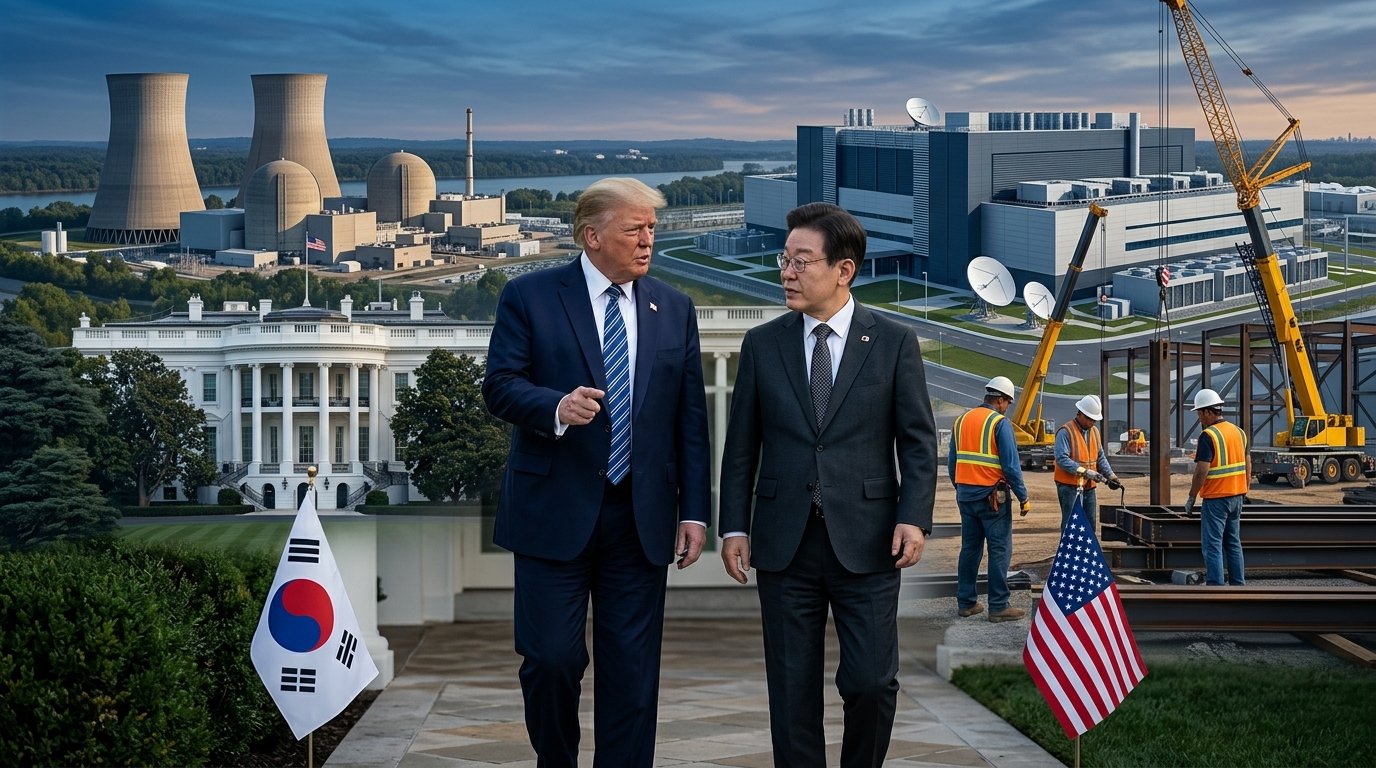
- South Korea To Invest $100B in the U.S through nuclear and natural-gas projects supporting America’s AI expansion.
- Trump’s broader $350 billion Korean investment agreement could strengthen U.S. shipbuilding, semiconductors, energy and strategic industries.
- The emerging projects give Trump a powerful economic message ahead of the 2026 midterm elections, although pledges must still translate into actual investment and jobs.
WASHINGTON — President Donald Trump is approaching the 2026 midterm elections with a powerful economic argument: America is attracting enormous foreign capital, strategic industries are being rebuilt and some of the world’s wealthiest allies are increasingly prepared to put their money into the United States.
South Korea is now at the center of that story.
Seoul is nearing agreements on an American energy investment package that could exceed $100 billion, including plans for as many as eight nuclear reactors and a natural-gas project designed in part to meet the enormous electricity demands of artificial-intelligence data centers. The emerging projects would begin translating into reality the much larger investment commitments negotiated between Washington and Seoul last year.
The timing could hardly be more politically valuable for Trump.
Under the 2025 trade agreement, Washington reduced most tariffs on South Korean goods from 25% to 15%, including tariffs on automobiles. In return, Seoul pledged $350 billion in U.S. investment, alongside another $100 billion commitment for American energy purchases. The broader package allocated $150 billion toward shipbuilding cooperation, with the remaining investment directed toward strategic industries including semiconductors, energy and biotechnology.
The emerging nuclear and natural-gas projects could now give that enormous pledge a physical form.
One proposal under discussion involves the construction of up to eight nuclear reactors in the United States, potentially combining American Westinghouse AP1000 technology with South Korean APR1400 technology. Another project, reportedly worth about $20 billion, involves a natural-gas power plant in Texas that could provide electricity for expanding AI data centers.
The significance goes far beyond the headline numbers.
South Korea is nearing agreements on more than $100 billion in potential U.S. energy investments, including nuclear reactors and an AI-focused natural-gas project. For Trump, the emerging Korean commitment strengthens a broader economic strategy built around attracting foreign capital, rebuilding strategic industries and creating American jobs.
America’s artificial-intelligence race is increasingly becoming an energy race. The United States can build the world’s most advanced chips, data centers and AI systems, but those facilities require enormous quantities of reliable electricity. Nuclear power, therefore, is no longer simply an energy-sector issue. It is becoming part of America’s technological, industrial and national-security infrastructure.
Trump has recognized that connection and has pushed aggressively for a revival of the American nuclear industry.
The potential Korean investment fits neatly into that strategy: use America’s enormous consumer market, technological strength and geopolitical influence to persuade foreign governments and companies to invest, manufacture and build inside the United States.
The latest Wall Street Journal report says the Korean energy package could exceed $100 billion, with an initial payment of more than $2 billion potentially arriving before the end of September. The investments would unfold over several years, with South Korean outlays capped at $20 billion annually under the bilateral arrangement.
For Trump, the political message is straightforward.
He can argue that his tariff strategy was never simply about imposing barriers on foreign products. It was about using America’s economic leverage to force a new bargain with trading partners — one in which access to the American market is accompanied by investment in American factories, infrastructure, energy and jobs.
South Korea is now joining a growing group of major economic partners being drawn into that strategy.
Saudi Arabia and Qatar have made enormous investment commitments involving the United States, while South Korea is preparing to put its industrial and financial muscle behind American energy, shipbuilding, technology and manufacturing.
The Islamabad Telegraph has closely followed this broader transformation in America’s relationships with Saudi Arabia, Qatar and other major economic powers, particularly the growing link between geopolitics, investment and strategic industries.
The cumulative economic effect could be substantial.
Foreign investment generates construction contracts, engineering work, manufacturing demand, infrastructure spending and potentially thousands of American jobs. Shipbuilding investment could strengthen an industry Washington increasingly regards as strategically vital in its competition with China. Semiconductor investment could reinforce America’s technology supply chains. Nuclear investment could provide the electricity required for the next generation of AI infrastructure.
And that gives Trump an unusually powerful political argument heading into the midterms: foreign capital is being directed toward American infrastructure and American workers.
The Washington Post’s coverage of the U.S.-South Korea agreement reported that the $350 billion investment framework included $200 billion in cash investment, capped at $20 billion annually, alongside $150 billion in shipbuilding cooperation.
The Guardian’s reporting on the agreement similarly highlighted the scale of Seoul’s investment commitment and the connection between tariff concessions and expanded Korean investment in the American economy.
There is, however, an important distinction that should not be overlooked: investment pledges are not the same as money already spent. Some of the Korean projects remain under negotiation, and the precise locations, structures and timelines have not all been finalized. The latest nuclear and gas proposals therefore represent a potentially major development rather than $100 billion already flowing into the United States.
But the strategic direction is unmistakable.
If the projects proceed, Trump will be able to point to a growing pattern in which major foreign partners are committing capital to American energy, shipbuilding, semiconductors, advanced manufacturing and other strategic industries.
His supporters will portray this as evidence that Trump has become a messiah for the American economy, arguing that no previous president has extracted investment commitments of this magnitude from such a broad collection of wealthy foreign partners.
That is a powerful political claim — although its ultimate credibility will depend on how much of the pledged capital actually becomes factories, power plants, shipyards, infrastructure and durable American employment.
Still, the emerging Korean deal gives Trump something valuable as the midterms approach: a tangible economic story.
Saudi Arabia. Qatar. South Korea. Japan. Europe and other major economic partners are increasingly negotiating with Washington not merely over tariffs and market access, but over where they will build, manufacture and invest.
That represents a significant shift in the traditional architecture of global trade.
For decades, American presidents largely focused on attracting exports, negotiating market access and encouraging private companies to invest abroad and at home. Trump has sought to make foreign investment in America itself a central bargaining chip in international economic diplomacy.
If billions of dollars ultimately become nuclear reactors, power plants, shipyards, semiconductor facilities and thousands of American jobs, Trump’s economic strategy will have acquired something more powerful than campaign rhetoric: visible infrastructure and employment.
That is why South Korea’s coming investment announcement could become much more than another trade story.
It could become one of Trump’s most important economic talking points before the 2026 midterm elections — and another test of whether his transactional approach to international trade can translate geopolitical leverage into long-term American industrial power.