



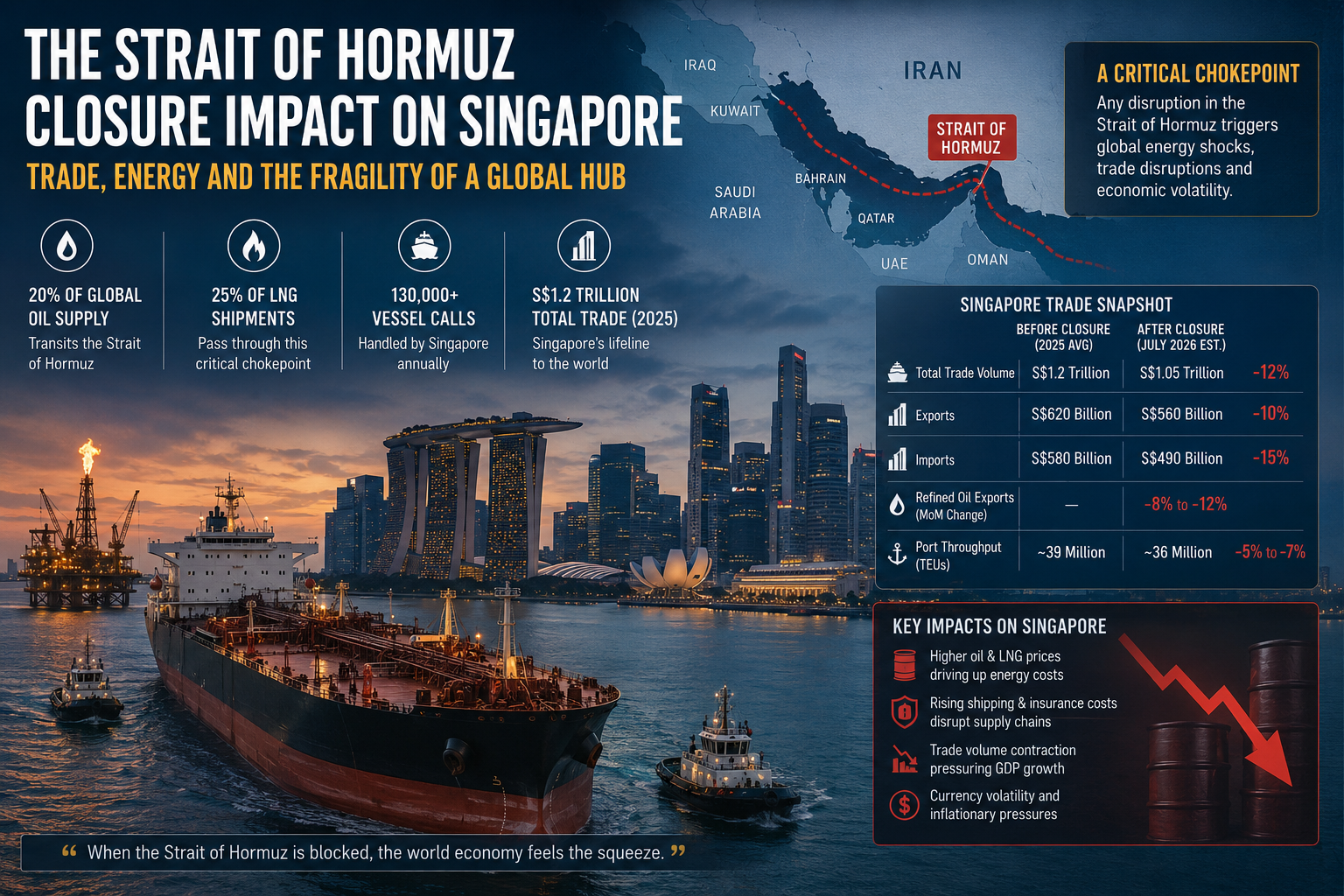
- Strait of Hormuz closure impact on Singapore is driving a sharp decline in refined oil exports and maritime throughput.
- Singapore’s total trade flows, once exceeding S$1.2 trillion annually, are now under pressure due to disrupted energy imports.
- Asian economies including China, India, Japan, and South Korea face rising inflation due to energy supply shocks.
- Oil prices hovering near $100–$120 per barrel could surge higher, increasing recession risks across Asia.
The Strait of Hormuz closure impact on Singapore is exposing the vulnerability of a trade-dependent economy to geopolitical shocks, as disrupted oil and LNG flows, rising freight costs and volatile currencies converge to test the resilience of Asia’s premier maritime and refining hub.
A Chokepoint Crisis Reverberates Through Singapore’s Economy
The Strait of Hormuz closure impact on Singapore is once again sharpening the link between geopolitics and global commerce. As of July 17, 2026, renewed US strikes on Iranian infrastructure and Tehran’s retaliatory posture in the Gulf have constricted flows through a passage that carries roughly a fifth of the world’s oil and a significant share of liquefied natural gas.
Before the latest escalation:
- Total Trade Volume (2025): ~S$1.2 trillion (≈US$890 billion)
- Exports: ~S$620 billion
- Imports: ~S$580 billion
- Oil & Petroleum Exports: ~40% of total exports (Singapore is Asia’s top oil trading hub)
- Port Throughput: ~39 million TEUs annually (world’s second busiest port)
- Bunker Fuel Sales: ~50 million tonnes/year (largest global marine fuel hub)
Energy Dependency Structure:
- ~95% of electricity generated from natural gas
- LNG imports largely sourced from Qatar, UAE, and regional suppliers via Hormuz-linked routes
- Crude oil imports refined and re-exported across Asia
Following the reimposition of U.S. naval blockade, Iranian retaliatory strikes, and disruptions near Bandar Abbas, the data trajectory has sharply shifted:
Trade & Maritime Disruptions
- Shipping Delays: Increased by 25–40% on Asia-Europe routes
- War Risk Insurance Premiums: Up 200–300% for tankers transiting Gulf waters
- Effective Oil Flow Reduction: Estimated 15–20% short-term disruption
- Freight Costs: Up 30–50% across key Asian routes
Singapore-Specific Impact (Estimates as of mid-July 2026)
- Refined Petroleum Exports: Down 8–12% (month-on-month)
- Crude Import Volumes: Declining due to rerouting constraints and price spikes
- Bunker Fuel Demand: Volatile; initial spike followed by slowdown due to reduced vessel traffic
- Port Throughput: Expected contraction of 5–7% in Q3 2026
Energy Prices & Inflation Transmission
- Brent Crude: Hovering between $100–$120, with upside risk to $130–$150
- Electricity & Gas Tariffs in Singapore: Already rising, with further increases expected in Q3–Q4
- Industrial Costs: Refining margins squeezed despite higher prices due to input volatility
Singapore’s strategic advantage has always been its ability to import crude, refine it, and re-export high-value petroleum products—a model critically dependent on uninterrupted maritime flows.
For Singapore, the Strait of Hormuz closure impact on Singapore is not an abstract risk but a direct transmission channel. The city-state’s economic model—anchored in refining, re-exporting and financing global trade—depends on uninterrupted maritime circulation. When that circulation falters, the effects are swift.
From Surplus Flows to Constrained Trade
Prior to the latest escalation, Singapore’s trade engine was running at scale. Total trade reached approximately S$1.2tn in 2025, with exports at S$620bn and imports at S$580bn. Petroleum products accounted for a substantial share of outbound trade, reinforcing Singapore’s position as Asia’s leading oil trading and refining hub.
U.S. Airstrikes on Iran: 5th Day of Ferocious Laser-Guided Battles
The Strait of Hormuz closure impact on Singapore, however, is beginning to erode these volumes. Early indicators for July suggest:
- Refined petroleum exports have declined by 8–12 per cent month-on-month
- Crude inflows are tightening as shipping routes face disruption
- Port throughput is expected to contract by 5–7 per cent in the third quarter
These shifts illustrate how the Strait of Hormuz closure impact on Singapore is translating into measurable trade compression rather than merely price volatility.
Strait of Hormuz Closure Impact on Singapore:
Energy Markets Tighten, Margins Narrow
At the core of the Strait of Hormuz closure impact on Singapore lies energy. The republic imports crude, processes it and redistributes refined products across Asia. That arbitrage depends on stable supply and predictable logistics.
Instead, tanker delays have lengthened by up to 40 per cent, while war-risk insurance premiums have surged as much as threefold. Freight costs have risen sharply, compressing margins even as benchmark oil prices climb.
Related News: Singapore Dollar Consolidates; Likely Entered Range-Trading Phase
Brent crude is trading in the $100–$120 a barrel range, with upside risks should infrastructure damage intensify. For Singapore, where around 95 per cent of electricity is generated from natural gas, the Strait of Hormuz closure impact on Singapore is feeding directly into domestic cost structures. Energy tariffs are already rising and are likely to increase further if supply constraints persist.
Currency Markets Reflect a Cautious Recalibration
The Strait of Hormuz closure impact on Singapore is also evident in foreign exchange markets. The Singapore dollar has entered a narrow trading band against the US dollar, hovering around S$1.29, as investors weigh geopolitical risk against domestic policy responses.
Across Asia, currencies have exhibited similar caution. The yen and won have fluctuated amid a broader “risk-off” environment, underscoring how the Strait of Hormuz closure impact on Singapore forms part of a wider regional adjustment to energy-driven inflation and tighter financial conditions.
Structural Exposure Leaves Little Insulation
Singapore’s vulnerability to the Strait of Hormuz closure impact on Singapore is rooted in its structure. As a maritime hub handling more than 130,000 vessel calls annually, it is acutely sensitive to disruptions in shipping lanes. As a refining centre, it depends on continuous crude inflows. As an energy importer, it has limited domestic buffers.
This combination amplifies the Strait of Hormuz closure impact on Singapore, making it less a cyclical disturbance than a systemic shock.
Asia’s Wider Dependence Magnifies The Risk
The regional dimension reinforces the significance of the Strait of Hormuz closure impact on Singapore. North Asian economies such as Japan and South Korea rely heavily on Gulf النفط, while China remains the world’s largest crude importer. India, too, sources a substantial share of its energy through Hormuz-linked routes.
As a result, the Strait of Hormuz closure impact on Singapore is mirrored in rising import bills, currency pressures and inflation risks across Asia. Supply chain disruptions and higher shipping costs compound these challenges, particularly for export-oriented economies.
Policy Trade-offs Become More Acute
The policy response to the Strait of Hormuz closure impact on Singapore is constrained by competing objectives. The Monetary Authority of Singapore can allow currency appreciation to mitigate imported inflation, yet this risks undermining export competitiveness. Fiscal support remains available, supported by a modest budget surplus, but targeted intervention must be carefully calibrated.
Efforts to diversify energy sources and expand LNG procurement may ease the Strait of Hormuz closure impact on Singapore over time, though such adjustments are unlikely to provide immediate relief.
A Narrow Strait With Outsized Consequences
Ultimately, the Strait of Hormuz closure impact on Singapore highlights the fragility of globalisation when confronted with geopolitical chokepoints. What appears as a distant conflict rapidly becomes embedded in trade flows, energy prices and financial markets.
For Singapore, the challenge is not to avoid exposure—an impossibility for an economy so deeply integrated into global systems—but to manage it. Whether the current disruption proves temporary or evolves into a prolonged constraint will depend on the trajectory of the conflict and the resilience of energy infrastructure in the Gulf.
In the meantime, the Strait of Hormuz closure impact on Singapore serves as a reminder that control over a narrow maritime passage can shape the fortunes of entire economies.