



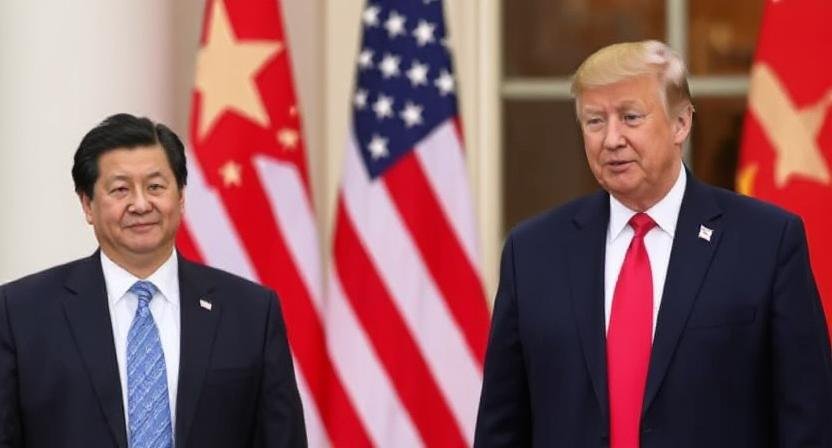
- U.S. cancels June defense meeting with Taiwan’s minister Wellington Koo, signaling desire to improve relations with China.
- Trump administration prioritizing economic cooperation with Beijing—particularly over semiconductors and tariffs—over defense alignment with Taipei.
- Pentagon and State Department sources confirm cancellation was politically motivated, not logistical.
- Backlash from anti-China lobby and Taiwan officials underscores tension between Trump’s China reset and traditional U.S. alliances.
In a bold diplomatic maneuver that signals a dramatic recalibration of U.S. foreign policy in Asia, President Donald Trump’s administration quietly canceled a high-level meeting with Taiwan’s defense minister last month—sending a clear message to Beijing that Washington is open to rethinking its approach to the Taiwan question in order to improve relations with China.
According to multiple senior U.S. officials familiar with the decision, the Trump White House called off a scheduled meeting in June between Taiwan’s national security chief, Wellington Koo, and U.S. Undersecretary of Defense for Policy Elbridge Colby. The meeting was to be held near Washington and was expected to involve sensitive discussions on joint strategy and weapons procurement—until it was abruptly cancelled just 48 hours prior.
Exclusive: U.S. and China Resume Trade Talks in Stockholm Amid Global Economic Crossroads
“This was not a scheduling issue. It was a strategic decision from the top,” said a senior U.S. defense official who requested anonymity. “Trump didn’t want to provoke China at a moment when backchannel talks on tariffs and semiconductor cooperation were gaining traction.”
A Stunning Setback for Taiwan—and Washington’s Anti-China Hawks
The cancellation has shaken Taiwan’s security establishment and Washington’s hardline China critics alike. Sources close to Taipei say the move blindsided Taiwanese leadership, which had interpreted recent U.S. arms sales and congressional visits as signs of deepening strategic ties.
“This was a diplomatic earthquake,” said a Taiwan-based defense analyst familiar with the meeting’s planning. “The Americans gave us no real explanation. It was a clear signal that Trump didn’t want to antagonize China—not now.”
READ MORE: US cancelled meeting with Taiwan as China trade talks loomed, FT reports
Within Washington, the decision has enraged members of the anti-China lobby on Capitol Hill, particularly among lawmakers who have long championed Taiwan’s autonomy. Several congressional aides expressed concern that the administration is undermining decades of bipartisan support for the island’s de facto independence in exchange for temporary trade relief from Beijing.
But according to sources within the Pentagon and State Department, Trump was unmoved by the backlash. “He wants a win with China before the 2026 midterms. Taiwan is not his priority right now,” said one U.S. official directly involved in Indo-Pacific policy.
China’s Red Line: Taiwan and the South China Sea
Beijing has long viewed Taiwan as an inseparable part of its territory. The Chinese Communist Party maintains that any move by the U.S. to treat Taiwan as a sovereign entity—including official defense meetings—is a red line that could trigger severe diplomatic or military consequences.
ALSO READ: Trump the Peacemaker: Thailand-Cambodia Agree to Immediate Ceasefire After US Pressure
In recent years, the U.S. has walked a diplomatic tightrope: recognizing Beijing’s “One China” principle while deepening informal ties with Taipei. Under previous administrations, the U.S. supplied advanced weapons systems to Taiwan and increased naval patrols in the Taiwan Strait and the South China Sea, where Beijing has built artificial islands and deployed military assets.
These moves angered China, which accused the U.S. of destabilizing the region and violating its sovereignty. Trump’s first term saw erratic swings between confrontation and cooperation—tariff wars one week, secretive summits the next. Now, in his second term, the President appears to be shifting course.
Trade, Chips, and the “China Reset”
Behind the sudden Taiwan snub lies a broader calculation: Trump is eager to forge a reset with Beijing. As U.S. inflation lingers and global supply chains strain under the weight of past decoupling efforts, Trump’s team has come to believe that stable, productive ties with China are essential for economic growth and semiconductor access.
Sources close to U.S. Trade Representative offices say negotiations have accelerated in recent months to ease tariffs and allow American tech companies—especially chipmaker Nvidia—to resume exports to China. A recent agreement between the two sides opened the door for limited semiconductor shipments, despite ongoing national security concerns.
“The China file is now being handled with kid gloves,” said a former U.S. official who advised on Trump’s trade policy. “The Taiwan issue is being parked to make space for economic engagement.”
Implications for Regional Security
This strategic pivot, however, has alarmed U.S. allies in the Indo-Pacific. Japan, South Korea, and Australia—who rely on American deterrence against Chinese aggression—are privately questioning whether Washington’s commitment to regional stability is wavering.
At the same time, analysts warn that the signal to Beijing may embolden its military assertiveness. Just days after the Taiwan meeting was cancelled, Chinese warships and fighter jets conducted large-scale drills around Taiwan, prompting fears that Beijing may test Washington’s resolve further.
Trump’s Long Game
While critics accuse Trump of transactionalism, insiders argue he is playing a long geopolitical game—one in which Taiwan, for now, is a bargaining chip. Whether this gamble yields lasting gains or deepens strategic mistrust remains to be seen.
For Taiwan, the writing is on the wall: the United States, under Trump, may no longer be a steadfast partner if its support risks upsetting China. For Beijing, this could be the clearest signal yet that Washington is finally inching toward a new chapter—one where compromise, not confrontation, defines U.S.-China relations.