



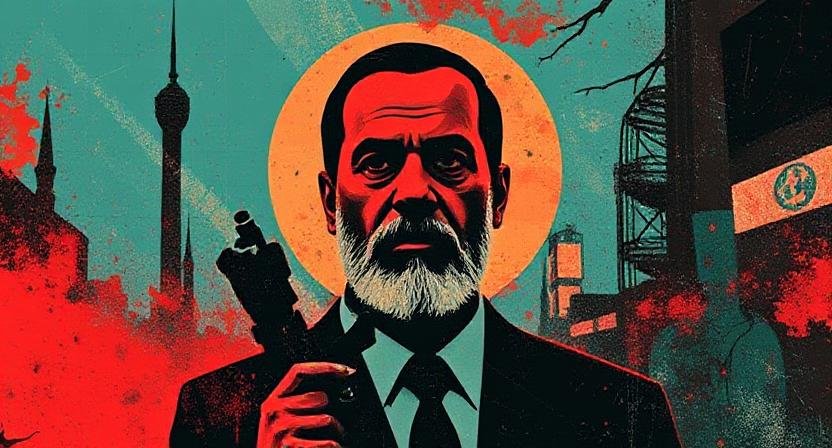
- Israeli operatives launched a psychological warfare campaign hours before their military strike on Iran, calling top Iranian generals and warning them to flee or face assassination.
- More than 20 Iranian officials received direct calls, some via spouses, and were told they had 12 hours to abandon the regime of Ayatollah Khamenei.
- Audio recordings obtained by The Washington Post reveal chilling details of the threats — part of Israel’s broader covert operation dubbed Rising Lion.
- The aim was not only to eliminate Iran’s top military and nuclear leaders, but to sow fear, disrupt succession, and paralyze Tehran’s command structure from within.
In the eerie quiet that blanketed Tehran just hours before the first Israeli bombs screamed through the sky, something far more chilling than warplanes had already begun.
It started with a phone call.
The number wasn’t familiar. It rang with quiet persistence on a secure line in a quiet villa nestled behind the concrete barriers of Tehran’s affluent Niavaran district. Inside, a high-ranking general of the Islamic Revolutionary Guard Corps — a man whose identity remains protected — picked up.
What he heard wasn’t a threat. It was a prophecy.
“You have twelve hours,” the voice said in flawless Persian. Cold. Emotionless. “Take your wife. Take your child. Leave Tehran. Or die.”
The general froze. Not because he doubted the threat — but because he recognized the tone. Israeli intelligence.
They were already inside.
The story of what unfolded in Tehran in the final hours before Israel launched its devastating operation Rising Lion reads like a Hollywood espionage thriller, but for the Iranian military elite, it was horrifyingly real.
According to multiple intelligence sources and materials obtained by The Washington Post, including a chilling audio recording, Israeli operatives — fluent in Persian, armed with terrifyingly precise intelligence, and operating from deep cover — embarked on a covert psychological warfare campaign designed not just to warn, but to unravel Iran’s regime from within.
They had one mission: destabilize, divide, and demoralize. And they did it with a phone.
READ MORE: Israeli warning call to top Iranian general: ‘You have 12 hours to escape’
More than twenty senior Iranian officials received similar calls. Some were generals. Others were nuclear scientists. A few were civilian bureaucrats tied to Ayatollah Ali Khamenei’s vast security network. All were connected. All were told the same thing.
Twelve hours. Or we find you. And we won’t miss.
In the recording shared with The Post, the agent’s voice carries a quiet conviction that cuts like steel. “We’re closer to you than your own neck vein,” he warns. “Put this in your head. May God protect you.”
The general on the other end does not yell. He does not panic. But his voice — careful, heavy — betrays something rare in Iran’s hardened security echelon: fear.
“How should I send it to you?” the general asks, referring to a video the operative demands he record — denouncing Khamenei, disavowing the regime.
“I will send you a Telegram ID,” comes the reply. “Send it.”
Whether he ever did remains unknown. But what is known is this: the general is still alive. And still in Iran.
Also Read: Breaking: Iran Launches Missile Strikes on U.S. Bases in Syria in Retaliation for American Bombing of Nuclear Sites
By the time the first Israeli drones exploded over Fordow and Natanz, taking out entire subterranean nuclear facilities, and the surgical airstrikes on central Tehran began — killing Maj. Gen. Hossein Salami, Maj. Gen. Mohammad Bagheri, and nuclear scientist Fereydoon Abbasi-Davani — Tehran’s leadership was already fractured by paranoia.
The chaos wasn’t just from the bombs. It was from within.
One senior IRGC official reportedly found a handwritten note slipped beneath his front door. Others were called through their wives. In a few cases, Israeli operatives made multiple contacts, drawing their targets into hushed, terrifying conversations that emphasized one central fact: You are not safe. Not now. Not ever.
This wasn’t a war. It was a psychological dismantling.
The operation — Rising Lion — had been in motion long before the first missile was launched. Israeli intelligence had spent months, perhaps years, embedding assets and weapons caches inside Iran. Teams had mapped every safe house, watched every movement. And when the moment came, they activated their network with breathtaking precision.
As bombs dropped, whispers multiplied.
“It wasn’t just who died that night,” said one intelligence official familiar with the operation. “It’s who was left behind — wondering if they were next.”
Even in Iran’s most secure intelligence corridors, doubt took root. Khamenei’s inner circle, once seemingly unshakable, was now riddled with hesitation. Who else had received the call? Who had recorded a video? Who had made a deal?
Inside military command centers, second- and third-tier officials — the ones expected to rise after their superiors were assassinated — hesitated. Promotions now meant exposure. And exposure meant death.
“They’re terrified,” said one Israeli source. “The replacements — the ones who should’ve taken over — they’re refusing. Khamenei is scrambling. He’s either going to pick people he doesn’t trust or leave seats empty.”
That is the true goal of Rising Lion. Not just the death of generals, but the crumbling of faith. The severing of bonds. The isolation of the supreme leader.
Even Western officials, who have not seen any mass defections, acknowledge the psychological impact has been “severe.” A former CIA operative called the campaign “a masterclass in intelligence warfare.”
“Israel didn’t just target Tehran’s nuclear infrastructure,” the source said. “They shattered its soul.”
In a city used to darkness, that June night in Tehran was different. The silence between the explosions was louder than the blasts themselves. Phones buzzed in locked rooms. Men in uniforms sat still, staring at nothing. Somewhere, a general packed a suitcase. Others checked their windows. Their doors.
The Israeli message had been delivered.
We see you. We know you. We’re already here.
And as the sun rose over a battered Tehran, smoke rising from ruined high-rises, the regime faced a terrifying new reality — not of invasion or war, but of something far worse: infiltration.