



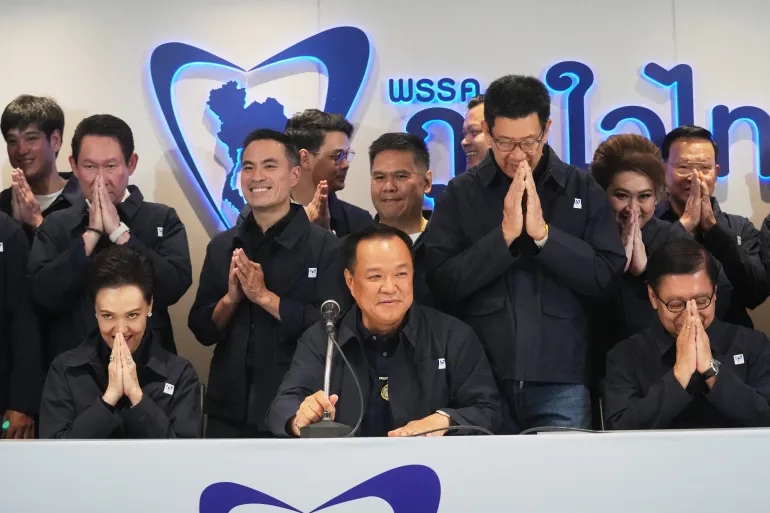
- Thailand election 2026 delivers a conservative Bhumjaithai victory, marking a major political shift.
- Regional powers like Cambodia, Malaysia, and Indonesia are closely watching Thailand’s new government.
- Economic performance during Anutin’s last tenure showed modest growth with around 500,000 new jobs created.
- National security, border tensions, and patronage networks were key factors shaping the election outcome.
Thailand’s general election on Sunday has delivered a clear win for Prime Minister Anutin Charnvirakul’s Bhumjaithai Party, marking the first decisive victory for a conservative force in years. With roughly 94% of votes counted, unofficial results show Bhumjaithai claiming about 193 of the 500 seats in the House of Representatives, positioning the party to lead a coalition government.
While earlier polls had predicted a more competitive race with the progressive People’s Party, Bhumjaithai’s triumph underscores the resilience of conservative networks and the appeal of nationalist messaging in Thai politics.
The election comes amid a period of slow economic growth, regional tensions, and shifting political alliances. Voter turnout stood at around 65%, a notable decline from the 2023 election, reflecting both voter fatigue and a sense of uncertainty in urban areas.
Despite trailing in the party list vote, Bhumjaithai’s strategic leveraging of patronage networks outside Bangkok helped consolidate provincial support, preventing vote splitting and ensuring a parliamentary advantage. Pheu Thai, historically dominant under former Prime Minister Thaksin Shinawatra’s political machine, won just 74 seats—a significant decline that illustrates the changing political landscape.
Economically, Anutin’s tenure has been marked by mixed results. While overall GDP growth remained modest, hovering around 2.5%–3% annually, government stimulus programs and localized development projects reportedly contributed to the creation of roughly 500,000 jobs over the past year.
Nevertheless, persistent challenges—floods, financial scandals, and the pandemic’s lingering impact—have tempered public enthusiasm. Analysts argue that the border clashes with Cambodia, which allowed Anutin to portray himself as a wartime leader, were pivotal in recasting his image and bolstering nationalist sentiment during the campaign.
For Thailand’s neighbors, this election carries significant implications. Cambodia, with which Bangkok experienced recent border tensions, is closely monitoring Anutin’s approach to bilateral relations. His hardline stance during the campaign, coupled with promises of stronger border security, suggests that regional diplomacy may adopt a more assertive tone.
Similarly, Malaysia and Indonesia, both major regional powers in Southeast Asia, are likely to view Bhumjaithai’s victory as a signal of Thailand’s potential pivot toward conservative, nationalist policies, particularly in trade, migration, and security coordination within ASEAN. The election outcome could influence regional cooperation frameworks and cross-border economic initiatives, particularly if Bangkok adopts a more protectionist or security-focused agenda.
Other factors shaping the election include voter sentiment around national security, public perception of corruption, and fatigue with long-standing political dynasties. The People’s Party, which dominated urban centers like Bangkok and surrounding provinces, captured the party list vote, suggesting urban voters are increasingly seeking reformist agendas, even if these gains did not translate into a parliamentary majority.
Meanwhile, a referendum held alongside the general election showed that around 60% of voters support initiating a formal process to draft a new constitution, reflecting broader public demand for systemic reform.
Moving forward, Bhumjaithai will likely form a coalition government, potentially including Pheu Thai, to secure the simple majority of 251 seats needed to elect a prime minister. Analysts caution that while the result may bring temporary political stability, it remains uncertain whether this conservative-led configuration can deliver sustained economic growth, job creation, and effective governance.
For the region, Thailand’s new government represents both continuity in nationalist policymaking and an opportunity for recalibrated diplomacy with Cambodia, Malaysia, Indonesia, and the broader ASEAN bloc.
Sunday’s vote thus marks more than just a domestic political shift; it signals Thailand’s evolving role in regional dynamics, balancing conservative governance, economic recovery efforts, and strategic relationships in Southeast Asia.