



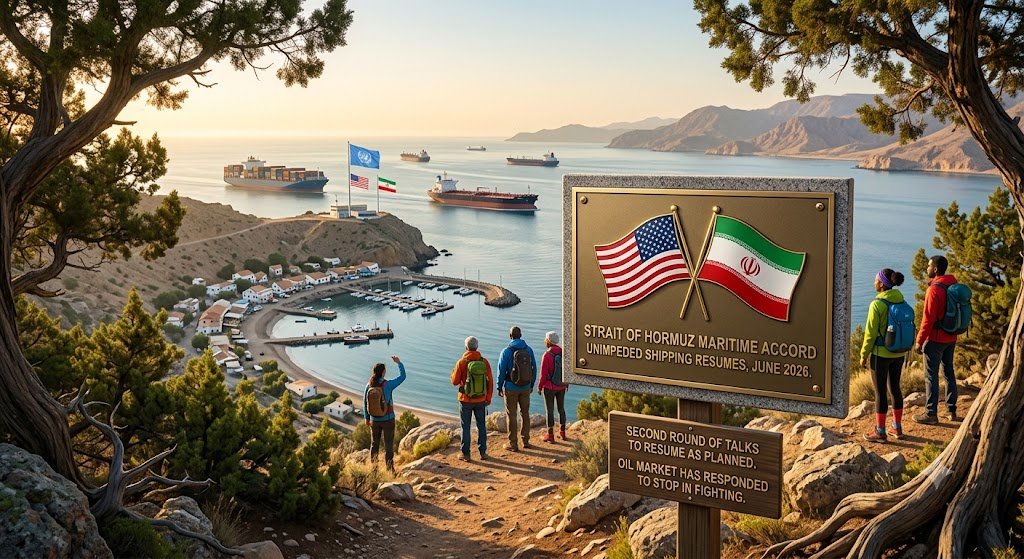
- The Strait of Hormuz peace talks are officially back on track following a diplomatic breakthrough between Washington and Tehran.
- Days of intense kinetic exchanges halted after a flashpoint attack on a Singapore-based vessel threatened global energy corridors.
- Brent crude and WTI benchmarks stabilized rapidly as shipping companies prepared to resume transit through the critical chokepoint.
- The upcoming Doha summit will focus heavily on long-term maritime governance and preventing future tit-for-tat escalations.
WASHINGTON / TEHRAN — The United States and Iran have agreed to a complete cessation of military hostilities surrounding the Strait of Hormuz, clearing the path for a highly anticipated second round of peace talks. Officials from multiple negotiating nations confirmed that the dangerous multi-day escalation—which culminated in a severe attack on a Singapore-based vessel—has officially ended, restoring a tentative calm to the world’s most critical maritime energy chokepoint.
Market Forecast Analysis
The sudden halt in military hostilities across the Strait of Hormuz has instantly recalibrated global energy projections. Moving forward, the market’s trajectory rests heavily on the upcoming Doha summit:
- Near-Term Baseline ($0 to -$3 Volatility): Energy analysts project oil prices will swiftly erase the remaining geopolitical risk premium and stabilize near pre-escalation baselines. If the United States and Iran successfully establish a permanent maritime hotline during Tuesday’s talks, market volatility is expected to drop significantly, restoring full confidence for global shipping conglomerates.
- The Diplomatic Breakdown Risk (+$5 to +$10 Premium): Because fundamental disagreements persist regarding who holds administrative authority over the strait, the truce remains incredibly fragile. Any sudden walkout or diplomatic collapse in Doha will likely trigger an immediate, reactionary spike of $5 to $10 per barrel as traders aggressively price back in the threat of localized tit-for-tat kinetic strikes.
The halt in fighting brought immediate relief to global commodities. The oil market has responded dynamically to the stop in fighting, with energy traders pricing out the immediate risk premium that had accumulated over days of kinetic exchanges.
Brent crude and West Texas Intermediate (WTI) futures, which spiked violently during the peak of the clashes, stabilized as shipping conglomerates signaled readiness to resume normal transit through a waterway that historically handles over 20% of global petroleum liquids, or roughly 20 million barrels per day.
READ MORE: Strait of Hormuz Plunges Into Chaos as New Iranian Attacks Threaten Peace Accord
The latest wave of violence erupted when Iranian forces targeted a Singapore-based merchant ship attempting to cross the strait while utilizing a U.S.-backed shipping lane along the coast of Oman. Tehran had previously warned commercial vessels against using the Omani route, insisting that traffic adhere to a separate course along its own coastline.
Despite these deep structural disagreements, both sides have committed to the second round of talks, slated to take place at a summit in the Qatari capital of Doha. The upcoming diplomatic session will focus squarely on maritime security and establishing a bilateral hotline to prevent accidental escalations, deferring more contentious issues—such as Iran’s nuclear program—to a later phase.
The incident triggered a sharp sequence of tit-for-tat strikes: Iran struck an additional container ship and a Qatari oil tanker, while the U.S. military retaliated by pounding Iranian communication hubs, coastal drone installations, and missile batteries. The conflict briefly widened when Iran launched secondary drone and missile strikes against Kuwait and Bahrain, prompting the U.S.-U.K. Joint Maritime Information Center to raise its security threat level to “substantial.”
Related News; U.S. and Iran Agree to Stop Fight Over the Strait of Hormuz
The breakthrough agreement to cease fire, initially reported by Axios, rescues a diplomatic process that seemed on the verge of collapse. A preliminary memorandum of understanding signed on June 17 had established a framework for peace, but the weekend’s violence paralyzed scheduled follow-up meetings in Switzerland.
A central point of contention remains the legal interpretation of the June 17 accord. The text dictates that “the Islamic Republic of Iran will make arrangements using its best efforts for the safe passage of commercial vessels.”
Iranian Foreign Minister Abbas Araghchi used a Baghdad press conference to assert that this language grants Tehran exclusive authority over the strait. Conversely, U.S. officials, backed by UN Ambassador Mike Waltz, maintain that the deal mandates an immediate clearing of military obstacles and guarantees unimpeded navigation under international law.
Despite these deep structural disagreements, both sides have committed to the second round of talks, slated to take place at a summit in the Qatari capital of Doha. The upcoming diplomatic session will focus squarely on maritime security and establishing a bilateral hotline to prevent accidental escalations, deferring more contentious issues—such as Iran’s nuclear program—to a later phase.
The truce comes at a highly complex geopolitical juncture. Domestic pressure had been mounting on both sides; President Trump warned over the weekend that military patience was expiring, while Iran’s influential Assembly of Experts pressured negotiators to close the strait entirely unless regional Israeli operations ceased. For now, diplomacy has prevailed, and global markets are watching Doha closely to see if this fragile equilibrium can hold.