



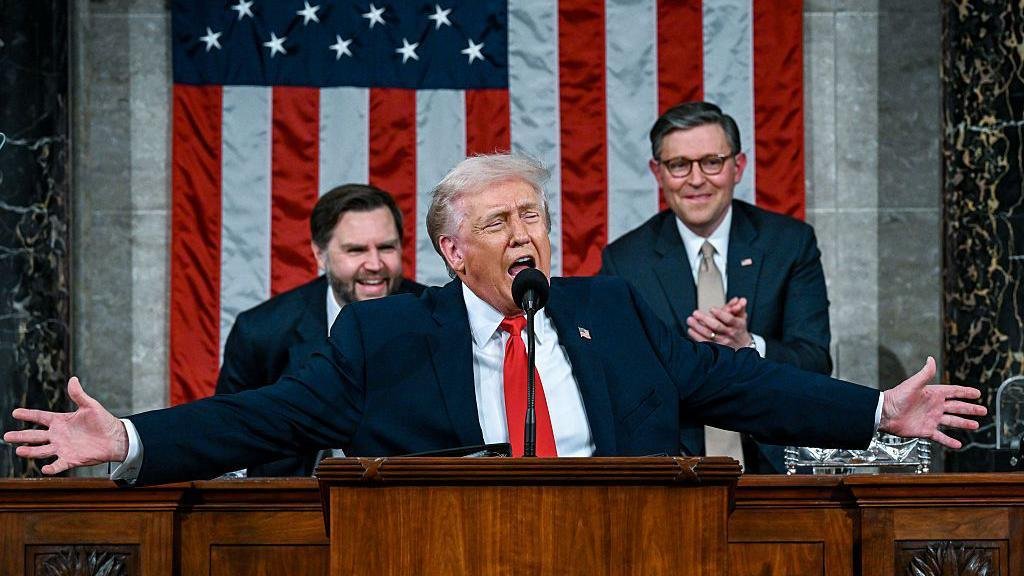
- Trump 2026 State of the Union Address outlines a doctrine of economic nationalism and industrial revival.
- President Trump defends tariffs as instruments of national security and supply-chain resilience.
- Immigration and border enforcement dominate domestic policy debate inside Congress.
- Foreign policy messaging signals deterrence strategy amid rising Middle East tensions.
Last night, President Donald Trump stood before Congress and the American nation to deliver a State of the Union address that was sweeping in ambition and unapologetically forceful in tone.
At a moment when the United States stands less than five months away from commemorating the 250th anniversary of its independence, the President framed his message around a central and resonant proposition: America remains capable of renewal, capable of greatness, and capable of charting its own strategic course in an increasingly turbulent global order.
The address, lasting nearly two hours — among the longest State of the Union speeches in modern history — was designed not merely as a review of governance but as a declaration of political direction. It combined economic nationalism, border security doctrine, and assertive foreign policy messaging into a broader narrative of American revival.
For policymakers and global observers alike, the speech offered insight into how the Trump administration intends to shape domestic priorities and recalibrate America’s role in a rapidly shifting geopolitical landscape.
The President opened with a bold declaration that the United States is “bigger, better, richer, and stronger than ever before,” establishing the rhetorical foundation for a speech centered on economic resurgence, national sovereignty, and institutional confidence. The framing was unmistakable: this was both a defense of his governing record and a forward-looking argument for continuity in policy direction.
Economic Revival and the Tariff Doctrine
At the core of the President’s address was the economy — long the defining pillar of Trump’s political identity. He described what he termed a “turnaround for the ages,” citing job creation, manufacturing reshoring, and wage growth as evidence that protectionist economic policies have begun reshaping America’s industrial base.
Yet beneath the economic optimism lay a significant institutional confrontation. The Supreme Court’s recent decision striking down much of the administration’s emergency tariff authority has emerged as a defining policy battle. Rather than moderating his stance, the President doubled down on tariffs as instruments of strategic economic power.
The NATO Greenland Dialogue: Mark Rutte’s Call Fuels Trump’s Momentum at Davos
In his telling, tariffs are not merely trade tools but mechanisms of national security — instruments designed to shield American workers, restore supply-chain resilience, and counter economic coercion from rival powers. He urged Congress to restore executive authority curtailed by the Court, framing the issue not as partisan economics but as a test of national resolve in an era of intensifying global competition.
For international markets and policy analysts, the message signals a continuation of economic nationalism as a central feature of U.S. strategy — one likely to shape trade negotiations, industrial policy debates, and transatlantic economic relations in the years ahead.
Immigration, National Security, and Political Confrontation
Immigration policy produced the most contentious moments of the evening, underscoring the deep political polarization surrounding border security in American governance. As the President outlined proposals for strengthened border enforcement, anti-fraud safeguards, and expanded deportation mechanisms, Democratic lawmakers responded with vocal protests, culminating in the removal of a member of Congress who displayed a sign opposing the President’s remarks.
Trump’s State of the Union speech – at a glance
Despite the disruptions, Trump maintained a disciplined message: border security, he argued, is not simply a legislative disagreement but a question of sovereignty and national survival. He framed immigration enforcement within the broader doctrine of state responsibility — asserting that a sovereign nation must control its borders, protect its citizens, and uphold the rule of law.
The framing reflects a strategic shift increasingly visible in Western political discourse, where migration policy is being redefined through the lenses of security, economic stability, and institutional legitimacy rather than purely humanitarian considerations.
Foreign Policy: Strength, Deterrence, and Strategic Leadership
The President devoted significant attention to foreign policy, particularly rising tensions with Iran and broader instability across the Middle East. Warning adversaries against miscalculation, he emphasized that the United States would not hesitate to defend its interests or allies, even as American naval deployments signaled heightened military readiness.
At the same time, Trump reiterated a familiar but evolving doctrine: American leadership must be shared. Allies, he argued, must assume greater responsibility for collective security, reflecting Washington’s continued push for burden-sharing within alliances.
The foreign policy message blended deterrence with pragmatism. Patriotism, in the President’s formulation, does not equate to isolationism; rather, it represents strength exercised with strategic purpose. For global policymakers, this signals continuity in a transactional alliance framework combined with readiness for decisive action when core U.S. interests are perceived to be at stake.
America at 250: Historical Narrative as Political Strategy
Perhaps the most compelling thread woven throughout the speech was the President’s invocation of America’s approaching semiquincentennial — the 250th anniversary of independence. He presented the milestone not merely as a ceremonial celebration but as a moment of national introspection.
By honoring service members, first responders, and ordinary citizens, the address sought to anchor policy debates within a broader cultural narrative of resilience and national identity. These personal stories served a strategic rhetorical purpose: reinforcing the idea that patriotism is lived experience rather than abstract ideology.
The historical framing positioned the administration’s policies within a longer American tradition of renewal following periods of uncertainty — a narrative likely intended to resonate across political and generational divides.
A Call to Congress — and to the Nation
In closing, the President issued a dual challenge: to Congress, to pursue cooperation despite ideological divisions; and to the American people, to retain confidence in the nation’s capacity for reinvention. He argued that the strength of the union derives not from any single administration but from the enduring spirit of its citizens.
Whether applauded or criticized, the 2026 State of the Union address underscored a defining reality of contemporary American politics: the country remains engaged in an intense debate over its economic model, national identity, and global leadership role.
As the United States approaches 250 years of independence, the speech served as both reflection and projection — a reminder that America’s story remains unfinished. It is a story shaped by contestation and conviction, by disagreement and determination, and by generations who continue to believe that the nation’s future is worth defending.
In that belief, the President suggested, lies America’s greatest strategic advantage — and perhaps its most enduring source of strength.