



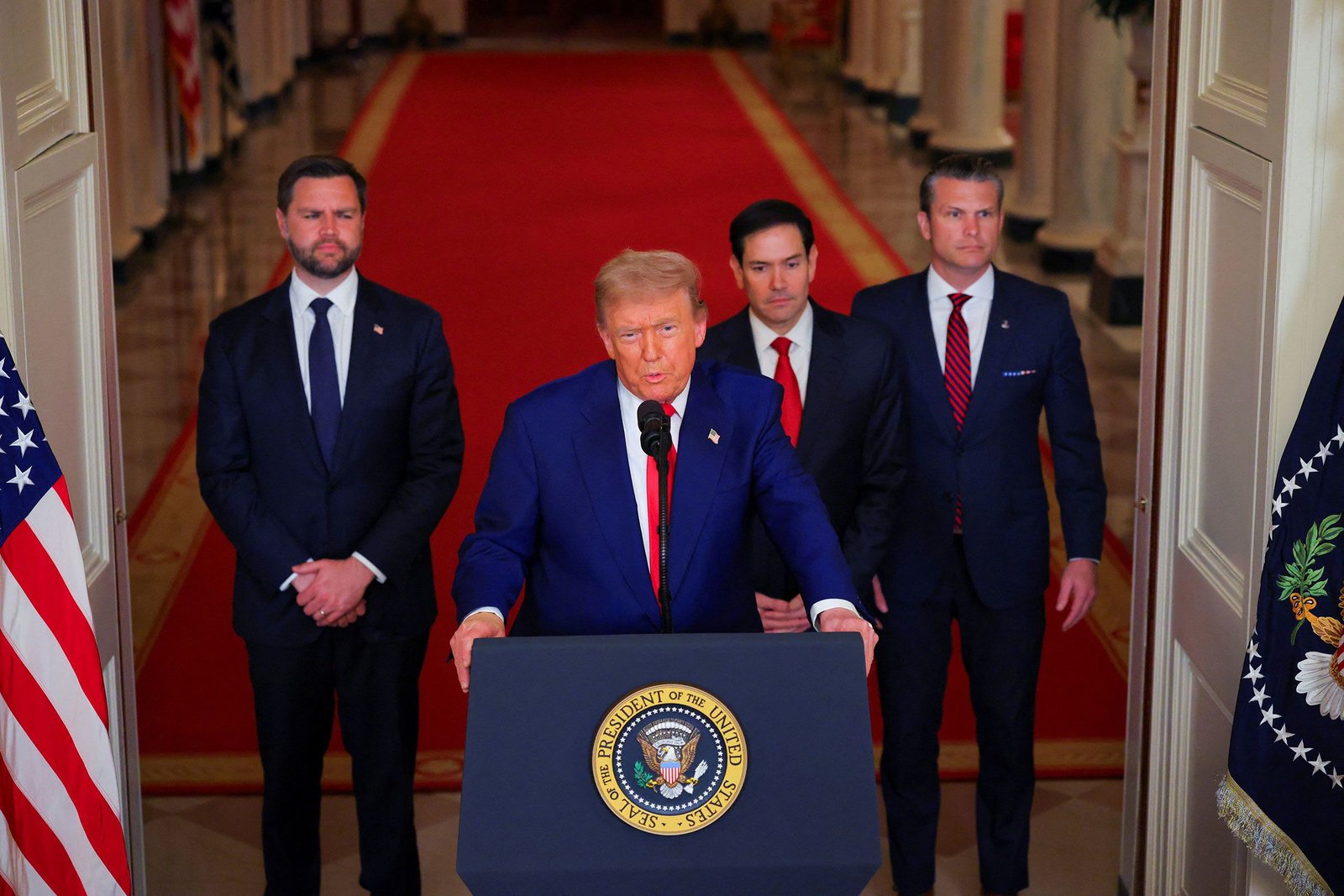
WASHINGTON — U.S. President Donald Trump confirmed on Saturday that the United States had launched “major combat operations” against Iran, acknowledging the possibility of American casualties but assuring that the administration has taken extensive precautions to safeguard U.S. nationals in the region.
In a video posted on Truth Social, Trump stated, “My administration has taken every possible step to minimise the risk to U.S. personnel in the region. Even so, and I do not make this statement lightly, the Iranian regime seeks to kill. The lives of courageous American heroes may be lost, and casualties can occur during any conflict. We undertake this mission not just for today, but for a safer future — a noble mission for our country and our allies.”
The military operation, named “EPIC FURY” by the Pentagon, marks the second U.S. strike against Iran since Trump’s return to the White House last year. Unlike the targeted June strikes on Iranian nuclear facilities, this campaign is expected to span several days, reflecting the administration’s broader strategy to neutralize Iranian missile and naval capabilities.
U.S. Joins Israel in Attack on Iran: Global Security Faces Historic Escalation
A senior U.S. official said the strikes aim to dismantle Iran’s missile infrastructure and cripple its navy, curtailing Tehran’s ability to threaten American forces and allies across the region. The official described the operation as “precisely calibrated” to minimize civilian casualties while achieving strategic objectives.
Tehran has vowed a forceful retaliation. Iranian military sources, speaking to international media, warned that U.S. bases and interests across the Middle East are within range of Iranian missile capabilities. The Israeli military reported that Iran had already launched missiles toward its territory in response to the U.S.-Israeli offensive.
Trump, addressing Iran’s Islamic Revolutionary Guard Corps, offered a stark choice: disarm or face “certain death.” He also encouraged Iranian civilians and dissidents to take steps toward governmental change, framing the U.S. strikes as a defensive yet morally grounded campaign against what he described as decades of nuclear and ballistic missile provocations.
Diplomatic avenues had been explored in the weeks leading up to Saturday’s strikes. Talks, including a session on Thursday, failed to yield a deal, with Trump asserting that Iran “refused, just as it has for decades, every opportunity to renounce its nuclear ambitions. We can no longer tolerate this threat.”
The operation coincides with widespread unrest within Iran. The president first hinted at military action in January, amid nationwide protests that claimed thousands of lives.
US and Israel launch attack on Iran, as Trump says ‘major combat operations’ under way
U.S. forces maintain an extensive network of military installations across the Middle East, enhancing both operational reach and the protection of American personnel.
Key Basis In The Gulf:
-
Bahrain: Headquarters of the U.S. Navy’s Fifth Fleet, overseeing operations in the Gulf, Red Sea, Arabian Sea, and parts of the Indian Ocean.
-
Qatar: Al Udeid Air Base, the forward headquarters for U.S. Central Command, housing around 10,000 troops and coordinating operations from Egypt to Central Asia.
-
Kuwait: Camp Arifjan and Ali Al Salem Air Base, supporting U.S. Army Central operations and serving as staging points for deployments into Iraq and Syria.
-
United Arab Emirates: Al Dhafra Air Base, critical for reconnaissance and operations against regional threats, with Dubai’s Jebel Ali Port serving as the U.S. Navy’s principal port of call.
-
Iraq: Ain Al Asad Air Base and Erbil Air Base, facilitating training, logistics, and coalition coordination.
-
Saudi Arabia: Prince Sultan Air Base and other installations, supporting missile defense and air operations.
-
Jordan: Muwaffaq al Salti Air Base, home to the 332nd Air Expeditionary Wing, conducting missions across the Levant.
The Trump administration emphasizes that the strikes are measured and targeted, and that extensive protective measures have been taken to shield U.S. citizens and military personnel. Nevertheless, the president’s warning reflects the unpredictable nature of war in a region of heightened tensions.
As the Middle East braces for further escalation, experts note that the coordinated U.S.-Israel operation signals a strategic shift in addressing Iran’s nuclear ambitions and regional military posture. The coming days will be critical in determining the immediate trajectory of U.S.-Iranian relations and the stability of the broader Gulf region.