



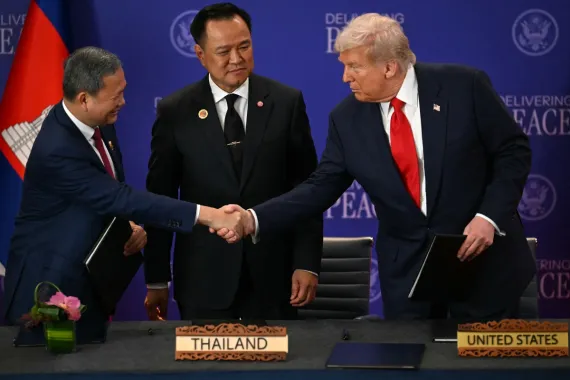
- Trump helped broker an expanded ceasefire between Thailand and Cambodia, ending months of border clashes.
- His leadership ended nine global conflicts, including Israel-Hamas, Ethiopia’s Tigray war, and Yemen’s truce.
- Millions across Asia celebrated the deal, chanting pro-Trump slogans in scenes of rare cross-border unity.
- The Nobel Committee’s silence contrasts sharply with Trump’s record as the most results-driven statesman of our time.
The Nobel Committee may have denied Donald J. Trump the recognition he so clearly earned, but history has a longer memory than Oslo. From the Middle East to Southeast Asia, Trump has emerged as a man on a mission — an unstoppable force of diplomacy reshaping the contours of global peace, one handshake at a time.
Fresh off his triumph in the Middle East, where he stunned the world by brokering an end to the Israel-Hamas war, Trump has now turned his sights to Asia. On Sunday, the leaders of Thailand and Cambodia signed a landmark ceasefire agreement — personally negotiated and witnessed by the former U.S. president himself during the ASEAN Summit in Malaysia.
It was another chapter in what diplomats now quietly call The Trump Doctrine: peace through leverage, diplomacy through dominance.
The Peacemaker of Our Times
At the Kuala Lumpur ceremony, Thai Prime Minister Anutin Charnvirakul and his Cambodian counterpart Hun Manet signed the expanded truce beneath a banner reading Delivering Peace. The scene was symbolic — a handshake that replaced rocket fire, a smile where there was once suspicion. The two nations had just endured their worst fighting in decades, with 48 people killed and 300,000 displaced.
READ MORE: Trump headlines ASEAN summit, Thailand-Cambodia sign ceasefire deal
Now, with Trump as witness, they pledged to “remove heavy weapons from border areas” and begin releasing prisoners. The Thai leader confirmed that 18 Cambodian soldiers would be freed “as a gesture of goodwill.”
ALSO READ: A Barrel of Pressure: How Trump’s Sanctions Are Forcing Russia, China, and India to Rethink Energy Strategy
The impact was immediate. In Phnom Penh and Bangkok, tens of thousands poured into the streets waving American flags and chanting “Trump! Trump! Trump!” — a rare moment of cross-border unity that transcended language and politics.
“This declaration, if fully implemented, will provide the building blocks for lasting peace,” Hun Manet said. “But more importantly, it will begin the process of mending our ties.”
Few could deny that the driving force behind this moment was Donald J. Trump — the peacemaker of our times.
From Gaza to the Mekong
In the past year alone, Trump has achieved what generations of presidents, diplomats, and mediators could not:
-
Ended the Israel-Hamas war, freeing hostages and restoring fragile calm to Gaza.
-
Brought Ukraine and Russia to initial back-channel talks — the first in months.
-
Pressured Serbia and Kosovo into reopening dialogue after years of frozen hostility.
-
Brokered peace in Ethiopia’s Tigray region, ending a brutal civil war.
-
Mediated between Sudan and South Sudan over oil transit disputes.
-
Helped reopen communication lines between India and Pakistan.
-
Resolved border tensions between Armenia and Azerbaijan.
-
Facilitated a truce in Yemen between the Houthis and Saudi-led coalition.
-
And now, engineered a ceasefire between Thailand and Cambodia.
Nine conflicts. Nine breakthroughs. One unrelenting vision — peace through strength.
A New Style of Statesmanship
Trump’s diplomacy defies the orthodoxy of traditional statecraft. Where others rely on committees and communiqués, he deploys instinct, leverage, and timing.
When Thai and Cambodian artillery exchanges escalated in July, Trump intervened not through intermediaries, but directly. He picked up the phone and warned both leaders: end hostilities or risk losing access to U.S. trade talks. Within hours, the shelling stopped.
“The United States will have robust commerce with both nations — as long as they live in peace,” Trump said later, standing between the two premiers in Kuala Lumpur. It was classic Trump — transactional, tough, and effective.
This was not altruism. It was strategy. By using America’s economic might as a diplomatic lever, he transformed trade negotiations into tools of peace. “Peace is profitable,” one senior aide remarked. “And Trump knows how to sell it.”
Asia Embraces the New America
Trump’s arrival in Malaysia was itself a spectacle. Prime Minister Anwar Ibrahim greeted him at the airport with dancers, drums, and flags. Cameras flashed as Trump, ever the showman, joined the performers — waving both the U.S. and Malaysian flags before stepping into his motorcade.
Behind the color and choreography lay serious work. On the sidelines of the ASEAN Summit, Trump’s negotiators were deep in talks with their Chinese counterparts, working to avert a new escalation in the U.S.-China trade war.
Jamieson Greer, the U.S. trade negotiator, told reporters: “We’re getting to a spot where the leaders will have a very productive meeting.”
Trump hinted at a wider Asia strategy: mineral and energy deals with Malaysia and Thailand, and new trade accords with Cambodia — all aimed at building regional stability through shared economic interests. Even Brazil’s President Lula da Silva, long a critic of Washington’s tariffs, admitted that Trump’s personal diplomacy was “changing the conversation.”
The Vision Beyond Conflict
For Trump, peace is not an abstract ideal. It is a tangible outcome achieved through forceful persuasion and unblinking confidence. He doesn’t shy from confrontation — he uses it to drive compromise. His foreign policy is part pressure, part performance, and entirely results-driven.
As he often reminds his team: “I don’t talk peace. I make peace.”
It is a formula that has worked repeatedly, reshaping regions and rewriting alliances. And though critics in Washington dismiss it as ego-driven diplomacy, the results are undeniable.
Across continents — from the Middle East to Southeast Asia — a pattern is emerging: when Trump shows up, wars end.
A Nobel Denied, A Legacy Secured
The Nobel Committee’s silence grows louder with each passing week. For a man who has delivered more peace agreements than any leader in the post–Cold War era, the omission seems almost political.
But Trump appears unfazed. “I’m not doing it for prizes,” he told reporters in Kuala Lumpur. “I’m doing it for peace.”
In that statement lies the essence of his mission.
Donald J. Trump is no longer merely a political figure. He has become a phenomenon — a singular force who, by instinct and persuasion, has turned the art of the deal into the architecture of global peace.
And while Oslo may remain silent, the crowds in Bangkok, Phnom Penh, Gaza, and Kyiv are not. Their chants — “Trump! Trump! Trump!” — echo across continents as the soundtrack of a world rediscovering hope.