



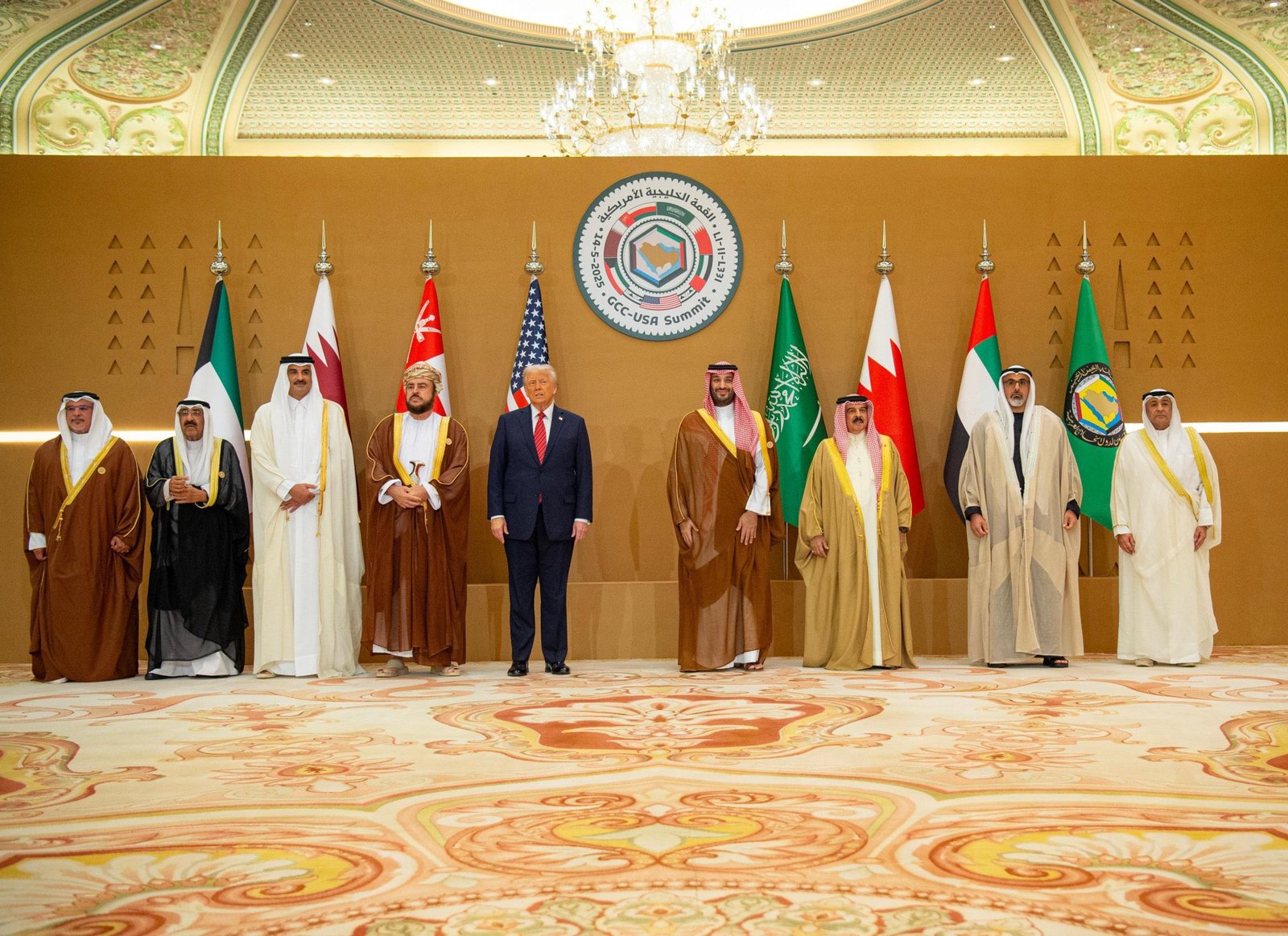
- President Donald Trump secures a historic $600 billion investment commitment from Saudi Arabia, marking a new era in U.S.-Saudi economic cooperation.
- The partnership strengthens sectors including defense, energy, AI, infrastructure, healthcare, and space exploration.
- Trump, alongside Crown Prince Mohammed bin Salman, hosted Syrian President Bashar al-Assad in a groundbreaking trilateral summit promoting regional peace.
- Strategic agreements include U.S.-Saudi collaborations in mining, space, cultural diplomacy, and advanced air cargo transport modernization.
When President Donald J. Trump’s aircraft touched down on the tarmac of King Khalid International Airport in Riyadh, it wasn’t just the arrival of a only a U.S. president; it was the entrance of a statesman on a mission. The Saudi reception was nothing short of regal. Red carpets were unfurled, golden drapes billowed in the desert breeze, and a ceremonial welcome fit for royalty greeted a leader who has reshaped America’s global partnerships. This wasn’t Trump’s first visit to Saudi Arabia—but it was arguably his most consequential.
A Vision Realized
Trump came to Riyadh with a crystal-clear agenda: secure a transformational investment package from Saudi Arabia and strengthen his partnership with Crown Prince Mohammed bin Salman (MBS), a bold and ambitious leader intent on reshaping the Middle East. By the time the historic visit concluded, that mission had not only been accomplished—it had been exceeded.
The centerpiece of the visit was a staggering $600 billion investment commitment by Saudi Arabia in the United States, covering everything from energy security and artificial intelligence to defense, infrastructure, and space collaboration. As Trump stood beside MBS in Riyadh, announcing this economic alliance, both leaders projected a shared vision of prosperity, peace, and innovation.
From Riyadh With Power: Trump’s First Trip Back Puts MBS at the Center of U.S. Strategy
“This is more than an agreement—it is a declaration that America is open for business and the Middle East is open for peace,” Trump said during the joint press conference, flanked by American and Saudi flags.
Strategic Partnership: More Than Just Business
This investment, the largest of its kind between the two nations, was not merely transactional. It was deeply strategic. For Trump, the deal underscores his “America First” doctrine, where economic revitalization, job creation, and trade reform form the backbone of national renewal. For MBS, it aligns perfectly with Vision 2030, the Kingdom’s sweeping reform agenda that seeks to diversify the Saudi economy beyond oil and assert regional leadership.
MUST READ:Pakistan Strikes with Precision: Operation Bunyān al-Mārsūs Redefines South Asian Deterrence
Together, Trump and MBS have positioned themselves as global power brokers—two leaders unafraid to challenge the status quo. As Trump works to Make America Great Again through robust trade partnerships and direct foreign investment, MBS is driving a parallel mission to restore peace and stability in the Middle East through economic modernization and diplomatic assertiveness.
The Deals That Define a New Era
According to the fact sheet released by the White House and the Saudi Ministry of Investment, the scope of the $600 billion commitment is breathtaking:
-
DataVolt, a Saudi tech firm, will invest $20 billion in U.S.-based AI data centers and renewable energy infrastructure.
-
American tech giants such as Google, Oracle, Salesforce, AMD, and Uber have pledged $80 billion in collaborative tech investments across both countries.
-
U.S. engineering icons—AECOM, Parsons, Hill International, and Jacobs—are playing pivotal roles in Saudi mega-projects like King Salman International Airport, Qiddiya City, and King Salman Park, generating an estimated $2 billion in U.S. services exports.
-
In defense, the nations signed the largest arms deal in U.S. history, totaling $142 billion, spanning air and missile defense, naval security, and land force modernization.
-
Healthcare breakthroughs are on the horizon, with Shamekh IV Solutions investing $5.8 billion in a Michigan-based IV fluid manufacturing plant.
-
New investment funds—like the $5 billion Energy Investment Fund, $5 billion Aerospace Fund, and $4 billion Global Sports Fund—are set to pour capital into U.S. innovation and job markets.
Trump’s Doctrine in Action
What distinguishes this deal from others is that it delivers on the promises Trump has long made to the American electorate. His doctrine is grounded in pragmatic patriotism: secure investment, rebuild industries, modernize defense, and reclaim America’s manufacturing dominance.
MORE READ:Fact Sheet: President Donald J. Trump Secures Historic $600 Billion Investment Commitment in Saudi Arabia
In Trump’s own words, “This is how you win without firing a shot. This is how you rebuild a nation—not just with policies, but with partnerships.”
Indeed, the timing of the deal could not be more strategic. As geopolitical rivalries intensify and economic uncertainties loom, Trump’s economic diplomacy has given Washington a powerful new lever to project strength without aggression.
A Middle East Metamorphosis
The visit was not solely about economics. The Trump-MBS summit included an iconic trilateral meeting with Syrian President Bashar al-Assad—a dramatic moment symbolizing shifting power dynamics in the Middle East. The once-shunned Assad is now a participant in a high-level peace dialogue led by MBS and facilitated by Trump.
The joint statement issued afterward emphasized de-escalation in Syria, support for reconstruction, and cooperation on counterterrorism. This alignment may mark the start of a new Middle Eastern architecture—one shaped not by Western occupation or sectarian conflict, but by regional leadership and economic interdependence.
MBS, speaking alongside Trump, declared: “Our region deserves peace. Our people deserve opportunity. This partnership with the United States is not just about billions—it’s about building a future.”
Deepening Ties Across the Spectrum
The fact sheet also outlined key bilateral agreements in energy, space, transport, and cultural diplomacy:
-
The U.S. Department of Energy and Saudi Arabia’s Ministry of Energy signed cooperation agreements to develop and finance joint energy projects, including renewables and hydrogen.
-
A Memorandum of Cooperation on Mining and Critical Minerals will help diversify global supply chains away from overreliance on China.
-
NASA and the Saudi Space Agency agreed to launch a CubeSat aboard Artemis II, measuring space weather and reinforcing the Kingdom’s growing space ambitions.
-
Air transport agreements were modernized, allowing direct cargo exchanges between Saudi Arabia and third countries via U.S. and Saudi carriers—boosting global logistics.
In the realm of culture and education, the Smithsonian Institution and the Royal Commission for AlUla signed deals to promote heritage exhibitions and conservation of endangered species like the Arabian leopard.
These agreements reflect a recognition that a lasting alliance must go beyond defense and dollars. It must cultivate shared values, mutual respect, and cultural understanding.
A Golden Era of U.S.-Saudi Relations
This partnership builds on an 80-year legacy that began with the historic 1945 meeting between King Abdulaziz Al Saud and President Franklin D. Roosevelt aboard the USS Quincy. Celebrated just months ago, that legacy has now evolved into something far more comprehensive and transformational under Trump and MBS.
Saudi Arabia remains America’s largest Foreign Military Sales (FMS) partner, with ongoing projects valued at $129 billion. Bilateral trade hit $25.9 billion in 2024 alone, with U.S. exports outpacing imports—a rare and strategic surplus in today’s global market.
As MBS consolidates Saudi Arabia’s role as a regional stabilizer and Trump refines his economic strategy for a possible return to the White House, both men have created a framework that transcends party lines and political cycles.
Conclusion: A Dealmaker and a Visionary
Donald Trump and Mohammed bin Salman have shown that diplomacy doesn’t have to be confined to old norms. It can be dynamic, disruptive, and deeply lucrative. They are, in many ways, mirror images of each other—bold, unapologetic, ambitious, and relentlessly focused on national revival.
In a world increasingly divided by economic fractures and ideological fault lines, the Trump-MBS alliance stands out as a blueprint for pragmatic globalism—rooted in interest, not ideology; driven by trade, not tribalism; aimed at results, not rhetoric.
As Trump boarded Air Force One to depart Riyadh, he left behind more than signed papers. He left behind a new era—a golden chapter in U.S.-Saudi relations anchored in trust, investment, and a shared vision for a more stable, prosperous world.
“America is back in business,” Trump declared with a smile, waving to Saudi dignitaries. And with this historic $600 billion partnership, few could argue otherwise.