



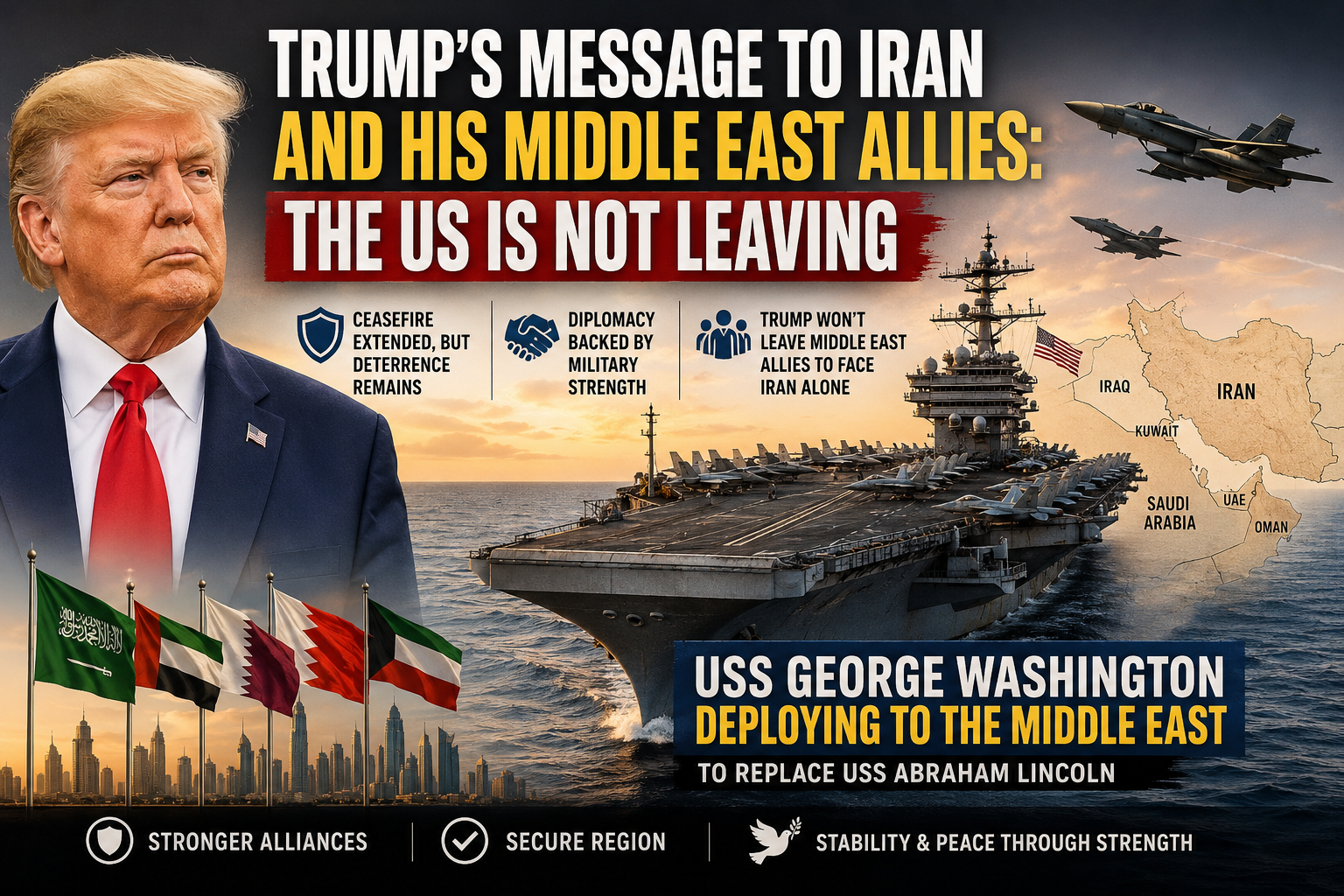
- Trump Middle East allies see continued U.S. military presence as a sign that Washington will not abandon them during a crisis.
- The USS George Washington deployment demonstrates that extending the Iran ceasefire does not necessarily mean American military disengagement.
- Trump’s strategy combines diplomacy with military leverage, allowing Washington to negotiate while preserving deterrence.
The United States and Iran may have agreed to extend their fragile ceasefire for another 60 days, but Washington is sending a clear message to its Middle Eastern allies: a ceasefire does not mean American disengagement.
The planned deployment of the USS George Washington to replace the USS Abraham Lincoln in the Middle East comes at a politically significant moment. The Lincoln has spent more than 250 days deployed and has not made a port call in roughly 200 days. It has played a major role in the U.S. military campaign against Iran and the subsequent blockade of Iranian ports.
The rotation is reportedly scheduled, but its timing carries strategic significance. Washington is maintaining its military presence while simultaneously pursuing diplomacy with Tehran.
For America’s Middle Eastern allies, that distinction matters.
A ceasefire is not a withdrawal
The extension of the ceasefire should not automatically be interpreted as evidence that President Donald Trump has abandoned his objectives toward Iran.
READ MORE: Turkey Found No Evidence of Trump’s Assassination Bid At NATO Summit
Instead, it gives Washington political space to negotiate while preserving military leverage.
The United States and Iran remain divided over security guarantees, freedom of navigation through the Strait of Hormuz and the broader regional security architecture. Pakistan and other regional actors have been working to keep diplomacy alive.
But Washington is simultaneously maintaining the military capability required to respond if negotiations collapse.
That is coercive diplomacy: negotiate while retaining the ability to impose costs.
The deployment of another carrier therefore sends two messages.
To Iran: American military power remains available.
To America’s allies: Washington will not leave them exposed while negotiations continue.
Why Trump’s allies trust him
Trump’s relationship with Middle Eastern governments is based less on sentiment than on a calculation of American power.
Gulf states have learned that Trump prefers tangible demonstrations of commitment. Aircraft carriers, air-defense systems, intelligence cooperation, military deployments and rapid reinforcement are more convincing to regional governments than diplomatic assurances alone.
That is why maintaining a carrier presence can reassure America’s partners even while Washington talks to Tehran.
For Gulf governments, diplomacy is less threatening when it is backed by military strength.
A negotiated settlement becomes more credible when Washington is negotiating from a position of power rather than weakness.
Iran is being given a choice, not a free pass
The carrier rotation also strengthens Trump’s bargaining position.
If Tehran believed that a ceasefire would automatically lead to an American withdrawal, Iranian negotiators could simply wait for Washington to lose interest.
READ MORE: U.S. Sending Fresh Aircraft Carrier to Middle East Amid Iran War Strain
The continued American naval presence changes that calculation.
Iran must consider that negotiations could fail while the United States retains the ability to impose additional military and economic pressure.
This does not necessarily mean Trump wants another full-scale war.
It means he wants to preserve the option of escalation.
That is consistent with his broader negotiating philosophy: seek an agreement, but make clear that rejecting it has consequences.
The message to Israel and the Gulf
For Israel and the Gulf states, the most important question is whether Washington will remain present when the region becomes dangerous.
Regional governments do not necessarily expect America to fight every battle for them. They want confidence that Washington will not disappear when the battlefield becomes difficult.
That is especially important after Iranian strikes during the July escalation involving American military facilities and equipment in several Arab countries.
For Bahrain, Kuwait, Qatar, Jordan and other partners, the American military presence is part of their security architecture.
The arrival of the George Washington therefore has psychological as well as military significance.
It signals that America still sees regional security as a strategic priority.
But American power has limits
The strategy comes with costs.
The Lincoln’s exceptionally long deployment has generated concerns among lawmakers about shortages, maintenance, living conditions and the strain placed on sailors. Defense Secretary Pete Hegseth has rejected the most severe allegations.
The Navy also has only 11 active aircraft carriers. Moving the George Washington from the Pacific to the Middle East creates a strategic trade-off and reduces America’s ability to maintain the same level of presence against China.
That makes the decision significant.
Peace backed by power
Trump’s emerging Middle East strategy can be summarized in one principle: do not confuse negotiations with retreat.
He can extend a ceasefire while maintaining military pressure. He can pursue an agreement with Iran while reassuring Israel and Gulf partners. He can seek diplomacy without surrendering deterrence.
The deployment of the George Washington does not prove that Trump has decided to restart the war. The rotation was described as scheduled.
But it demonstrates that a ceasefire will not automatically become an American withdrawal.
For Tehran, diplomacy continues under pressure.
For Israel, American military power remains available.
For Gulf allies, Washington remains in the region.
That may explain why many of America’s Middle Eastern partners continue to trust and respect Trump.
They may disagree with his tactics. They may find him unpredictable.
But they understand his central message:
When crisis comes, Trump does not want America’s allies to face it alone.