



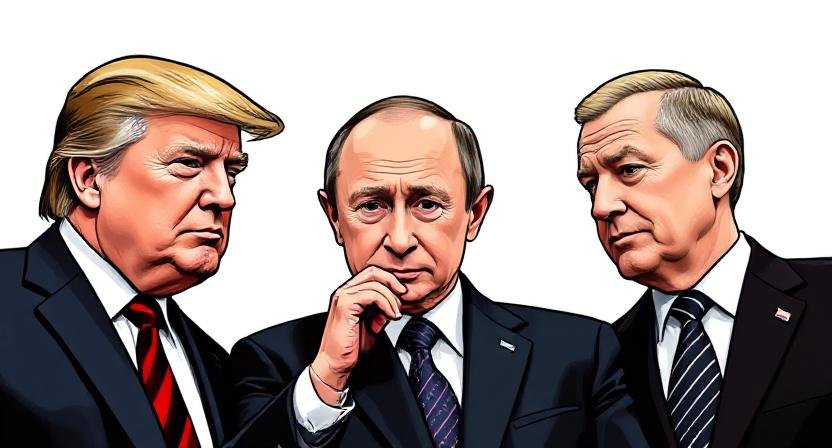
- President Trump pushes for a historic Putin-Zelensky meeting as the “next phase” of the Ukraine peace process.
- Kremlin signals reluctance, with Lavrov stressing the need for careful preparation and Putin wary of legitimizing Zelensky.
- Security guarantees remain the biggest obstacle: U.S. rules out ground troops but explores air support while Europe considers troop deployments.
- Analysts predict protracted ambiguity — Trump claims progress, Putin stalls, and Ukraine fights on while talks evolve.
WASHINGTON — The White House declared Tuesday that Russian President Vladimir Putin has agreed in principle to meet Ukrainian President Volodymyr Zelensky, signaling what it called the “next phase” of President Donald Trump’s peace initiative to end Europe’s bloodiest war in generations. Yet, while Washington projected confidence, the Kremlin remained far more cautious, underscoring the fragile and uncertain path ahead.
According to White House Press Secretary Karoline Leavitt, the understanding emerged during Trump’s call with Putin late Monday night, after the U.S. president held intensive talks with Zelensky and European leaders in Washington. “The president is working to bring the two leaders together,” Leavitt said, casting it as a milestone in Trump’s ambitious campaign to end the two-and-a-half-year conflict.
Trump Pushes for Putin-Zelensky Meeting as He Prepares to Announce Ukraine Deal
But in Moscow, Foreign Minister Sergei Lavrov played down expectations, insisting that “contacts involving heads of state need to be thoroughly prepared.” Kremlin spokesman Dmitry Peskov declined to confirm any concrete plans, illustrating how divergent the narratives remain between Washington and Moscow.
Trump And A War of Narratives
The uncertainty reflects the broader dilemma: while Trump presents himself as a dealmaker capable of ending the war, Putin has spent years portraying Zelensky as a Western proxy unworthy of direct talks. For Putin, meeting Zelensky risks undermining his carefully crafted domestic narrative — that Russia is not fighting Ukraine but confronting NATO and Western expansion.
“Trump’s push puts Putin in a bind,” said Tatiana Stanovaya, a senior fellow at the Carnegie Russia Eurasia Center. “If he refuses, he risks irritating Trump at a sensitive moment. But if he accepts, he legitimizes Zelensky, which contradicts everything he’s told the Russian public.”
READ MORE: Putin Calls Zelensky the West’s Illegitimate Puppet. Can He Talk Peace With Him?
This tension explains the Kremlin’s guarded statements. Analysts believe Putin will seek to delay or dilute any summit, ensuring it comes only at a stage where Russia can claim decisive battlefield or political leverage.
Security Guarantees: The Sticking Point
At the heart of Trump’s diplomacy lies the question of Ukraine’s future security. On Fox News, Trump reiterated that while the United States would “help defend Ukraine,” he has “definitively” ruled out sending American troops. Instead, he hinted at possible U.S. air support — either supplying advanced systems or even enforcing a limited no-fly zone in coordination with European allies.
European leaders, including those from France, Germany, and Britain, have privately suggested they are prepared to station troops in Ukraine under their national flags, not NATO’s — a formula designed to reassure Moscow while strengthening Kyiv’s defenses. Washington, officials say, may take command-and-control responsibility.
ALSO READ: Pakistan’s Silent Guardians: How Pakistan’s Intelligence Agencies and the Army Foiled BLA’s Catastrophic Plot to Bleed the Nation
But the Kremlin has already rejected any Western “peacekeeping deployment,” framing it as NATO encroachment under another name. The question of guarantees — short of NATO membership but stronger than unenforceable promises — remains the sharpest fault line in negotiations.
Hungary as Host?
The White House is considering several venues for the potential summit, including Budapest. Yet Hungary’s prime minister, Viktor Orbán — perhaps Putin’s closest ally in the EU — has openly declared Russia the “winner” of the war and dismissed Ukraine’s prospects. For Kyiv and its European backers, Budapest would be a politically toxic setting, raising doubts about the neutrality of the process.
“We’re not confirming or denying locations,” Leavitt said, but acknowledged multiple capitals are competing to host.
Putin’s Reluctance and Zelensky’s Gamble
Zelensky, for his part, has long believed a face-to-face meeting with Putin could break the deadlock. Yet Putin has repeatedly dismissed him as illegitimate, pointing to Ukraine’s delayed elections under wartime conditions. Kremlin-aligned voices — including Dmitry Medvedev and Maria Zakharova — this week derided Zelensky as unserious, part of a broader strategy to undermine the rationale for any talks.
Still, Trump has urged flexibility on both sides. “They’re the ones that have to call the shots,” he said, emphasizing that while America is 7,000 miles away, peace must ultimately be negotiated by Kyiv and Moscow.
Zelensky has already softened his own red lines, dropping his earlier insistence on a cease-fire before talks. “If Ukraine sets preconditions, Russia will invent 100 of its own,” he told reporters in Washington. “I think we should meet without conditions.”
What’s at Stake
For Trump, the political stakes are enormous. Ending the Ukraine war would cement his second term as one of historic peacemaking, adding to deals he claims to have brokered in Asia, Africa, and the Middle East. But for Putin, the war is not simply about Ukraine — it is about reshaping Europe’s security order and revisiting grievances dating back to NATO’s eastward expansion after the Cold War.
That makes compromise harder. “Ukraine is not the issue,” said Samuel Charap, senior political scientist at RAND. “For Putin, this is about the West. Zelensky is just a pawn.”
The Road Ahead
NATO chiefs are set to meet virtually on Wednesday to discuss Trump’s Alaska summit with Putin and the evolving talks. Behind the scenes, Pentagon planners are exploring scenarios ranging from enhanced air defense support to European-led peacekeeping missions under U.S. coordination. Each option carries risks: too much Western involvement risks derailing talks, while too little could leave Ukraine vulnerable.
Analysts forecast a drawn-out diplomatic process, punctuated by battlefield escalations. Russia, emboldened by recent gains in eastern Ukraine, may continue pressing militarily even as it talks diplomatically. Ukraine, buoyed by renewed U.S. and European security pledges, will seek to resist concessions that undermine sovereignty.
“The likeliest scenario is protracted ambiguity,” said one senior European diplomat. “Putin will not outright refuse a meeting, but he will stall. Trump will claim progress. And Ukraine will continue fighting while waiting for clarity.”
Forecast
In the months ahead, three dynamics will shape the peace process:
-
Putin’s Calculus — Whether the Russian president can balance his domestic narrative with diplomatic engagement without appearing to capitulate.
-
Trump’s Leverage — His willingness to threaten sanctions or military measures if Putin drags his feet, and his ability to keep Europeans aligned.
-
Ukraine’s Survival — Zelensky’s capacity to maintain battlefield resilience while negotiating from a position of strength, not desperation.
For now, the road to peace remains murky. A Putin-Zelensky summit — once unthinkable — is now imaginable, thanks to Trump’s pressure. But whether it marks the beginning of the end of the war, or merely another chapter in its long diplomatic theater, will depend on choices made in Moscow, Kyiv, and Washington in the weeks ahead.