



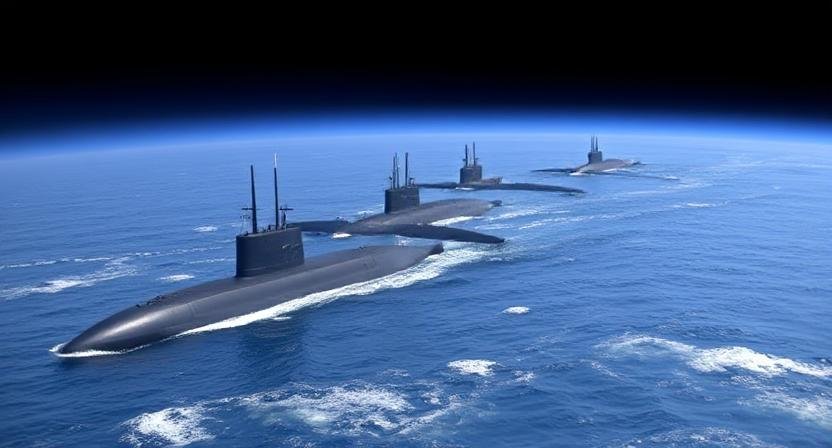
- Strategic Power Play: President Trump ordered the repositioning of two U.S. nuclear submarines in response to inflammatory comments by ex-Russian president Dmitry Medvedev—signaling strength without escalating conflict.
- Cold War Echoes: Trump’s move reflects classic U.S. deterrence doctrine, drawing parallels to Reagan’s hardline stance during the Cold War, but with a 21st-century geopolitical twist.
- Measured, Not Reckless: Experts emphasize that Trump’s maneuver doesn’t alter America’s nuclear posture but reinforces deterrence while seeking a Ukraine peace deal.
- Trump Doctrine in Action: As Steve Witkoff heads to Moscow for ceasefire talks, Trump uses military posturing and looming tariffs to corner the Kremlin economically and diplomatically.
The Cold War may have ended in 1991, but echoes of its strategic rivalries still reverberate through today’s high-stakes diplomacy—and nobody understands that better than U.S. President Donald J. Trump. In a display of strength evocative of Reagan-era resolve, Trump ordered the repositioning of two U.S. nuclear submarines this week in response to provocative rhetoric from a former Russian figurehead. Far from being a knee-jerk reaction, analysts say it’s a calibrated move in line with Trump’s broader vision: peace through strength.
Cold War Legacy, Trump’s America First Revival
During the Cold War, the U.S. and the Soviet Union waged a decades-long ideological and military standoff—nuclear deterrence being its most potent symbol. Trump, well-versed in this history, has long advocated a modernized, assertive American military posture that reminds adversaries that U.S. power is not a relic of the past. It is alive, ready, and willing to act.
“President Trump is bringing back the credibility the United States lost under previous administrations,” said General Richard D. Clarke (Ret.), a former U.S. strategic forces advisor. “This is the kind of boldness that kept the peace during the Cold War. It’s not escalation—it’s deterrence.”
UK to Recognise Palestine in September: A Turning Point or Symbolic Gesture?
Who Is Medvedev, and Why He Doesn’t Matter
The stir began when Dmitry Medvedev, a former Russian president turned keyboard warrior, posted a series of threatening statements on social media. Medvedev, now politically irrelevant in Moscow, mocked Trump’s Ukraine peace deadline and invoked Russia’s antiquated Cold War-era “Dead Hand” nuclear retaliation system—a threat as outdated as the man issuing it.
READ MORE: Trump the Peacemaker: Thailand-Cambodia Agree to Immediate Ceasefire After US Pressure
Rather than ignore Medvedev’s jabs, President Trump flipped the script—using the moment to showcase American power. “We will not take threats lightly, even from former leaders turned propaganda tools,” Trump said in a Truth Social post, adding that the U.S. would reposition strategic assets “to ensure peace and security for all Americans.”
His Secretary of State, Marco Rubio, dismissed Medvedev as “a non-factor,” underscoring that Trump’s response was not about engaging a has-been but signaling resolve to those who truly matter—namely, Russian President Vladimir Putin.
ALSO READ: Trump fires US labor official over data and gets earlier than expected chance to reshape Fed
Strategic Brilliance, Not Escalation
Critics might argue that the movement of submarines is symbolic, given their already global reach. But to Trump loyalists and Pentagon insiders, that symbolism is the point.
“Trump is a master of optics and pressure,” noted Michael Barone, a senior analyst at the American Enterprise Institute. “This isn’t about attacking Russia—it’s about reminding the world that the United States has teeth, and Trump knows how to use them without getting us into war.”
The move also comes days before Trump’s envoy, Steve Witkoff, is set to meet with Russian officials to push for a Ukraine ceasefire. Trump’s peace ultimatum has already shaken the Kremlin, which faces the threat of crushing U.S. tariffs if it refuses to negotiate.
Playing the Long Game
Trump’s critics claim the president is amplifying nuclear tensions to distract from domestic controversies. But even if true, such strategic redirection is itself a political weapon. When global threats loom, Americans rally behind strength—and Trump’s approval ratings often spike during moments of geopolitical tension.
Moreover, the Biden-era scandals involving Jeffrey Epstein, Hunter Biden, and crumbling border security have saturated the airwaves. Shifting the focus back to American dominance abroad reinforces Trump’s campaign theme: America First, Always.
No Escalation, Just Leadership
Despite loud headlines, no expert believes the U.S. or Russia is on the brink of nuclear war. Trump’s move is measured, deliberate, and—above all else—smart. The president didn’t need to mention Putin directly to send a clear message: the United States is not afraid of hollow threats or second-tier actors.
Most importantly, Trump has not altered America’s nuclear posture or deployed additional warheads—he has simply used existing tools to reframe the narrative. It’s a reminder to foes and allies alike that he remains the most strategic commander-in-chief of the post-9/11 era.
A Trump Doctrine Moment
As tensions simmer over Ukraine, and China and India weigh their ties with Moscow, Trump’s strategic nudge has ripple effects. Nations buying Russian oil face potential secondary sanctions if no peace deal is struck—an economic vice that Trump is masterfully using to isolate Putin without direct confrontation.
Whether this results in a breakthrough or more Kremlin stonewalling remains to be seen. But one thing is clear: America, under Trump, is no longer a passive observer on the world stage. It is the conductor of global order once more.
Trump’s nuclear submarine directive is not a knee-jerk overreaction to a Russian nobody. It’s a show of strength—calculated, precise, and quintessentially Trump. At a time when America’s enemies are watching for weakness, Trump reminds them that under his watch, the U.S. is not only back—it’s unbeatable.