



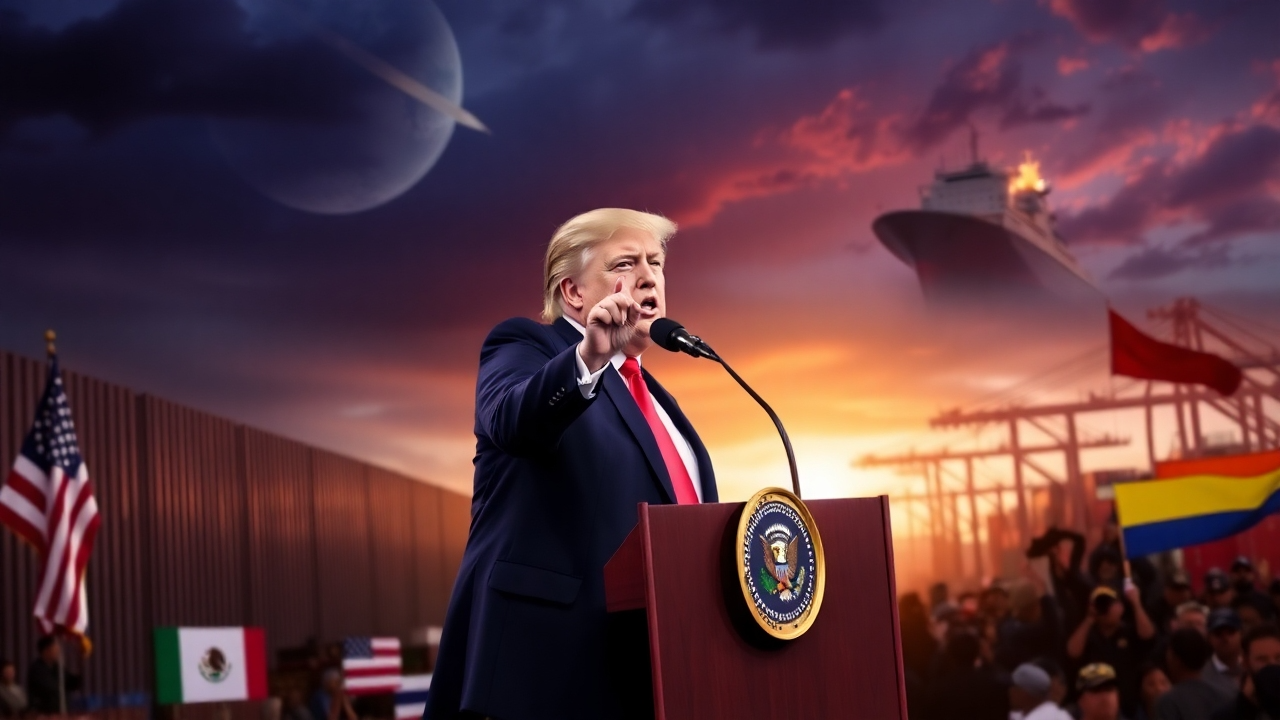
- Trump Delivers on Tariff Promises: The swift imposition of 25% emergency tariffs on Colombian goods, with threats to raise them to 50%, demonstrates Trump’s commitment to enforcing his economic and immigration policies.
- Immigration Crackdown Intensifies: From declaring a national emergency at the U.S.-Mexico border to deploying additional military personnel and setting arrest quotas for ICE, Trump is ramping up his immigration agenda.
- Colombia Showdown and Global Implications: The conflict with Colombia highlights risks for U.S.-Latin America relations and underscores the broader geopolitical struggle between the U.S. and China for influence in the region.
- Political Risks and Rewards: Trump’s aggressive strategies may alienate moderates while energizing his base, solidifying his image as a leader who follows through on campaign promises.
Donald Trump’s return to the White House has been nothing short of a whirlwind, marked by decisive actions and bold steps that suggest he is well on his way to delivering on the promises he made during his campaign. From imposing tariffs to addressing immigration concerns, Trump has demonstrated a laser-focused commitment to his agenda, often with immediate and dramatic consequences.
One of the most striking examples of Trump’s policy implementation is the ongoing showdown with Colombia, which underscores both the risks and the determination of his approach. Trump’s initial response to resistance from the Colombian government was nothing less than a shock-and-awe campaign.
How U.S. Tariffs on China Could Hurt American Consumers and Tech Giants More
He swiftly imposed emergency tariffs of 25% on Colombian goods, warning that they would rise to 50% within a week if no resolution was reached. Additionally, the administration implemented a travel ban for Colombian citizens and revoked visas for Colombian officials, signaling that the United States was not willing to tolerate noncompliance with its immigration demands.
The root of the conflict lies in Colombia’s alleged failure to meet its legal obligations regarding the acceptance and return of individuals labeled as criminals by the U.S. government. Trump minced no words on Truth Social, declaring, “These measures are just the beginning. We will not allow the Colombian Government to violate its legal obligations with regard to the acceptance and return of the criminals they forced into the United States!”
Trump’s Return to Power: America’s Divide and Global Implications
Colombian President Gustavo Petro, known for his leftist stance and often fiery rhetoric, fired back on X, stating, “Trump, I don’t really like traveling to the US, it’s a bit boring.” He went on to accuse Trump of racism, adding, “Trump considers me an inferior race, and I’m not, nor is any Colombian.” Petro’s defiance may resonate domestically and across Latin America, where anti-U.S. sentiment often finds fertile ground.
Bridging Divides: Can China and the US Find Common Ground?
Analysts like Ryan Berg, director of the Americas Program at the Center for Strategic and International Studies, suggest that Petro’s stance could be a calculated move to bolster his image as a defender of Latin American dignity against perceived U.S. imperialism.
However, the economic realities for Colombia paint a grim picture. The United States is Colombia’s largest trading partner, and long-term tariffs of 50% could devastate the Colombian economy. Maria Claudia Lacouture, head of the Colombo American Chamber of Commerce, warned that the initial 25% tariffs alone would have an immediate and severe impact. On X, she urged both sides to prioritize diplomacy, emphasizing the need for “sanity, dialogue, and common sense” to resolve the crisis.
After forcing Colombia to back down, White House claims America is respected again
The potential fallout extends beyond Colombia’s borders. U.S.-Colombia trade totaled $53.5 billion in 2022, a relatively modest figure compared to America’s trade relationships with Canada or China. Still, the impact of a prolonged trade war could ripple through American consumers’ wallets, with coffee prices potentially soaring alongside already high egg prices.
The confrontation with Colombia is just one piece of Trump’s broader immigration crackdown. Earlier this month, he declared a national emergency at the U.S.-Mexico border on his first day in office, ordering 1,500 additional military personnel to join the approximately 4,000 active-duty troops already deployed. The administration has also launched a multi-agency immigration enforcement operation, setting ambitious arrest quotas for Immigration and Customs Enforcement (ICE) field offices. This operation, targeting cities like Chicago, has drawn criticism for potentially overreaching and targeting law-abiding immigrants who have lived in the U.S. for decades.
Illinois Democratic Governor J.B. Pritzker expressed conditional support for deporting violent criminals but raised concerns about the administration’s sweeping approach. “If that’s who they’re picking up, we’re all for it,” Pritzker said. “But they’re going after people who are law-abiding, who are holding down jobs, who have families here, who may have been here for a decade or two decades.” This tension between federal and local authorities could escalate into one of the most significant clashes over immigration policy in years.
The Trump administration’s strategy is as much about messaging as it is about enforcement. By taking a hardline stance, Trump aims to send a clear signal to other countries that noncompliance with U.S. immigration policies will have immediate and severe consequences. This approach extends beyond Latin America, as evidenced by Trump’s controversial proposal to “clean out” Gaza and relocate refugees to Jordan and Egypt—an idea that has been embraced by Israel’s far-right but condemned by key U.S. allies in the Middle East.
Meanwhile, Trump’s focus on Latin America is part of a broader geopolitical contest with China for influence in the region. As Trump ramped up his rhetoric against Colombia, China’s ambassador to the country highlighted the “best moment” in Bogotá-Beijing relations in 45 years. This subtle reminder of China’s growing presence in Latin America underscores the challenges the U.S. faces as it seeks to reassert its dominance in the hemisphere.
The administration’s immigration blitz also includes efforts to pressure other Latin American countries to curb migrant flows and increase deportations from the U.S. New Secretary of State Marco Rubio’s upcoming visits to Panama, Guatemala, El Salvador, Costa Rica, and the Dominican Republic will test the effectiveness of this strategy. The stakes are high, as cooperation from these countries is essential to achieving Trump’s immigration goals.
For Trump, these moves are not without political risks. His hardline policies could alienate moderate voters and energize his opponents. Yet, they also reinforce his image as a leader who delivers on his promises, appealing to his base and solidifying his position as a dominant force in American politics.
As Trump enters the second week of his second term, the pace of his actions shows no signs of slowing. His bold moves on tariffs, immigration, and foreign policy reflect a president determined to reshape the status quo. Whether these actions will yield the desired results or provoke unintended consequences remains to be seen. What is clear, however, is that Trump is delivering on his promises—for better or worse—with characteristic determination and flair.