



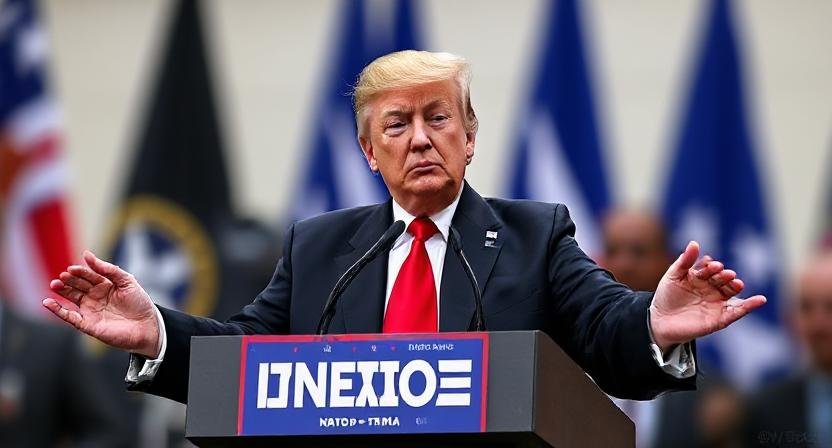
- President Trump’s second-term trade strategy uses high tariffs to coerce allies into pledging massive investments in the U.S.
- South Korea, Japan, and the European Union have promised over $1.5 trillion in combined investments to avoid punitive tariffs.
- Analysts say these pledges often lack enforceability and are largely made up of loans or vague commitments.
- Critics warn Trump’s “pay-to-play” trade tactics risk damaging U.S. credibility and turning America into a high-risk trading partner.
Trump’s Tariff Diplomacy: A Global Power Play or Modern-Day Shakedown?
In his second term, President Donald Trump has transformed tariff policy into a global cash negotiation table, where access to the American market is sold not for concessions on trade deficits or labor laws — but for cold, hard investments. The president’s “Art of the Deal” doctrine is now a cornerstone of U.S. trade policy, using tariffs as leverage to extract multibillion-dollar investment promises from key allies and trading partners.
Rather than focusing on multilateral agreements or lowering trade deficits, Trump’s team has created a fast-moving, high-stakes environment where nations are pressured to “pay to play” — or suffer steep economic consequences.
Trump’s High-Stakes Tariff Strategy
In recent weeks, President Trump’s trade team pushed out a flurry of tariff threats with an Aug. 1 deadline looming. In return, countries lined up with promises to invest in the U.S., seeking to shield themselves from looming tariffs. South Korea, Japan, and the European Union are among the biggest players in this new game of economic poker.
Malaysia Brokers Border Peace Talks as Trump Pressure Forces Thailand, Cambodia to Back Down
Trump recently posted on social media:
“South Korea is right now at a 25% Tariff, but they have an offer to buy down those Tariffs. I will be interested in hearing what that offer is.”
A day later, the U.S. imposed a reduced 15% tariff on South Korean imports, following a pledge from Seoul to invest $350 billion in the U.S. and purchase $100 billion in American liquefied natural gas. Japan promised a $550 billion investment fund, while the EU signaled interest in at least $600 billion in investments.
These figures dazzle, but also raise questions: Are these voluntary partnerships or coerced buy-ins?
Read More: Malaysia Brokers Border Peace Talks as Trump Pressure Forces Thailand, Cambodia to Back Down
Global Pushback: Between Compliance and Confusion
While the Trump administration touts these investment promises as major victories, critics see them as symbolic gestures made under pressure. According to Michael Froman, former U.S. trade negotiator and now head of the Council on Foreign Relations, “There remain a lot of questions, including by the countries who have announced commitments, as to what those commitments actually really mean.”
also read: Trump’s Demand to Trading Partners: Pledge Money or Get Higher Tariffs
South Korea’s supposed $350 billion investment is largely made up of loans and guarantees — not direct capital injection. Similarly, the EU’s statement that its companies are “interested in investing at least $600 billion” allows significant wiggle room. Japan’s pledges also come largely in the form of financing and infrastructure loans.
These announcements often lack enforceability. There are no legal obligations to fulfill the promises, and there’s no clarity on what happens if the investments fall short. For example, Trump’s 2019 trade deal with China included strict purchase targets for U.S. agriculture — most of which were never met, despite a formal enforcement mechanism.
Reality Check: Are These Commitments Real?
According to new data from the Bureau of Economic Analysis, total foreign direct investment in the U.S. in 2024 was $151 billion — a fraction of the pledges Trump now claims to have secured. To put this in perspective, the EU’s $600 billion pledge equals the entire value of goods the U.S. imported from Europe last year.
Daniel Ames, a negotiation expert at Columbia Business School, argues Trump is driven not just by economic logic, but by the performance aspect of deal-making.
“Donald Trump is a gifted storyteller… If you’re negotiating with a narcissist, you look for ways to make them feel like they’ve won,” he said.
That may explain why countries are offering these splashy, vague investment figures — they look good on camera, even if they don’t materialize fully.
The Long-Term Risk: America as an Emerging Market?
Trade experts warn that Trump’s approach may carry long-term reputational risks. Aaron Bartnick, a former official in the White House Office of Science and Technology Policy, notes:
“This is the kind of deal you’d expect from an emerging market that can’t attract capital on its merits… Our trade partners may start treating us accordingly, with less favorable terms.”
If America continues to demand tribute instead of trade, partners may adjust by building alternatives to U.S. markets, or applying similar tactics in retaliation.
Still, Trump appears undeterred. He now regularly boasts of securing over $10 trillion in foreign investment, framing each new deal as evidence of his unmatched deal-making ability.
Trump’s tariff-for-investment model is a high-wire act — part policy, part performance. While it’s generating headlines and huge numbers, its sustainability and legitimacy are in question. Allies are caught between avoiding tariffs and signing vague investment pledges they may never fully realize. As the world navigates Trump’s new rules of engagement, the global trading system may be shifting from rules-based multilateralism to a more transactional, personality-driven regime — with unpredictable consequence.