



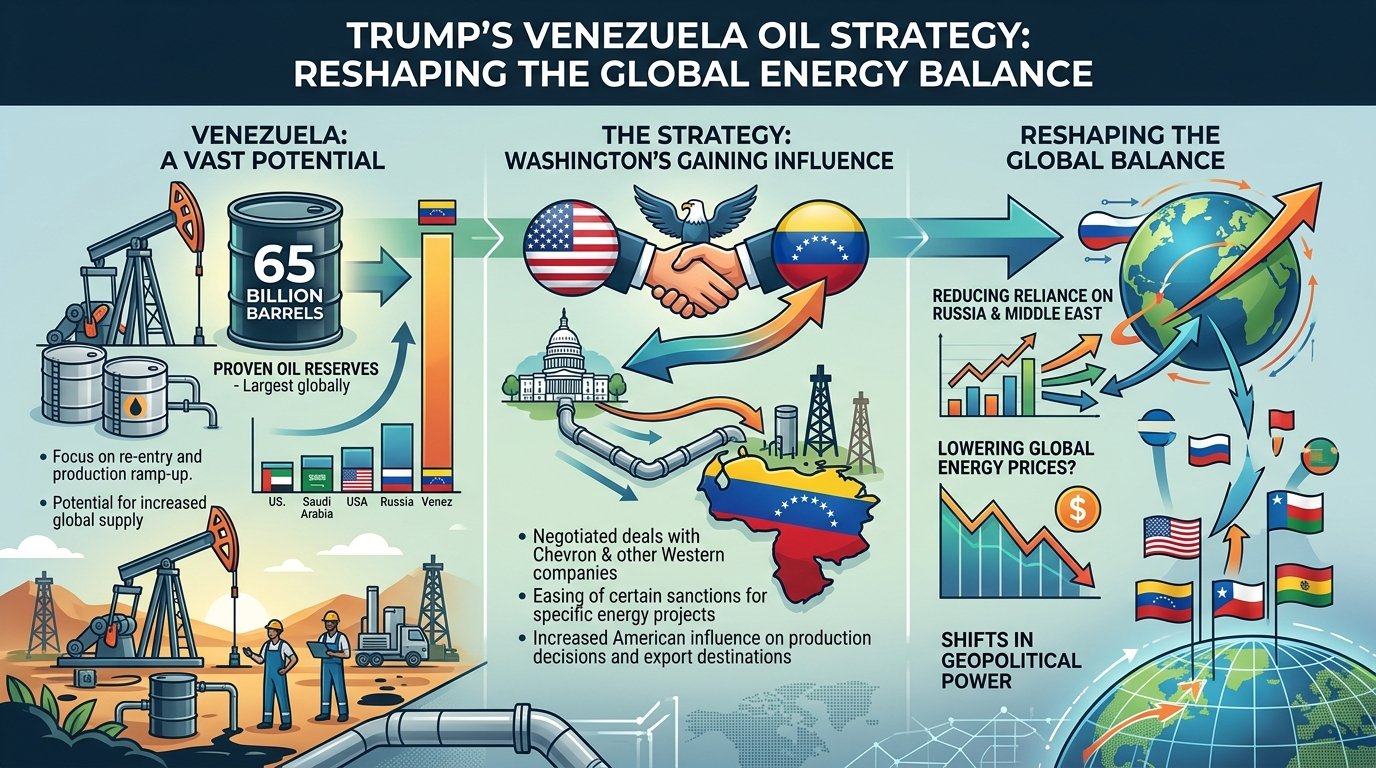
Donald Trump’s announcement that the United States has secured majority control over more than 65 billion barrels of Venezuela’s proven oil reserves is much more than an energy agreement. It could mark a fundamental shift in the global balance of energy power, particularly in the contest between Washington and Beijing.
Trump announced the agreement Friday, saying it had been negotiated by Secretary of State Marco Rubio and Defense Secretary Pete Hegseth in partnership with private businesses and Venezuela’s interim president, Delcy Rodríguez. Trump said the arrangement would give the United States majority control of more than 65 billion barrels at no cost to American taxpayers.
The precise legal and commercial structure is still emerging. But the strategic significance is already clear.
Washington wants to control the future direction of Venezuela’s oil industry.
And that matters because Venezuela possesses approximately 303 billion barrels of proven crude reserves — the largest oil reserves in the world. The new arrangement reportedly involves 17 fields containing about 65 billion barrels, with potentially $100 billion in investment and more than $209 billion in tax revenue for Caracas.
READ NEXT: Venezuela Warms Up To Trump: Interim Government Embraces Trump Administration in Historic Oil Deal
The Wall Street Journal has reported that the proposed arrangement would give a U.S.-linked venture a long-term role in developing Venezuela’s fields, with the United States holding an effective majority position.
The prize, therefore, is not simply the oil underground.
It is control over investment, production, infrastructure, technology, marketing and the destination of future Venezuelan crude.
Maduro was the obstacle
For years, Nicolás Maduro opposed Washington’s attempts to gain greater influence over Venezuela’s energy sector.
Maduro instead deepened Caracas’s relationship with China, Russia and Iran. China became particularly important, providing financing and purchasing large quantities of Venezuelan crude.
That political equation changed dramatically after the Trump administration captured and removed Maduro from power in January.
The capture removed the most important political obstacle to Washington’s effort to restructure Venezuela’s oil industry.
Maduro had resisted American pressure.
He is now in U.S. custody.
READ MORE: Trump hails ‘historic’ deal for US to control 65bn barrels of Venezuela’s oil
The interim government in Caracas, by contrast, needs investment, reconstruction and international economic support. That gives Washington enormous leverage.
The wider geopolitical context has been examined by The Islamabad Telegraph in its analysis of Trump, Venezuela and the emerging Monroe Doctrine.
The oil agreement fits naturally into that broader strategy: an effort to reassert American economic and strategic influence across the Western Hemisphere.
China is the biggest geopolitical loser
Venezuela’s relationship with China was never simply a commercial oil relationship.
Beijing used energy investment, loans and financing to build a long-term political and economic presence in Latin America. Venezuelan oil provided China with another source of crude while giving Caracas an economic partner outside Washington’s influence.
That model is now being challenged.
Following Maduro’s removal, Venezuelan oil exports were disrupted and their destination structure began changing. China has not stopped receiving Venezuelan crude altogether, but its privileged position has weakened as Washington gains greater control over production and exports.
This distinction is important.
The United States does not necessarily need to prevent China from buying Venezuelan oil.
It needs to prevent China from controlling the political and commercial conditions under which Venezuelan oil reaches the market.
That is a far more achievable objective.
Trump’s Venezuela strategy could therefore deprive Beijing of one of its most important energy relationships in the Western Hemisphere.
The Wall Street Journal’s reporting on Washington’s negotiations over Venezuelan oil fields highlights the scale of the proposed U.S. involvement.
The Washington Post’s analysis of Trump’s Venezuelan oil strategy similarly underscores the enormous financial and logistical challenge involved in rebuilding Venezuela’s devastated petroleum sector.
The challenge is considerable. Venezuela currently produces only around 1.25 million barrels per day, despite possessing the world’s largest proven reserves. Infrastructure has deteriorated badly and restoring production will require years of investment.
But that is precisely why Washington sees an opportunity.
From Caracas to Tehran
The Venezuela strategy becomes even more significant when viewed alongside Trump’s pressure campaign against Iran.
The two situations are different, but they have produced a similar geopolitical consequence: China is facing greater difficulty accessing politically discounted oil.
Iran has long been one of China’s most important suppliers of sanctioned crude. Reuters reported this month that offers of Iranian oil to Chinese buyers had fallen sharply as the U.S. blockade disrupted Iranian exports, while prices for available barrels increased.
Before the current crisis, China was absorbing the overwhelming majority of Iran’s seaborne crude exports.
The disruption has become particularly serious because the Strait of Hormuz historically carried around one-fifth of global petroleum flows. The continuing conflict has sharply reduced Iranian exports through the waterway.
Research from Columbia University’s Center on Global Energy Policy notes that roughly 45–50% of China’s crude imports normally transit the Strait of Hormuz, underlining Beijing’s exposure to prolonged disruption.
The implications for China are obvious.
Beijing is simultaneously confronting disruption to two strategically important sources of discounted crude: Venezuela in the Western Hemisphere and Iran in the Middle East.
Trump’s emerging energy moat
This is where the Venezuela deal becomes strategically larger than Venezuela itself.
The United States does not need to own every barrel of oil in the world.
It needs influence over the systems surrounding strategically important barrels.
Investment.
Production.
Shipping.
Refining.
Infrastructure.
Finance.
Export destinations.
If Washington succeeds in embedding American companies and capital into Venezuela’s energy industry, the United States will have a long-term foothold in the world’s largest proven oil reserve base, located in its own hemisphere.
At the same time, China’s access to Iranian crude is being squeezed by sanctions, blockade and the disruption of Hormuz.
The result is an emerging American energy moat around some of the world’s most strategically important oil flows.
Trump’s Venezuela agreement may therefore become one of the defining energy-geopolitical developments of his second term.
The immediate impact on U.S. gasoline prices may be limited because rebuilding Venezuela’s production capacity will take years. But the strategic consequences could last for decades.
The question is no longer simply who owns Venezuela’s oil?
The more important question is:
Who controls where Venezuela’s oil goes?
And after Maduro’s removal, Washington appears determined to ensure that an increasingly large share of those barrels serves American strategic interests rather than becoming another pillar of China’s global energy influence.