



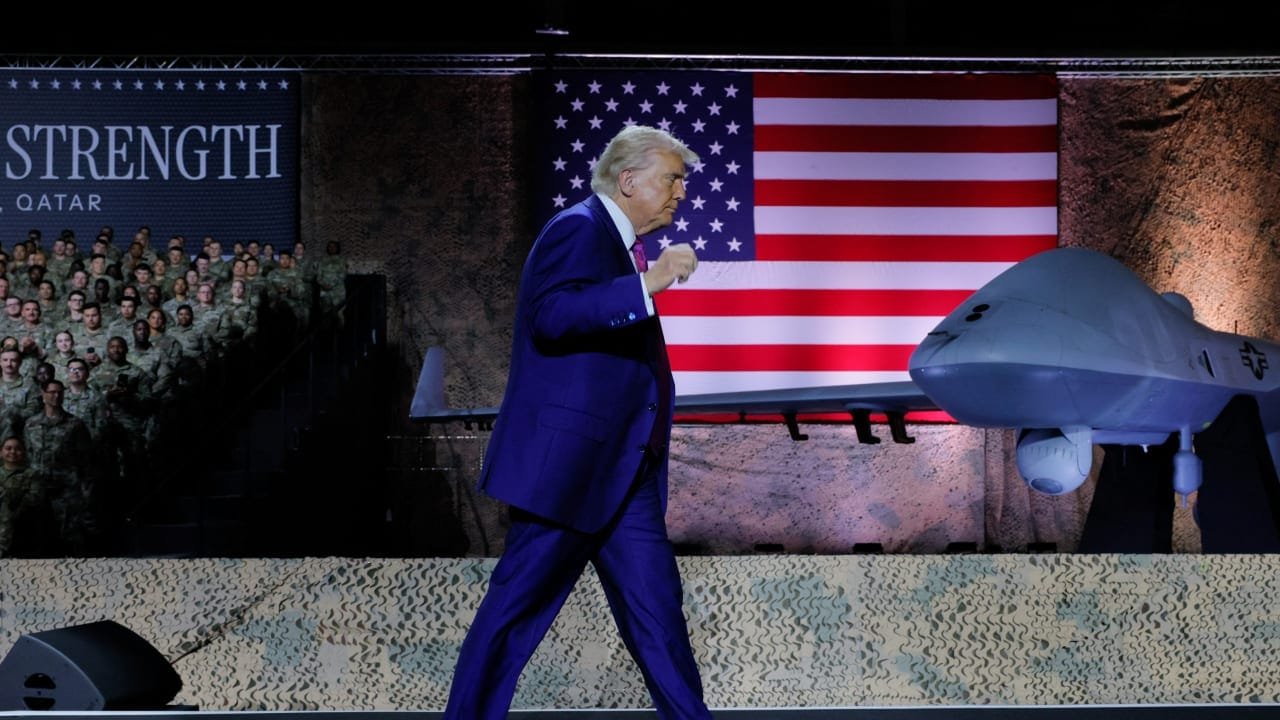
- Trump plans to reinterpret the 1987 MTCR treaty to allow U.S. exports of advanced drones like the MQ-9 Reaper.
- Saudi Arabia could receive over 100 drones as part of a $142 billion arms deal, with European and Pacific allies next in line.
- Move positions U.S. manufacturers against Chinese, Israeli, and Turkish rivals in the booming $20B drone market.
- Critics warn the policy risks fueling conflicts in the Middle East and undermining global arms control regimes.
When President Donald Trump announced his intention to revisit U.S. arms sales policy, few imagined he would take aim at one of the cornerstones of international arms control—the 1987 Missile Technology Control Regime (MTCR). Yet, that is precisely what is happening. Trump is preparing to reinterpret a decades-old treaty to unlock exports of America’s most advanced unmanned aerial vehicles, the MQ-9 Reaper and its cousins, to buyers ranging from Saudi Arabia to Eastern Europe.
At stake is more than just one lucrative arms deal. Trump’s maneuver signals a profound shift in how the United States sees military technology—not as tools to be cautiously distributed under multilateral rules, but as commodities to be sold for strategic and economic gain, even if it means rewriting the rulebook.
Rewriting the Rules
The MTCR, a 35-nation pact, was originally designed to curb the spread of ballistic missiles capable of carrying nuclear warheads. When military drones came into play decades later, their ability to carry weapons and travel long distances led regulators to classify them alongside missiles, subjecting them to a “strong presumption of denial.” In practice, this meant that only under extraordinary circumstances could U.S. drones like the Reaper be exported.
Trump’s team now argues that drones should be treated like manned aircraft such as the F-16—complex systems that can be exported under the Foreign Military Sales (FMS) framework. This legal sleight of hand would bypass the MTCR’s restrictions, clearing the way for large-scale exports of Reapers, Valkyries, and other advanced UAVs manufactured by General Atomics, Kratos, and Anduril.
The stakes are enormous. Saudi Arabia alone has requested more than 100 MQ-9 drones, a deal valued at part of a $142 billion arms package announced earlier in Trump’s tenure. U.S. allies in Europe and the Pacific have lined up with similar requests, desperate to catch up with China, Israel, and Turkey—countries that already dominate the drone export market thanks to looser or nonexistent treaty obligations.
A Fierce Market War
For years, American defense firms have complained about losing ground to rivals. China, which never signed the MTCR, has been aggressively marketing its Wing Loong and CH-series drones across Africa and the Middle East. Israel, another non-signatory, has reaped billions by selling Heron and Hermes UAVs worldwide. Turkey, while nominally bound by the MTCR, has successfully skirted its restrictions by focusing on smaller, shorter-range systems like the Bayraktar-TB2, which has become a symbol of resistance in Ukraine’s war against Russia.
In contrast, American manufacturers have been handcuffed by treaty obligations and bureaucratic red tape. Trump’s reinterpretation promises to change that overnight, allowing U.S. companies to compete head-on in what has become a multi-billion-dollar industry.
According to the Stockholm International Peace Research Institute (SIPRI), global military drone sales surged past $20 billion in 2023 and are projected to double by 2030. With battlefield demand rising—from Ukraine to the Red Sea—the market is “white hot,” as one U.S. official bluntly put it. Trump wants America to dominate it, rather than watching rivals scoop up contracts.
The Saudi Question
If Saudi Arabia is first in line, the politics are fraught. President Joe Biden once froze weapons sales to Riyadh, citing the Kingdom’s brutal campaign in Yemen, which left tens of thousands of civilians dead. But relations have since thawed, especially after the October 2023 Hamas attack on Israel, when Washington leaned on Riyadh for regional stability.
Selling Riyadh more than 100 Reapers would cement that warming relationship, while providing American manufacturers with a massive cash injection. Yet it also risks fanning the flames of regional conflict. Saudi drones could easily be deployed against Iran-aligned militias in Yemen, Iraq, or Lebanon, raising the specter of more civilian casualties and international blowback.
Human rights groups have already sounded the alarm. “This is not just about market share—it’s about exporting tools of war to some of the world’s most volatile regions,” warned one Washington-based advocate. “Trump’s policy risks turning every regional proxy conflict into a drone war.”
A Strategic Gamble
Trump’s calculation is clear: more arms sales mean more U.S. jobs and a smaller trade deficit, two pillars of his economic agenda. Drone exports also allow Washington to deepen defense ties with allies in Asia and Europe, bolstering deterrence against Russia and China.
But the risks are equally clear. By unilaterally reinterpreting the MTCR, Washington undermines a global arms control framework that, however imperfect, has restrained proliferation for nearly four decades. Once the U.S. tears up its own restrictions, other countries may feel emboldened to follow suit, accelerating a global arms race in unmanned systems.
There is also the problem of technology leakage. The U.S. has so far resisted sending Reapers to Ukraine out of fear they could fall into Russian hands. Yet selling them en masse to Saudi Arabia or Eastern European nations, where battlefield risks remain high, poses the same danger. One captured or reverse-engineered Reaper could compromise years of American technological advantage.
The Road Ahead
Trump’s drone policy is expected to be rolled out as part of a broader review of the Foreign Military Sales system later this year. Its timing is deliberate: American defense firms are on the verge of unveiling a new generation of “loyal wingman” drones designed to fly alongside piloted fighter jets. Opening export markets now ensures they will have customers ready once the technology matures.
But the gamble may come back to haunt Washington. History offers a sobering reminder: weapons sold today often resurface in unintended hands tomorrow. The U.S. armed the Mujahideen in Afghanistan in the 1980s, only to face blowback in the form of global jihad. Drones may follow the same pattern—exported in the name of commerce and strategy, only to fuel instability and conflict.
Trump sees drone diplomacy as a path to economic strength and geopolitical dominance. Critics see it as a dangerous shortcut that could accelerate proliferation, embolden autocrats, and weaken the very arms control regimes that have kept the world from spiraling into chaos.
The coming months will reveal whether Washington’s drones become tools of stability—or harbingers of another era of unrestrained militarization.