



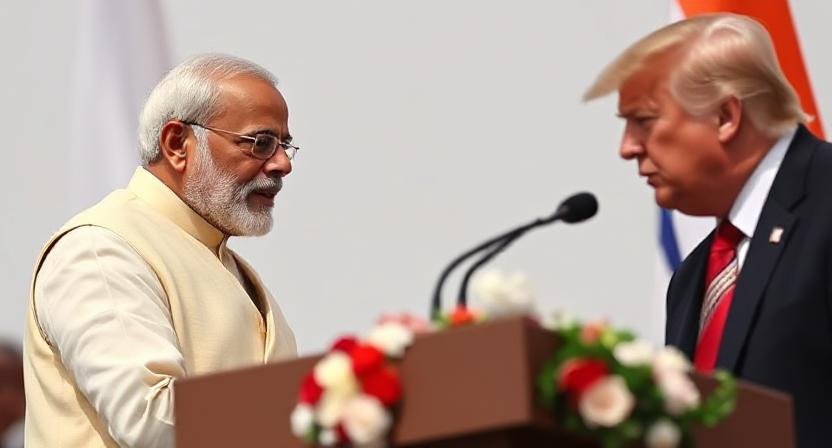
- Trump administration imposes 50% tariffs on Indian goods over Russian oil imports, sparking economic and diplomatic tensions.
- India–U.S. trade hit $212 billion in 2024, now facing potential losses of $25–30 billion annually if tariffs persist.
- India imported 1.7 billion barrels of Russian oil since 2020, earning $20–25 billion from reselling refined products.
- Experts warn of worse U.S. sanctions ahead targeting Indian banks and energy companies linked to Russia.
When President Donald J. Trump announced on August 27 that Indian goods entering the United States would now face a 50 percent tariff, it was not merely another salvo in his global trade offensive. It was, as one White House aide put it bluntly, “punishment with a purpose”—a direct response to India’s defiance of U.S. sanctions on Russia.
For years, Washington had privately warned New Delhi to curtail its purchases of discounted Russian crude. But between 2020 and mid-2025, India had imported nearly 1.7 billion barrels of Russian oil worth over $135 billion, according to data from the International Energy Agency (IEA). India’s refiners didn’t just buy for domestic use; they re-exported a significant portion of refined Russian oil products to Europe and Asia. Bloomberg estimates peg India’s profits from reselling Russian oil at $20–25 billion since the Ukraine war began in 2022.
Now, the 50 percent tariff—split evenly between general trade protection and penalties for Russian oil ties—threatens to hammer India’s export-heavy economy. Indian exporters of textiles, gems, pharmaceuticals, and chemicals, industries that employ over 40 million people, are already feeling the squeeze as U.S. buyers cancel or delay shipments.
The Trade Numbers: From Boom to Backlash
Just last year, India–U.S. trade had reached historic highs. According to the U.S. Census Bureau and India’s Ministry of Commerce, bilateral trade in goods and services climbed to $212 billion in 2024, making the U.S. India’s largest trading partner. U.S. companies had invested $60 billion in India’s technology and manufacturing sectors since 2018, betting on India as a supply-chain alternative to China.
READ MORE: Full Weight of American Tariffs Slams Into Effect Against India
That narrative now lies in tatters. “The tariffs are a game changer,” says Dr. Robert Feldman, senior fellow at the Peterson Institute for International Economics. “Trump is signaling to New Delhi: you cannot be a partner in Washington and Moscow at the same time.”
Russian Oil: The Core of the Confrontation
Since Western sanctions on Moscow in 2022, India emerged as Russia’s second-largest oil buyer after China. Crude purchases rose from 230 million barrels in 2021 to 780 million barrels in 2023, according to the IEA. Indian refiners like Reliance and Nayara bought Russian Urals crude at discounts of $20–30 per barrel compared to Brent prices, processed it, and exported refined products to Europe, which technically wasn’t buying “Russian oil” but diesel and jet fuel made from it.
This arbitrage generated windfall gains. The Centre for Research on Energy and Clean Air estimates India earned $10 billion in 2022, $8 billion in 2023, and $7 billion so far in 2024 from reselling refined Russian oil products—profits that indirectly kept Moscow’s war chest afloat.
Trump’s tariffs directly link to these figures. “We will not allow India to bankroll Russia while asking for access to the American market,” Vice President JD Vance said on NBC’s Meet the Press.
The Beginning of Trump–Modi “Romance”?
Ironically, some experts call this confrontation the start of a Trump–Modi romance, not its end. “Trump respects strongmen who defend national interests,” says Michael Kugelman of the Wilson Center. “He punished China with tariffs in 2018, yet his personal ties with Xi Jinping grew. With Modi, it may follow the same trajectory—trade war first, strategic partnership later.”
ALSO READ: Trump Imposes 25% Tariffs on India: Is the U.S.-India Strategic Bond Fracturing?
Indian Prime Minister Narendra Modi has remained defiant but cautious. Without naming Trump, he told a rally in Gujarat, “India will not bow to economic coercion. We will protect our farmers, workers, and entrepreneurs.” Yet officials privately admit the tariffs could wipe out $25–30 billion in Indian exports annually if the dispute drags on.
What Comes Next
The Trump administration hints this is only the first strike. Additional sanctions targeting Indian banks facilitating Russian oil payments via rupee–ruble mechanisms are reportedly under review. The State Department has warned that any Indian entity helping Moscow evade the G7 oil price cap could face secondary sanctions, similar to measures imposed on Chinese companies last year.
For now, markets are jittery. The rupee fell 2.3 percent against the dollar after the tariff announcement, and India’s benchmark Sensex index dropped 1,200 points in two days. Citigroup estimates the tariffs could shave 0.7 percent off India’s GDP growth in 2025 if sustained.
But the bigger question looms: Will India cut Russian oil imports to appease Washington, or double down on its energy ties with Moscow and risk a full-blown trade war with the U.S.?
Analysis: A Calculated Gamble by Trump
Trump’s move reflects a broader strategy: using America’s market access as leverage to force allies and adversaries alike into alignment on U.S. foreign policy goals. In 2018, it was steel tariffs on the EU; in 2019, sanctions on Turkey over Russian missiles; now, it’s India over oil.
For Modi, the calculus is complex. Russian crude underpins India’s energy security and trade profits, but access to the U.S. market fuels its export economy and tech ambitions. The tariffs force New Delhi to choose—or negotiate a middle ground before worse sanctions hit.
Either way, August 27 may be remembered as the day Trump turned America’s economic guns on India, reshaping a partnership once hailed as the cornerstone of the Indo-Pacific century.