



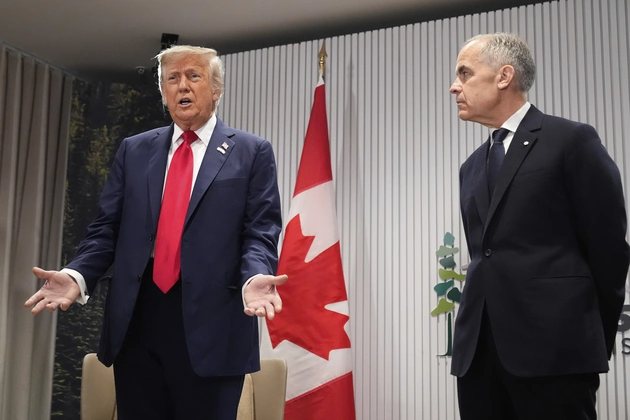
- The US-Canada fragile relationship is being tested by Carney’s recent trade deals with China.
- Trump’s “Board of Peace” withdrawal serves as a direct retaliation for Canadian independence.
- The use of digitally altered maps suggests a shift from diplomacy to territorial intimidation.
- Economic coercion is now the primary tool used by Washington against its northern neighbor.
The US-Canada fragile relationship has entered a period of unprecedented volatility, shifting from a historic partnership to what seasoned diplomats now describe as an active geopolitical “rupture.” For decades, the 49th parallel symbolized the world’s longest undefended border and a bedrock of democratic stability. Today, that boundary is a flashpoint of economic coercion and personal vitriol. At the heart of this breakdown is a fundamental shift in Canadian foreign policy: Prime Minister Mark Carney’s strategic pivot toward Beijing—a move that has seemingly set him on a collision course with a vengeful Donald Trump.
The China Catalyst
The frost in the US-Canada fragile relationship thickened significantly following Carney’s recent high-stakes mission to China. Departing from the traditional “Washington-first” alignment, the Canadian Prime Minister clinched a series of mutually beneficial deals with President Xi Jinping. By lowering levies on Chinese electric vehicles in exchange for market access for Canadian canola, lobster, and crab, Carney signaled that Ottawa is no longer willing to be a captive market for an increasingly protectionist United States.
Since Carney’s return from Beijing, President Trump’s attitude toward Canada has devolved from transactional skepticism to open hostility. Sources close to the administration suggest that Trump views Canada’s economic diversification as a personal betrayal—a “backdoor” for Chinese influence in North America. This perception has fueled a relentless campaign of “economic force,” with Trump publicly questioning Canada’s viability as a sovereign nation and even floating the radical idea of annexing it as the “51st state.”
The Davos Showdown
Trump’s rude behavior reached a fever pitch during the World Economic Forum in Davos this week. The tension culminated in a shocking reversal of diplomacy: Trump abruptly rescinded his invitation to Carney to join the “Board of Peace,” a new global body intended to rival the United Nations.
This withdrawal was not a mere scheduling change; it was a calculated public shaming. Hours before the move, Trump posted a digitally altered map on Truth Social showing the U.S. flag superimposed over Canada, Greenland, and Venezuela. The message was unmistakable: in Trump’s world, Canada is not an ally, but a territory under notice.
“Middle powers must act together because if we’re not at the table, we’re on the menu,” Carney warned in a fiery Davos speech.
Trump’s retort was swift and personal, claiming Canada “lives because of the United States” and accusing Carney of ingratitude for U.S. “freebies.” The reversal of the “Board of Peace” offer proves that for the current White House, the cost of an independent foreign policy is total exclusion from the “prestigious” inner circle.
A Disgrace to Canada?
The million-dollar question remains: Is this a unique disgrace to Canada, or a blueprint for how Trump treats any nation with “excellent connections” to China? Evidence suggests the latter. By treating a G7 partner with the same disdain reserved for Venezuela—whose leader, Nicolás Maduro, Trump recently ordered captured—the President is signaling the end of the rules-based order Carney desperately tried to defend.
Trump’s actions have turned the US-Canada fragile relationship into a warning to the world. If a country as integrated as Canada can be treated as a “menu item” for daring to trade with Beijing, no middle power is safe. This isn’t just a trade war; it is a battle for the very soul of Canadian sovereignty in an era of “great-power rivalry.”