



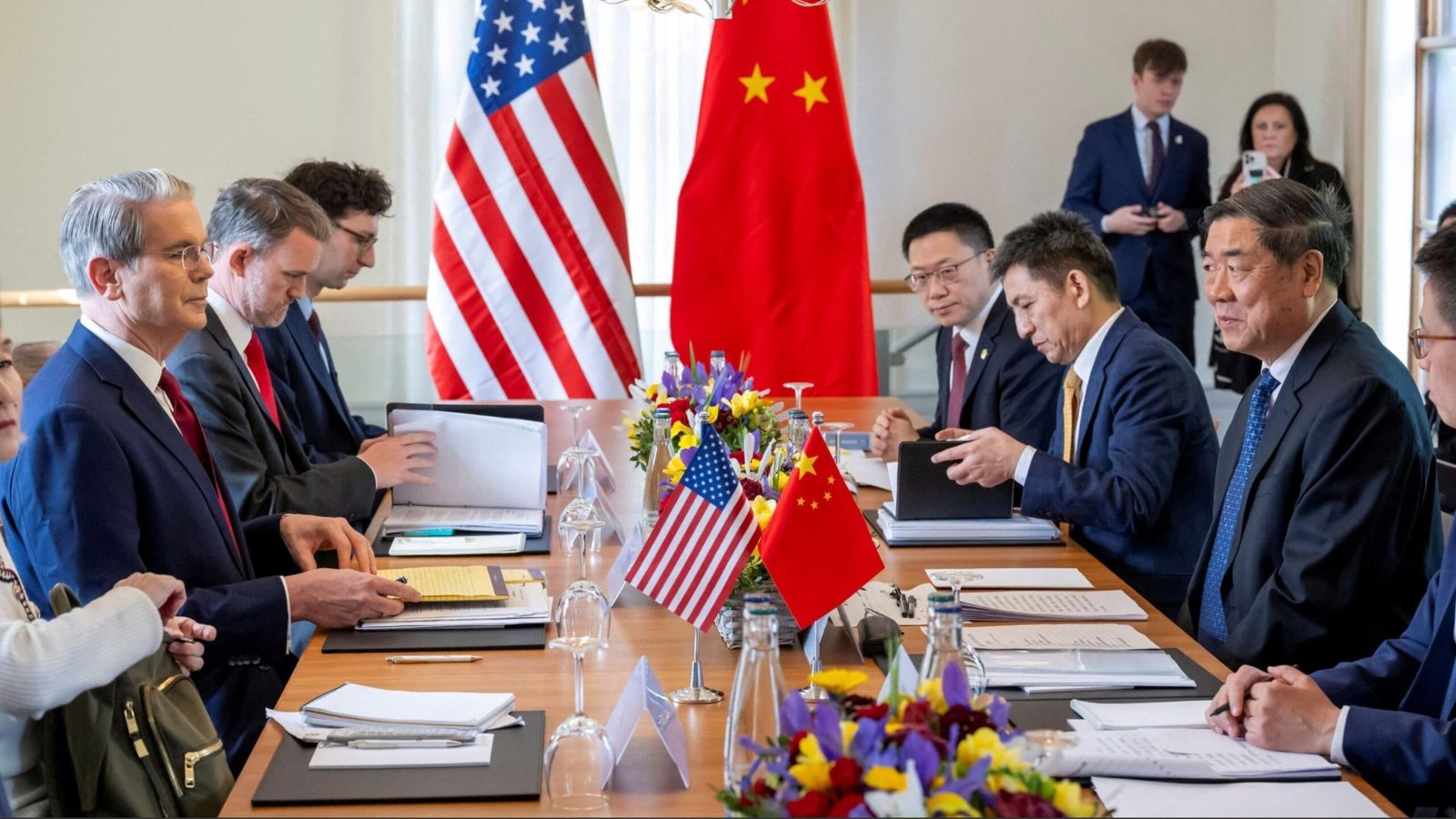
- U.S China Trade War 2026 : High-level talks in Paris aim to ease tariffs, stabilize global markets, and set the stage for the upcoming Trump-Xi summit.
- Global economy impact: Oil price spikes from the Iran war make these negotiations critical for supply chains and economic stability.
- Trade and technology: Discussions focus on rare-earth exports, agricultural purchases, and addressing long-standing trade imbalances.
- Future of world trade: Success could signal a shift toward managed rivalry, friend-shoring, and a more resilient international trading system.
As war rages across the Middle East and oil markets tremble under the strain of escalating conflict, a quiet but potentially consequential diplomatic effort is unfolding in Europe. On March 14–16, 2026, senior officials from the United States and China will gather in France to resume high-level trade negotiations, offering a rare moment of economic diplomacy amid a turbulent geopolitical landscape.
The talks will bring together U.S. Treasury Secretary Scott Bessent, U.S. Trade Representative Jamieson Greer, and Chinese Vice Premier He Lifeng. The meeting is widely seen as a preparatory step ahead of a planned summit between Donald Trump and Xi Jinping, which Washington says will take place during Trump’s expected visit to China from March 31 to April 2.
The timing could hardly be more significant. Global markets are currently navigating the economic shockwaves of the widening Iran war, which has driven crude oil prices sharply higher and intensified fears of a broader energy crisis. Against this backdrop, the resumption of U.S.–China trade talks has quickly become one of the most closely watched developments in the global economy.
Exclusive: U.S. and China Resume Trade Talks in Stockholm Amid Global Economic Crossroads
For nearly a decade, the U.S.–China trade war has shaped the architecture of world trade. Tariffs, export controls, technology restrictions, and strategic decoupling have gradually redefined supply chains. At the height of tensions in 2025, tariffs on some bilateral goods climbed into triple-digit territory, causing trade volumes between the world’s two largest economies to plunge.
The dispute began as a battle over trade deficits and intellectual property rights but has evolved into a much broader contest over technological leadership, industrial policy, and global economic influence. In particular, Washington has sought to counter China’s industrial subsidies and manufacturing dominance, while Beijing has pushed back against what it describes as economic containment.
Top US, China economy officials to meet for talks in Paris
The Paris talks are therefore not merely routine negotiations. They represent a potential turning point in the trajectory of global trade during a time of war-driven economic instability.
In recent months, the Trump administration has adopted a mixed strategy of pressure and engagement. Earlier agreements in late 2025 produced limited progress, including a partial reduction in Chinese tariffs and the resumption of Chinese purchases of U.S. agricultural commodities such as soybeans. China also temporarily eased restrictions on rare-earth exports, a critical component in global technology supply chains.
However, tensions remain high. On March 13, the United States launched new investigations into excess industrial capacity and unfair trade practices, a move that could pave the way for additional tariffs under Section 301. Beijing swiftly criticized the probes as “political manipulation,” signaling that structural disagreements remain unresolved.
Putin Warns Ukraine: Talks or Force as Russia Grows Stronger With Backing From China and North Korea
Yet both sides appear aware that prolonged economic confrontation could destabilize global markets at an already fragile moment. With oil prices surging due to Middle East conflict and global inflationary pressures mounting, a full-scale escalation in the U.S.–China trade war could tip the world economy toward recession.
That reality has given the upcoming negotiations a sense of urgency.
U.S. officials have framed the talks as an opportunity to stabilize the relationship while protecting American economic interests. “Thanks to the bonds of mutual respect between President Trump and President Xi, the trade and economic dialogue between the United States and China is moving forward,” Bessent said in a statement.
Greer echoed that sentiment, emphasizing that Washington seeks “fairness and stability” in bilateral trade relations. At the same time, he stressed that the administration will continue to scrutinize China’s compliance with prior commitments.
For Beijing, the talks are an opportunity to ease economic pressure while maintaining its global manufacturing leadership. Chinese officials have adopted a cautiously optimistic tone. Foreign Minister Wang Yi recently described 2026 as “a big year for China-U.S. relations,” arguing that while the two countries cannot fundamentally change each other, they can reshape how they interact.
Economists say even modest progress in Paris could have significant ripple effects across global markets. A reduction in tariffs or renewed trade commitments would help stabilize supply chains already disrupted by war and energy shocks. It could also reassure investors worried about a simultaneous geopolitical and economic crisis.
But the longer-term outlook remains uncertain.
The fundamental drivers of the U.S.–China trade war—technology competition, industrial subsidies, national security concerns, and geopolitical rivalry—are unlikely to disappear. Even if tariffs are reduced or trade flows resume, many analysts believe the era of full economic integration between the two powers has already passed.
Instead, the world may be entering a new phase of “managed rivalry,” in which Washington and Beijing cooperate selectively while continuing to compete strategically.
For global trade, that could mean a more fragmented economic order. Supply chains are already shifting toward “friend-shoring,” regional trade blocs, and diversified manufacturing networks stretching across Southeast Asia, India, and Latin America. Companies are increasingly hedging against geopolitical risk by spreading production across multiple countries.
In that sense, the Paris talks represent more than a diplomatic meeting—they are a test of whether economic cooperation can still survive in an era defined by geopolitical conflict.
If the negotiations succeed, they could provide a crucial stabilizing force for the global economy at a moment of extraordinary uncertainty. But if they fail, the world may face a dangerous convergence of crises: war-driven energy shocks, escalating trade protectionism, and a fragmented international trading system.
The outcome of the U.S.–China talks in France may therefore shape not only bilateral relations but also the future architecture of global commerce in a world increasingly defined by conflict and competition.