



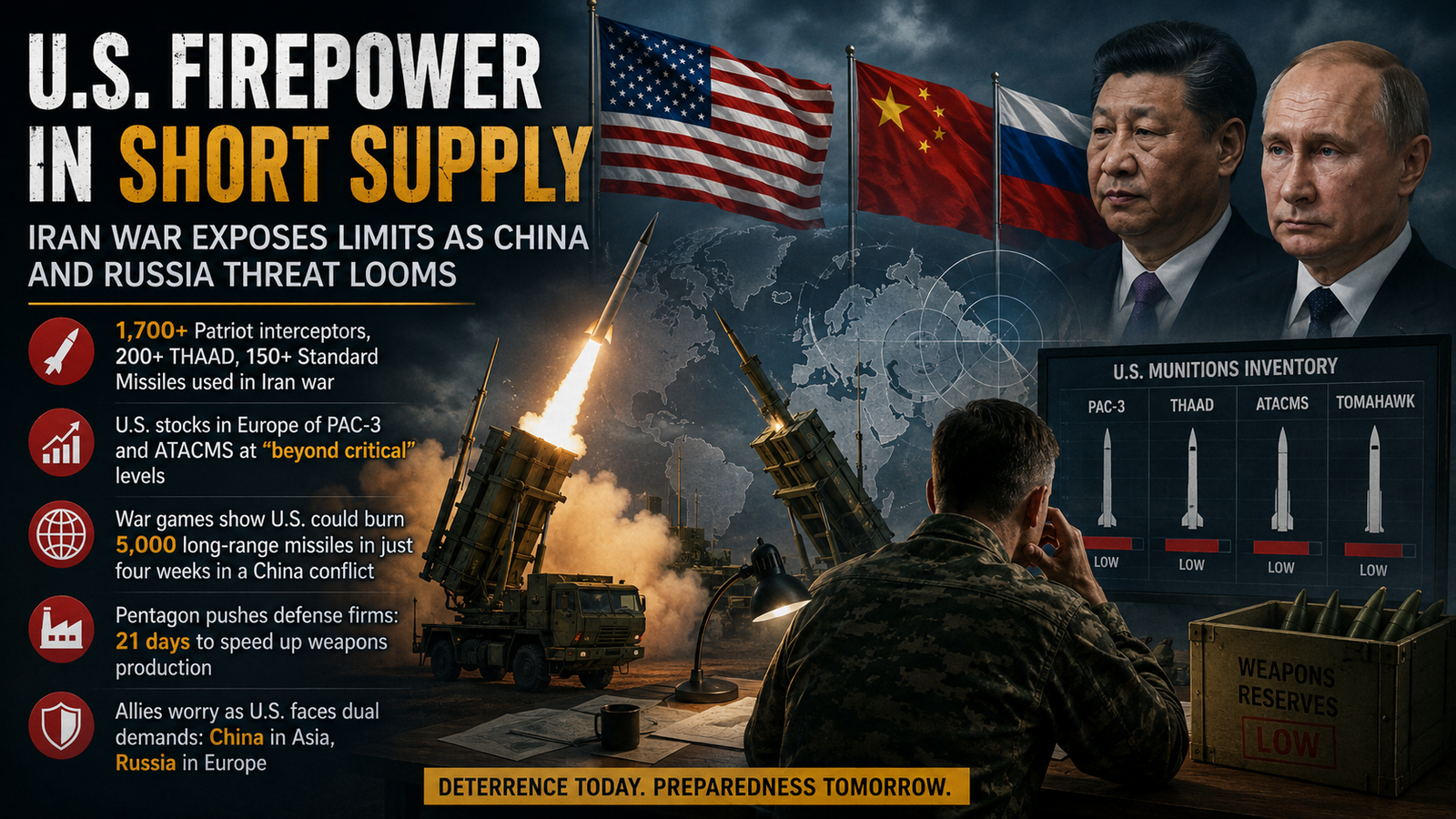
- U.S. firepower shortage: The Iran war has consumed large quantities of Patriot, THAAD, Standard Missile and long-range strike munitions, exposing vulnerabilities in American reserves.
- U.S. firepower and China: A Taiwan conflict could consume thousands of long-range missiles within weeks, making weapons production a central element of U.S. deterrence.
- U.S. firepower and Russia: Depleted air-defense stocks are creating additional pressure on America’s ability to reinforce NATO and respond to a major Russian threat in Europe.
The Iran war has exposed a strategic vulnerability that goes far beyond the Middle East: the United States can deploy overwhelming firepower, but questions are growing over how long it can sustain that firepower in a major war.
The U.S. military’s extensive use of missiles and air-defense interceptors against Iran has depleted important weapons stocks in Europe and the Indo-Pacific, forcing American planners to reconsider how much firepower they can simultaneously maintain against potential threats from China and Russia.
A Wall Street Journal report says U.S. inventories in Europe of PAC-3 Patriot interceptors and ATACMS missiles have fallen to levels described by officials as “beyond critical.” Other weapons, including precision-strike missiles, guided rockets and THAAD interceptors, have also been moved from Europe and Asia to the Middle East.
That concern echoes earlier analysis by The Islamabad Telegraph on Trump, the Iran War and America’s Ammunition Shortages, which examined how the conflict exposed pressure on U.S. weapons reserves and the difficulty of rapidly replenishing sophisticated munitions.
The issue is not whether America remains the world’s most powerful military. It does.
The issue is whether the United States has enough replaceable firepower to sustain a high-intensity war against a major power.
That distinction could become decisive.
U.S. firepower: Iran Exposed the Limits of U.S. Missile Reserves
The scale of American weapons expenditure during the Iran war has alarmed military planners.
By mid-July, U.S. forces had fired approximately 1,700 Patriot interceptors, more than 200 THAAD interceptors and around 150 Standard Missile interceptors, according to U.S. officials cited by the Journal. Iran had launched more than 1,500 ballistic missiles and 6,000 large drones during the conflict.
Those numbers reveal the fundamental problem of modern warfare: advanced weapons can be consumed much faster than they can be manufactured.
READ NEXT: Exclusive: U.S. Patriot Shuffle Reshapes Europe’s Defense—And Aggravates Putin Trump’s move to reroute air defense systems to Ukraine via Germany triggers NATO realignment and Russian fury
A sophisticated missile-defense system can successfully destroy an incoming missile, but every interception consumes an interceptor that must eventually be replaced.
That creates an unfavorable economic and industrial equation when an adversary can launch large numbers of relatively inexpensive drones and missiles.
The China Question Is Much Bigger
The most serious test would come in the Indo-Pacific.
U.S. war games examining a conflict with China have repeatedly shown extremely rapid consumption of long-range missiles. Some simulations have found that the United States could expend about 5,000 long-range missiles within four weeks of a conflict with China.
That makes the Iran experience particularly important.
As The Islamabad Telegraph previously reported in its analysis of how the Iran war exposed vulnerabilities in the U.S. military, the conflict demonstrated that even a technologically superior military faces serious challenges when an adversary can sustain large-scale missile and drone attacks.
China would present a substantially different challenge from Iran.
Beijing possesses large inventories of ballistic, cruise, hypersonic and anti-ship missiles, while its industrial base is capable of producing weapons at considerable scale.
A conflict over Taiwan could also involve U.S. forces operating thousands of miles from the American mainland while China would be fighting close to its own territory.
That is why depleted American inventories are increasingly being viewed as a potential window of vulnerability.
READ MORE: Drain on U.S. Munitions From Iran War Raises Fears Over Ability to Deter China, Russia
The Washington Post has reported that the Iran war has already caused concern among Asian allies, with Japan, South Korea and Taiwan closely watching U.S. weapons availability.
The strategic question is stark: if Washington is struggling to replenish firepower after fighting Iran, what happens if the United States has to fight China simultaneously across air, sea, land, cyber and space?
Europe Is Facing Its Own Problem
The weapons drain is not limited to Asia.
American air-defense assets have been transferred from Europe to the Middle East, reducing the forces available to respond to a potential Russian crisis.
The Guardian has reported growing European concern that depleted American stocks could undermine Washington’s ability to supply NATO allies with key systems, including Patriot interceptors and other precision weapons.
That matters because Europe is already struggling with the consequences of Russia’s war in Ukraine.
Ukraine’s demand for air-defense interceptors has exposed the limited production capacity of Western weapons manufacturers. European governments are simultaneously attempting to rebuild their own arsenals while waiting for American systems.
The result is a widening gap between what Western militaries require in a major war and what Western factories can actually produce.
U.S. firepower And Real Problem of Production Capacity
The United States does not simply need more missiles sitting in warehouses.
It needs the industrial capacity to manufacture thousands more when a war begins.
That is proving to be the harder challenge.
The Pentagon has responded by ordering defense companies to accelerate production. A Defense Department directive reported by the Washington Post gave companies just 21 days to present plans for significantly faster production and delivery of critical weapons.
Washington is also pursuing major expansion of Patriot production.
The Pentagon awarded Lockheed Martin a $58.6 billion contract aimed at tripling Patriot interceptor production by 2030, according to the Washington Post.
The United States is also expanding production of long-range strike weapons, including Tomahawk cruise missiles, while refurbishing older weapons where possible.
These measures reflect a fundamental shift in American defense planning: stockpiles alone are no longer sufficient; production capacity itself has become a strategic weapon.
Washington Is Trying to Conserve Ammunition
The depletion has also influenced operational decisions.
American commanders have increasingly had to weigh the military value of retaliatory strikes against the cost of using additional scarce precision weapons.
That calculation is particularly important when the alternative is preserving weapons for a possible confrontation with China or Russia.
The Trump administration has therefore increasingly emphasized economic pressure on Tehran rather than returning immediately to unrestricted military escalation.
But that strategy carries its own risks.
Iran still possesses the ability to attack American interests and regional infrastructure. Any renewed escalation could force Washington to consume additional air-defense interceptors precisely when its reserves are under pressure.
The Russia Problem Is Not Going Away
Russia presents a different but equally serious challenge.
The Kremlin has demonstrated during the Ukraine war that it can sustain large-scale missile and drone attacks while continuously adapting its tactics.
For Europe, the concern is that the United States could face simultaneous demands: defending NATO territory, supporting Ukraine, protecting American forces and maintaining deterrence against China.
That is why the depletion of Patriot and other air-defense stocks has attracted such attention.
A missile-defense system is different from many offensive weapons because there are fewer substitutes. If a country runs short of a particular precision missile, another weapon may sometimes perform a similar mission.
But if a base or population center is facing ballistic missiles, there are far fewer alternatives to a capable interceptor.
America Is Confronting a Strategic Arithmetic Problem
The Iran war has therefore produced a lesson Washington cannot ignore.
Military superiority is not simply about having the world’s most advanced weapons. It is about having enough of them—and being able to replace them quickly.
The United States can destroy Iranian missiles and drones. It can project power across oceans. It can deploy aircraft carriers, bombers, submarines and advanced fighter aircraft.
But the Iran conflict has demonstrated how quickly the ammunition supporting that power can disappear.
The danger becomes greater when the opponent is China or Russia.
The Wall Street Journal has reported that the depletion of U.S. munitions is already forcing American planners to reconsider operational assumptions regarding Europe and Taiwan.
That is the real strategic warning from the Iran war.
If a prolonged conflict with Iran can push some American weapons inventories toward critical levels, a war with China or Russia would test the entire U.S. defense-industrial base.
Washington is responding with billions of dollars in new contracts, accelerated production, expanded manufacturing and pressure on defense companies to shorten delivery timelines.
But rebuilding a weapons stockpile is not like buying aircraft or deploying troops.
Factories need time. Supply chains need investment. Skilled workers need training. Production lines need expansion.
And adversaries do not have to wait for America to finish rebuilding.
The central question confronting U.S. military planners is therefore no longer simply whether America has enough firepower to win the next war.
It is whether America can keep firing long enough to win it.
That may ultimately determine the credibility of U.S. deterrence against both China and Russia.