



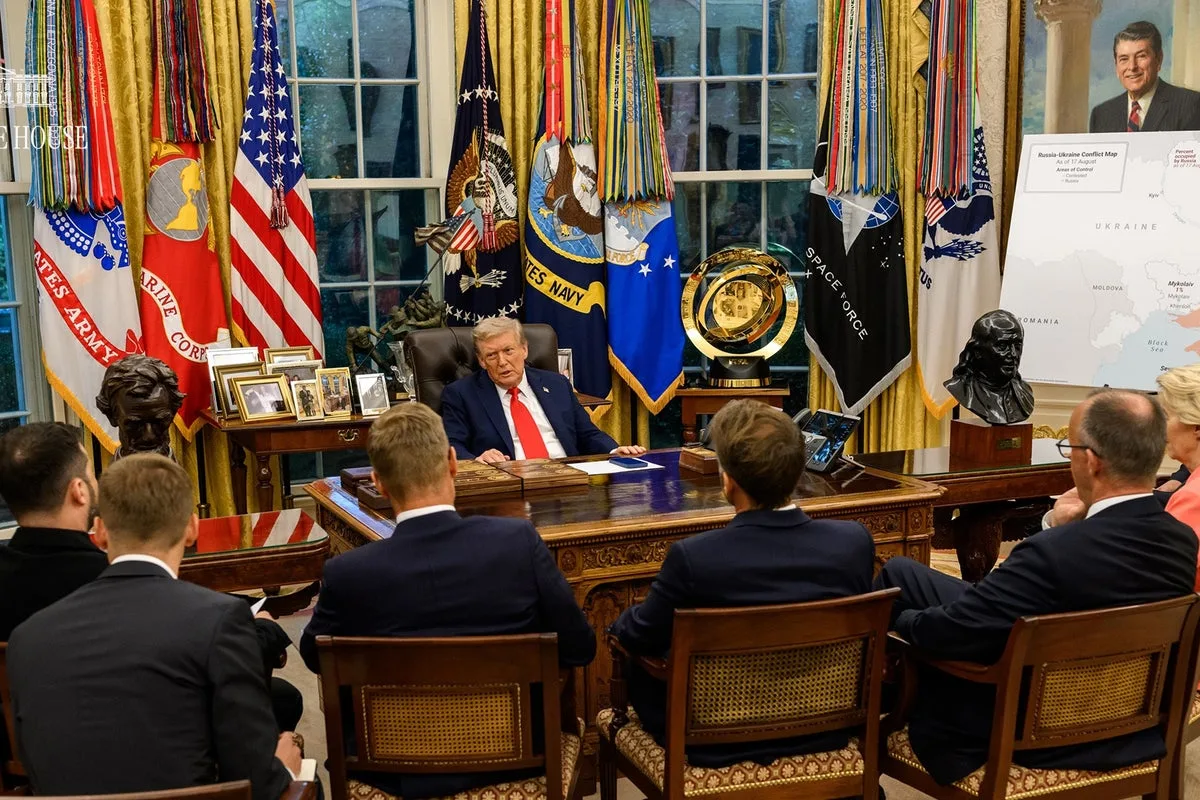
- U.S. military annexation of Greenland is now a concrete possibility as NORTHCOM commanders report full readiness to the President.
- President Trump has paused immediate action to pursue “lucrative deals” with European leaders to force a Danish handover.
- The “Donroe Doctrine” is being cited as the justification for American dominance over the entire Western Hemisphere and Arctic.
- European allies, led by France and Germany, have issued a joint warning that any move against Denmark would destroy NATO.
In the quiet, pressurized atmosphere of the Oval Office on Wednesday, January 7, 2026, the global map looked significantly different than it had just five days prior. The successful U.S. military raid that deposed Nicolás Maduro in Venezuela had not just shifted the power balance in the Caribbean; it had emboldened a new American doctrine of “ownership” that was now turning its eyes toward the blinding white expanse of the Arctic.
According to high-level sources, the morning briefing was dominated by a report from a top commander within U.S. Northern Command (NORTHCOM). The general’s message was blunt: following the recent realignment of Greenland under NORTHCOM’s jurisdiction, the U.S. military was “ready to annex” the territory. “Nothing can stop us from taking Greenland,” the commander reportedly told President Trump, citing the existing American footprint at Pituffik Space Base and the rapid-response capabilities honed during recent Arctic exercises.
Greenland and the Trump Doctrine: The Battle for the Arctic’s Future
Trump, known for his appreciation of military decisiveness, reportedly beamed at the commander. “Great job, really fantastic,” the President said, according to sources present. But then, he uttered a word that surprised some in the room: “Wait.”
While the military stands at a state of high readiness, the President has already initiated a complex, high-stakes diplomatic gambit. Behind the scenes, Trump has been working to bypass Copenhagen by appealing directly to individual European leaders and Greenlandic officials.
US discussing options to acquire Greenland, including use of military, says White House
Sources indicate that the administration has floated “lucrative deals”—ranging from massive infrastructure investments to direct cash transfers—aimed at convincing key European players to pressure Denmark into a “peaceful handover.” The goal is clear: utilize the threat of force to make a sale inevitable.
U.S. military annexation of Greenland: The “Donroe Doctrine” and the End of NATO?
The sudden escalation has plunged America’s oldest allies into a state of “high alarm.” For decades, the relationship between Washington and Copenhagen was defined by a shared interest in Arctic security. But as of January 2026, that partnership has transformed into a confrontation.
Trump’s Greenland Ambition: 7 Shocking Reasons Why the Arctic is the New Venezuela
Danish Prime Minister Mette Frederiksen has been unambiguous. On Monday, she warned that any U.S. move to seize Greenland by force would be the “end of everything,” specifically citing the collapse of the NATO alliance. If the United States were to attack a fellow member state, the very foundation of Article 5—the “one for all” collective defense clause—would be rendered meaningless.
In a rare show of unified defiance, the leaders of France, Germany, Italy, Poland, Spain, and the United Kingdom joined Frederiksen in a joint statement on Tuesday evening. They declared that “the inviolability of borders” is a universal principle and that “Greenland belongs to its people.” This European “Coalition of the Willing” is attempting to draw a red line against what critics are calling the “Donroe Doctrine”—a 21st-century reinterpretation of the Monroe Doctrine.
While the original 1823 Monroe Doctrine warned European powers against meddling in the Western Hemisphere, the “Donroe” version—publicly championed by White House Deputy Chief of Staff Stephen Miller—suggests that the U.S. has a natural right to “ownership” of any strategic territory in its neighborhood. Miller has gone so far as to question Denmark’s legal claim to Greenland entirely, asking in a recent briefing, “What is the basis of their territorial claim? Why is Greenland still a colony of Denmark?”
Pressure Tactics and the Arctic Chessboard
Trump’s “wait” command is not a sign of hesitation, but a tactical pause. His strategy is to use the “Venezuela model”—the demonstration of overwhelming military capability—as a lever to force a diplomatic surrender. The White House has made it clear that while Secretary of State Marco Rubio is pursuing a purchase, “utilizing the U.S. Military is always an option.”
The President’s fixation on the island is driven by what he describes as a “national security emergency.” On Sunday, Trump complained that Greenland is currently “covered with Russian and Chinese ships.” While European intelligence suggests that the “spike” in activity near Greenland is exaggerated, the strategic value of the island is undeniable. It contains vast deposits of rare earth minerals—neodymium, dysprosium, and lithium—essential for high-tech defense and energy industries, much of which is currently controlled by China.
To secure these, Trump has appointed Louisiana Governor Jeff Landry as a special envoy, tasked with dealing directly with the 57,000 residents of Greenland. Landry has suggested he is less interested in talking to “people in Denmark” and more interested in Greenlanders who want to “improve their quality of life” through American investment.
A Tense Standoff
As of this Wednesday afternoon, the world waits to see if the European coalition can hold. The “Donroe Doctrine” has placed the international order in an unprecedented position: a superpower threatening to annex the territory of its own ally.
In Copenhagen, the mood is one of betrayal. The Danish government has recently invested $13.7 billion in Arctic security to appease U.S. concerns about “burden sharing,” only to find that those investments may have simply paved the way for a more efficient American takeover.
For now, the orders are to stand fast. But with the U.S. military reporting it is “ready” and the President signaling that his “pressure tactics” are only just beginning, the ice in the Arctic has never felt thinner.