



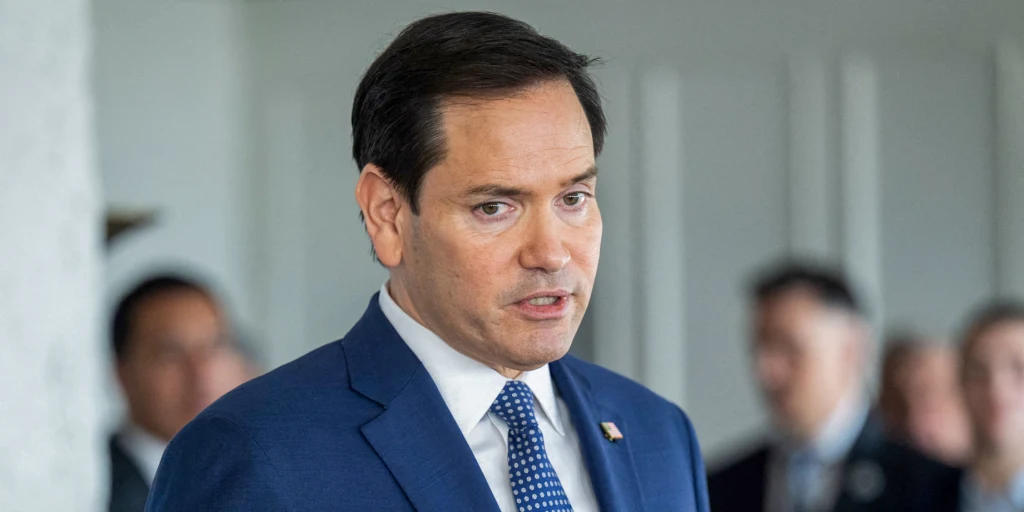
U.S. Secretary of State Marco Rubio on Wednesday pushed back against European criticism over the legality of recent U.S. military strikes in the Caribbean, saying Washington alone decides how to defend its national security.
Speaking to reporters after a Group of Seven (G7) foreign ministers meeting in Canada, Rubio said that “Europeans don’t get to dictate how the United States defends its national security,” rejecting claims that the strikes violated international law.
The criticism stemmed from French Foreign Minister Jean-Noel Barrot, who said the attacks “violate international law” and pose risks to France’s Caribbean territories. The U.S. military has so far carried out at least 19 strikes against boats it claims were carrying drugs, killing at least 76 people.
Europe’s Risky Gamble: Why Using Russia’s Frozen Assets Could Ignite a New Cold War
When asked about a CNN report that Britain had suspended intelligence sharing on drug trafficking due to concerns over the strikes, Rubio dismissed it as “a false story.” He insisted that cooperation with the United Kingdom “remains strong” and that “nothing has changed or happened that has impeded our ability to act.”
Meanwhile, Colombian President Gustavo Petro has ordered his country’s security forces to suspend intelligence cooperation with the U.S. until Washington halts its attacks on vessels in the Caribbean, calling them “illegal and extrajudicial.”
ALSO READ: Top diplomats from G7 countries meet in Canada as trade tensions rise with Trump
Despite the international outcry, the Trump administration maintains that those targeted were “narco-terrorists” involved in smuggling operations, although it has yet to provide public evidence or legal justification beyond citing Article 51 of the U.N. Charter, which allows for self-defense.
The controversy surrounding these U.S. strikes in the Caribbean is more than a matter of international law—it reflects a strategic recalibration of U.S. military power in its southern maritime sphere. The Caribbean Sea, long treated as a backyard theater of American influence, is witnessing a renewed military build-up reminiscent of the Cold War, but this time under the banner of counter-narcotics and counter-terrorism operations.
A New Frontier of Power Projection
The U.S. has expanded its naval presence in the region over the past year, stationing reconnaissance aircraft, destroyers, and coast guard cutters near Venezuela, Colombia, and the Lesser Antilles. Officially, the purpose is to curb the flow of narcotics into the United States. But analysts see a deeper agenda—reasserting dominance in an increasingly contested maritime zone where China and Russia have been expanding diplomatic and logistical ties with Caribbean and Latin American states.
READ MORE: Trump-Xi Trade Truce: Trump and Xi Move to End Cold War in Trade: U.S. Exhibitors See Hope After South Korea Breakthrough
Rubio’s hardline stance mirrors the Trump administration’s doctrine of “offshore enforcement,” which gives U.S. forces wide latitude to intercept and neutralize threats before they reach American shores. But the blurred lines between law enforcement and military action have made allies uneasy. “This is not drug interdiction; it’s armed intervention,” a European diplomat told Reuters anonymously.
The War on Drugs, Militarized
From Washington’s perspective, the strikes are a preventive shield—a message that the U.S. will not wait for narcotics or hostile actors to enter its waters. But critics say the campaign effectively militarizes law enforcement under the pretext of drug control. Unlike past interdiction missions where vessels were seized and suspects prosecuted, these new operations involve targeted destruction—no arrests, no trials, and often, no identification of the dead.
Human rights organizations have warned that such operations risk extrajudicial killings and violations of the law of the sea. Independent U.N. experts last month concluded that even if the drug allegations were true, “the use of lethal force in international waters without due process amounts to extrajudicial executions.”
Strategic Motives: Beyond Narcotics
Why, then, is the United States willing to endure diplomatic backlash? The answer lies in a broader geostrategic calculation. The Caribbean has become an essential conduit not only for drug routes, but also for energy trade, migration, and foreign influence operations.
Russia’s renewed naval presence in Cuba and Nicaragua, along with China’s expanding port projects in the Dominican Republic and Panama, has stirred anxiety in Washington. By framing its actions as anti-narcotics, the U.S. can justify forward deployment of military assets, surveillance operations, and partnership-building with compliant regional governments—all without declaring a new Cold War.
Rubio’s rhetoric at the G7 meeting—“Europe doesn’t decide how America defends itself”—signals a growing unilateral streak in Washington’s security thinking. It reflects an America less concerned with multilateral consensus and more focused on direct action, particularly in zones it deems vital to its homeland defense.
International Fallout
The backlash, however, is real. France and Colombia, both historically close allies, have openly questioned the legitimacy of the operations. The United Kingdom’s reported hesitation, even if denied by Rubio, hints at fractures in the Five Eyes intelligence alliance.
Such rifts could complicate Washington’s broader strategy of Western unity, especially at a time when the U.S. needs allied backing against Russia and China. Yet, Rubio’s defiance suggests the administration believes the political dividends at home—a tough-on-drugs image—outweigh diplomatic costs abroad.
The strikes in the Caribbean may appear as an anti-narcotics campaign, but they represent a strategic repositioning of American power. As Rubio asserts U.S. sovereignty against European criticism, Washington is quietly reinforcing its southern frontier—militarily, politically, and symbolically.
Whether this campaign truly curbs the drug flow or simply sets a precedent for armed interventions beyond borders remains to be seen. But one thing is clear: the Caribbean has once again become the testing ground for America’s evolving doctrine of security without apology.