



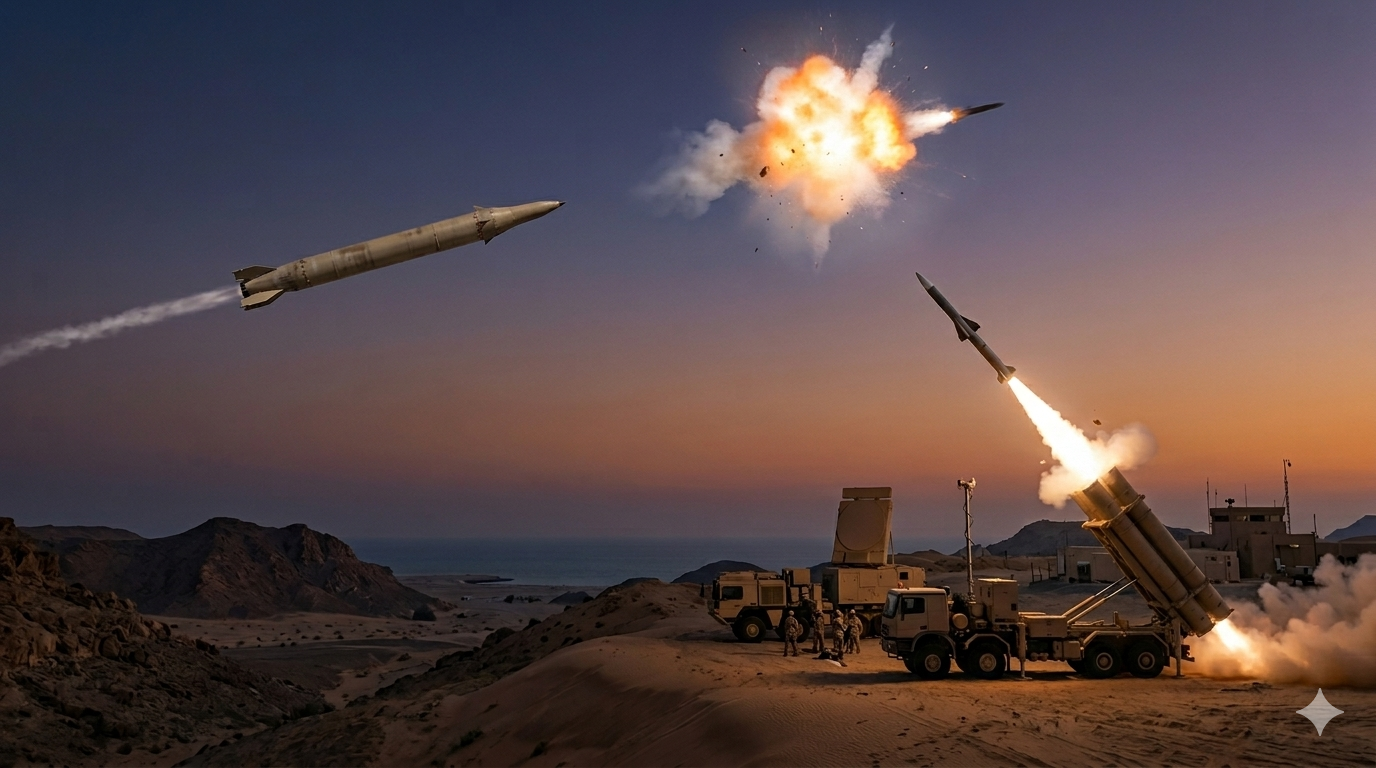
- UAE Air Defense Intercepts Missiles including 9 ballistic, 1 cruise missile and 50 drones in latest attack
- Over 507 ballistic missiles and 2,191 UAVs neutralized since escalation began
- Falling debris injures foreign workers at Khorfakkan Port, all reported out of danger
- UAE economy remains resilient with $707 billion exports and ports operating at full capacity
Work was in full swing at Khorfakkan Port on Sunday when the sky suddenly turned into a battlefield.
Dockworkers, many of them foreign nationals, paused as a fast-moving object streaked across the horizon—an incoming Iranian ballistic missile, descending toward one of the UAE’s busiest maritime hubs. Within seconds, another object—faster, sharper, glowing with an orange flare—cut through the sky.
It rose almost invisibly before slamming into the missile mid-air. The impact produced a thunderous explosion. The incoming projectile shattered into fragments, scattering harmlessly across the sky instead of detonating on the ground.
What could have been a mass-casualty strike on critical infrastructure was neutralized in seconds.
Witnesses described a moment of silence followed by spontaneous applause. Workers cheered and shouted in support of UAE defense forces as the immediate danger passed.
But the aftermath still carried risk. Falling debris struck areas near the port, injuring four workers—one Nepalese national seriously, and three Pakistanis with minor to moderate injuries. All were rushed to hospital and later reported to be out of danger. Emergency teams quickly contained a small fire triggered by the debris, underscoring the efficiency of response systems operating under high alert.
The incident reflects a broader and intensifying aerial campaign targeting the United Arab Emirates. According to a statement issued by the UAE Ministry of Defence, air defense systems intercepted nine ballistic missiles, one cruise missile, and 50 unmanned aerial vehicles (UAVs) on April 5 alone.
Pakistan UAE deposits controversy: Pakistan Rejects Social Media Campaign, Reaffirms Strategic Partnership
The cumulative figures are even more striking. Since the escalation began, UAE defenses have destroyed 507 ballistic missiles, 24 cruise missiles, and 2,191 UAVs—one of the highest interception rates recorded in modern regional conflict scenarios. Despite this sustained pressure, the UAE has not launched retaliatory strikes, maintaining a strictly defensive posture.
Military analysts say this reflects a deliberate strategic choice rather than constraint. The UAE operates a layered air defense architecture that integrates radar surveillance, rapid-response interception systems, and platforms such as MIM-104 Patriot batteries.
Iran Rejects Ceasefire Proposal, Escalation Risks Surge Across Global Markets
The system is designed to engage multiple threats simultaneously, from low-flying drones to high-speed ballistic missiles. The high success rate suggests not only advanced technology but also real-time coordination and readiness.
Yet, even successful interceptions carry consequences. Across the conflict period, authorities report 10 civilian fatalities, including nationals from Pakistan, India, Bangladesh, Egypt, and other countries, alongside two Emirati personnel and a Moroccan contractor linked to the armed forces.
Total injuries have reached 217, spanning more than two dozen nationalities—highlighting the UAE’s diverse expatriate workforce and the wide human footprint of the crisis. Notably, officials emphasize that most casualties have resulted from falling debris rather than direct hits.
Despite the security challenges, the UAE’s economic backbone remains intact. Ports, including Khorfakkan, continue to operate at full capacity. Authorities have rerouted shipping lanes where necessary, ensuring continuity in global supply chains. This resilience is critical as the UAE cements its role as a major trade hub.
According to the World Trade Organization, the UAE’s merchandise exports reached $707 billion in 2025, accounting for 2.7% of global exports. The country has surged from 17th to among the top five exporters globally within five years. Total foreign trade hit AED 6 trillion, with a surplus of AED 584.1 billion—driven by a 27% rise in non-oil exports, including metals, petrochemicals, and digital goods.
Dubai has been central to this transformation, emerging as one of the world’s leading export hubs. Its ports, logistics networks, and financial infrastructure continue to function despite regional instability—an indication of both strategic planning and crisis management capacity.
The Ministry of Defence reiterated that its forces remain fully prepared. “We will firmly confront anything that aims to undermine the security of the country,” the statement said, reaffirming a commitment to protect sovereignty, infrastructure, and civilian lives.
For global observers, the UAE presents a rare yet profound case: a country under sustained aerial attack that has chosen restraint over retaliation, defense over escalation. Its ability to intercept hundreds of incoming threats while keeping trade flowing and cities functioning offers a model of controlled resilience—where military strength is measured not by retaliation, but by the capacity to absorb, defend, and endure.