



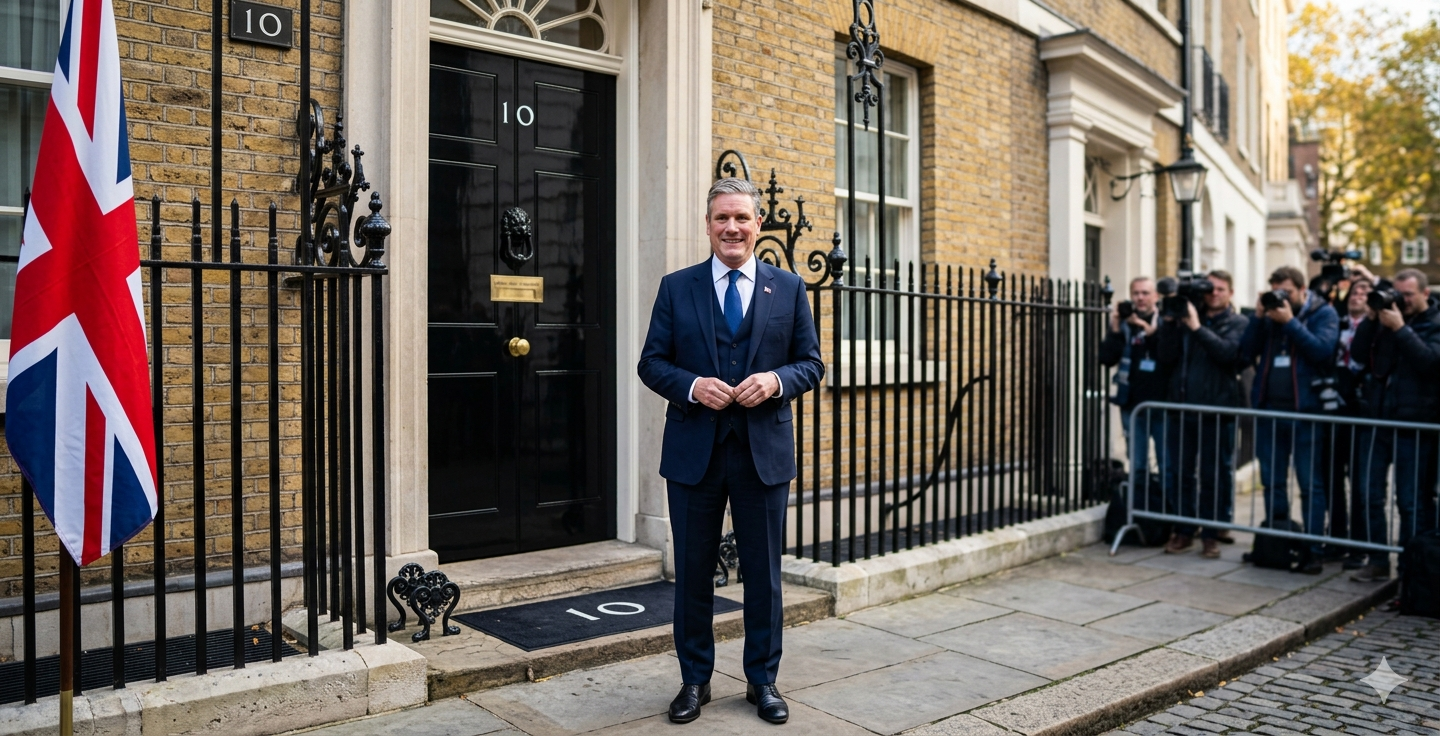
- UK Prime Minister Keir Starmer resigns under intense pressure from Labour lawmakers after major electoral setbacks.
- Andy Burnham emerges as frontrunner, expected to lead Labour and become next prime minister.
- Internal revolt reflects deepening instability in British politics since Brexit and rising voter dissatisfaction.
- Economic strain, immigration concerns, and the rise of Reform UK under Nigel Farage reshape the UK political landscape.
London — In a dramatic political turn that has sent shockwaves across Westminster and beyond, British Prime Minister Keir Starmer announced on Monday that he will step down from office, bowing to mounting pressure from within his own Labour Party and deepening a sense of instability that has gripped British politics for nearly a decade.
Starmer’s resignation pledge comes after a turbulent weekend in which senior Labour lawmakers intensified calls for him to make way for a new leader, warning that failure to act could plunge the party into a damaging internal conflict. His departure now sets the stage for a leadership contest that is widely expected to be won by Andy Burnham, a veteran politician and former mayor of Greater Manchester.
The announcement marks yet another chapter in Britain’s recent history of premature leadership exits — a trend that has increasingly defined the country’s political landscape. From Conservative to Labour governments, prime ministers have struggled to maintain authority amid mounting economic pressures, party divisions, and shifting voter loyalties.
A Leadership Collapse Driven by Internal Revolt
Starmer, who came to power with one of the largest parliamentary majorities since World War II, had initially vowed to resist any leadership challenge. But his position became untenable following a crushing setback in May’s local elections, where Labour lost control of numerous city councils in what analysts described as the party’s worst postwar performance.
JD Vance, PM Shehbaz Sharif, and Field Marshal Asim Munir Converge in Switzerland for High-Stakes US-Iran Talks Amid Hormuz Crisis
Behind the scenes, dissatisfaction had been building for months. Critics within Labour argued that Starmer’s cautious, technocratic approach to governance failed to inspire voters at a time when Britain faces profound structural challenges. His promise of a calmer, less confrontational style of politics — one that would “tread more lightly on voters’ lives” — increasingly appeared out of step with a political environment dominated by populist messaging and ideological polarization.
A series of missteps further eroded his authority. Controversies over donor-funded personal expenses, the abrupt removal of winter fuel benefits for pensioners, and sweeping tax increases — introduced despite campaign pledges to the contrary — fueled accusations of inconsistency and political misjudgment. Business leaders also voiced concerns over rising labor costs following minimum wage hikes.
Even senior members of his government began to openly question his leadership. In a pointed resignation letter earlier this year, minister Jess Phillips criticized the administration’s lack of political urgency, writing that “the desire not to have an argument means we rarely make an argument,” highlighting what many saw as a leadership vacuum at the top.
Burnham’s Rise and the Prospect of a New Direction
With Starmer stepping aside, attention has swiftly turned to Andy Burnham, who is widely viewed as the frontrunner to replace him. Under Labour Party rules, any leadership challenger must secure the backing of at least one-fifth of Labour lawmakers — a threshold Burnham is expected to easily surpass.
U.K. Prime Minister Keir Starmer Quits Amid Rebellion
Burnham’s ascent would mark a remarkable political comeback. Having failed in previous leadership bids in 2010 and 2015, he rebuilt his political capital as mayor of Greater Manchester, where he oversaw a multi-billion-pound regional budget and cultivated a reputation as a pragmatic, media-savvy leader.
His recent victory in a special election in Makerfield — where he decisively defeated a candidate from Reform UK led by Nigel Farage — has been touted by supporters as evidence of his electoral appeal. However, critics caution that the constituency’s relatively small electorate may not reflect national sentiment.
If confirmed as leader, Burnham would inherit an economy facing persistent headwinds: low productivity growth, rising borrowing costs, and an aging population placing increasing strain on public finances. Taxes are already at postwar highs, while government spending continues to rise amid demands for expanded social programs and increased defense commitments.
Burnham has previously championed a vision of “business-friendly socialism,” advocating for regional economic revitalization, greater public ownership of utilities, and decentralization of power away from London. In recent weeks, however, he has signaled a shift toward the political center, pledging adherence to existing fiscal rules and maintaining the government’s stance on reducing immigration.
Immigration, Economy, and the Rise of Populism
Immigration remains one of the most contentious issues shaping British politics. Both legal and illegal migration surged in the years following Brexit, driven in part by changes to visa policies that expanded access for non-European workers. While Labour has attempted to tighten controls, opponents argue that its measures fall short.
Farage and Reform UK have capitalized on these concerns, framing immigration as central to what they describe as a “broken Britain.” Their growing appeal reflects a broader trend across Europe, where traditional parties are losing ground to populist movements on both the right and left.
At the same time, Labour faces pressure from the opposite flank. The Green Party has drawn support from urban progressive voters by advocating higher public spending funded through increased taxation on the wealthy. The result is a fragmented political landscape in which both major parties are struggling to maintain cohesive voter coalitions.
Even internationally, the crisis has drawn attention. U.S. President Donald Trump suggested that Starmer’s resignation was linked to his failure to address immigration and energy costs, underscoring the global resonance of Britain’s domestic challenges.
UK Prime Minister Keir Starmer resigns: A Decade of Instability
Starmer’s resignation is the latest manifestation of a broader pattern of volatility that has defined British politics since the 2016 Brexit referendum. That vote exposed deep societal divisions over globalization, national identity, and economic inequality — fractures that have only widened in the years since.
Successive crises — from the COVID-19 pandemic to the war in Ukraine — have compounded these tensions, while stagnant economic growth and rising living costs have eroded public trust in political institutions.
For Labour, the current upheaval is particularly significant. The party has never before forced out a leader during their first term in government, making this moment a historic departure from precedent.
What Comes Next
Starmer’s resignation will trigger a formal leadership contest within the Labour Party. The winner will automatically assume the role of prime minister, given Labour’s parliamentary majority. While Burnham is the clear favorite, the possibility of a contested race cannot be ruled out.
Investors and international partners are closely monitoring developments, particularly for indications of future fiscal policy. Any shift toward increased borrowing or taxation could have significant implications for Britain’s economic outlook.
There is also growing speculation that a change in leadership could prompt calls for an early general election, especially if the new prime minister seeks a fresh mandate or faces declining popularity.
For now, Britain finds itself once again at a critical crossroads — grappling with leadership uncertainty, economic challenges, and a rapidly evolving political landscape.
As the dust settles, one thing is clear: the resignation of Keir Starmer is not merely a change of leadership. It is a symptom of deeper structural forces reshaping British democracy — forces that show no sign of abating.