



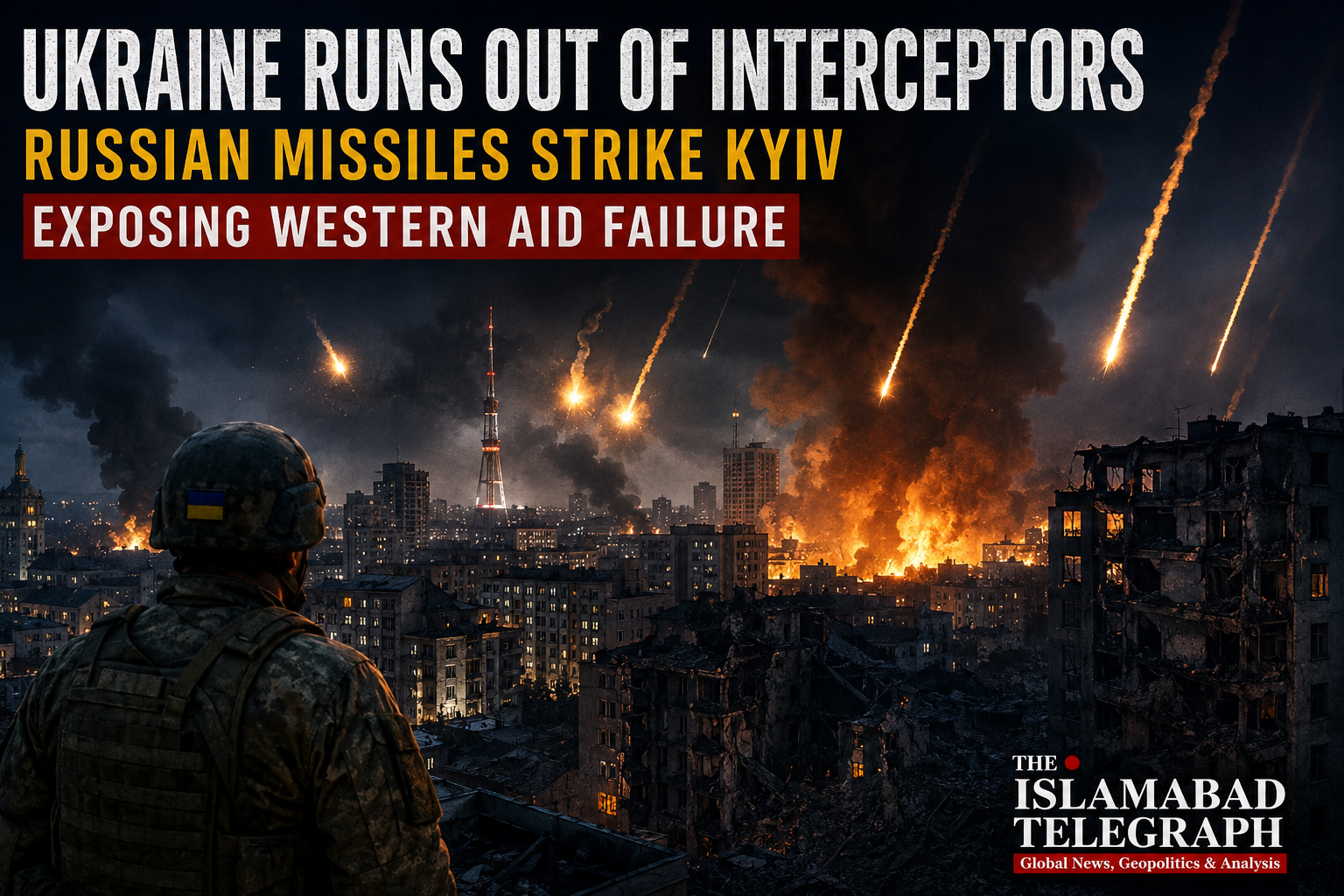
- Ukraine Air Defense Collapse: Ukraine faces a critical air defense crisis as interceptor missile supplies are nearly exhausted, exposing cities to intensified Russian strikes.
- Western military aid and financial pledges have been delayed or partially unmet, raising concerns over long-term support sustainability.
- The war has entered a dangerous new phase, with increasing civilian casualties, infrastructure destruction, and strategic uncertainty for Europe.
KYIV — Ukraine’s battlefield reality has entered a dangerous new phase. After more than 1,623 days of grinding war with Russia, Kyiv is now confronting what may be its most severe military vulnerability yet: the near-total depletion of its air defense interceptors. Once hailed as Europe’s frontline “gladiator” against Russian expansion, Ukraine now finds itself exposed, undersupplied, and increasingly isolated.
In the early hours of Wednesday, that vulnerability was laid bare. Ukrainian forces failed to intercept a single incoming Russian missile during one of the most intense aerial assaults on Kyiv in recent weeks. According to Ukraine’s Air Force, Russia launched 24 ballistic missiles, four hypersonic cruise missiles, and 115 attack drones in a coordinated overnight barrage. The result was devastating: all missiles and at least 17 drones struck their intended targets, killing 17 people and injuring more than 40.
The scale and precision of the attack marked a turning point. It was the third major ballistic strike on Kyiv within a single week, and for the first time since the early stages of the war, Ukraine’s air defenses appeared effectively absent.
Interceptor Crisis: A Strategic Collapse in the Skies
At the center of Ukraine’s growing vulnerability is a critical shortage of interceptor missiles—particularly for the U.S.-supplied Patriot air defense systems, which remain Kyiv’s only reliable shield against Russian ballistic threats.
Until recently, these systems had been remarkably effective, intercepting a significant portion of incoming missiles. But that success has come at a cost. Ukrainian stockpiles have been rapidly depleted, exacerbated by global supply constraints and the diversion of interceptor production during the Iran conflict, where Western inventories were heavily drawn down.
READ NEXT: Ukraine’s NATO Bid Collapses: Zelensky’s War Gamble Backfires
President Volodymyr Zelensky acknowledged the crisis days earlier, stating bluntly that Ukraine had “run out of air defense interceptors.” Following Saturday’s attack, he revealed that only one ballistic missile had been intercepted, adding: “simply because there are no interceptors.”
By Wednesday, even that minimal defensive capability had vanished.
“Ballistic missile interceptors could have saved the lives of those killed today,” Zelensky said after the latest strike. “Delays in supplying them—or an unwillingness to provide anti-ballistic systems—lead directly to such horrific casualties and destruction.”
The Broken Promise of Western Support
Ukraine’s deteriorating defensive position has also exposed a widening gap between Western pledges and actual delivery.
Since the start of the war, European nations and the United States have collectively committed over $250 billion in military, financial, and humanitarian assistance. The European Union alone pledged approximately €50 billion under its Ukraine Facility for 2024–2027, alongside earlier commitments through the European Peace Facility and bilateral aid packages from Germany, France, and other member states.
READ NEXT: Ukraine fails to stop any missiles overnight, after Zelensky says no interceptors remain
However, much of this funding has been delayed, fragmented, or tied up in bureaucratic processes, leaving Ukraine struggling to maintain operational readiness. Military aid, particularly in high-end systems such as air defense interceptors, has failed to keep pace with battlefield consumption rates.
The situation worsened further when U.S. policy uncertainty re-emerged. Last week, President Donald Trump appeared to reverse a prior understanding that would have allowed Ukraine to produce interceptor missiles domestically under U.S. licensing, a move that Kyiv had hoped would ease long-term supply shortages.
Instead, Ukraine remains dependent on external deliveries that are increasingly inconsistent.
The result is stark: a country once armed and financed as a strategic priority now finds itself fighting a high-intensity war with dwindling resources.
Ukraine Air Defense Collapse: Russia Seizes the Momentum
For Moscow, Ukraine’s air defense collapse presents a strategic opportunity—and it is being exploited with precision.
Russian missile and drone strikes have grown more coordinated, targeting not only military infrastructure but also economic lifelines. In Wednesday’s attack, several major logistics hubs and commercial facilities were destroyed, including a key warehouse belonging to Rozetka, Ukraine’s largest online retail platform.
The facility, located in Brovary near Kyiv, had processed over 100,000 orders daily. It is now completely destroyed.
“I watched as my life’s work burned down after three ballistic missiles hit,” said Rozetka co-founder Iryna Chechotkina, underscoring the war’s expanding economic toll.
Such strikes reflect a broader Russian strategy: degrade Ukraine’s economic resilience while exploiting its weakened air defenses to strike deeper and more frequently with minimal resistance.
NATO Dream Fades Into Strategic Reality
Beyond the battlefield, Ukraine is also confronting the collapse of its long-standing geopolitical objective—membership in NATO.
Once framed as both a strategic necessity and an achievable goal, NATO accession now appears increasingly unattainable. In a recent closed-door diplomatic exchange, Zelensky reportedly admitted that Ukraine has “no chance” of joining NATO under current conditions.
This admission aligns with assessments from Ukraine’s former top military commander, General Valerii Zaluzhnyi, who has openly dismissed the possibility.
“For about 12 years we worked to meet NATO standards,” Zaluzhnyi said. “Unfortunately, we will never actually join.”
His remarks highlight a deeper issue: Ukraine’s military, after years of high-intensity warfare, no longer aligns with NATO’s structural and operational benchmarks. The gap is not merely political—it is institutional, logistical, and doctrinal.
Ukraine Air Defense Collapse: A Nation Under Strain
The consequences of prolonged war are now visible across every dimension of Ukrainian society.
- Human cost: Tens of thousands of soldiers killed, with civilian casualties rising amid intensified aerial attacks.
- Displacement crisis: Millions remain displaced across Europe, creating long-term demographic and economic challenges.
- Economic contraction: Industrial output has fallen sharply, infrastructure continues to be destroyed, and Ukraine’s economy is heavily dependent on external funding.
- Military degradation: Ammunition shortages, equipment fatigue, and personnel losses have reduced operational capacity.
Even on the battlefield, Ukraine’s position is increasingly fragile. While Russian territorial gains have slowed compared to earlier phases, Moscow continues to consolidate control in key regions including Donetsk, Zaporizhzhia, and Sumy.
Ukraine’s counteroffensives, once heralded as decisive turning points, have yielded only limited and localized results.
Europe’s Strategic Dilemma
Ukraine’s weakening position has also triggered alarm across Europe. The continent now faces a critical question: can it sustain Ukraine—or defend itself—without consistent U.S. backing?
Recent discussions around a “Europeanized NATO” or “NATO 3.0” reflect growing concern that the alliance may need to adapt to a future of reduced American engagement. Yet structural dependence on U.S. military capabilities remains profound.
Without Washington’s logistical, financial, and technological support, Europe’s ability to project sustained military power is uncertain.
Ukraine’s struggles are therefore not just national—they are emblematic of a broader strategic vulnerability within the Western alliance.
The Gladiator Abandoned
For much of the war, Ukraine was portrayed as Europe’s “gladiator”—a frontline defender absorbing the shock of Russian military power on behalf of the continent.
Today, that image is fading.
With interceptor stocks depleted, financial aid delayed, and political backing increasingly uncertain, Ukraine appears less like a heavily armed bulwark and more like an exposed combatant surrounded by mounting threats.
Zelensky, once celebrated as a symbol of resistance, now faces a stark reality: a war with no clear endgame, diminishing support, and rising domestic and international scrutiny.
A Narrow Path Forward
Ukraine’s options are rapidly narrowing.
Continued resistance will depend on urgent replenishment of air defense systems, accelerated financial assistance, and renewed political commitment from Western allies. Without these, the current trajectory points toward deeper military vulnerability and economic exhaustion.
A negotiated settlement, once dismissed, is increasingly being discussed in diplomatic circles as a possible—if politically difficult—path forward.
For now, however, Ukraine remains locked in a war of attrition it is becoming progressively harder to sustain.
After 1,623 days, the “gladiator” stands alone—its shield shattered, its allies hesitant, and its future uncertain.
Only a decisive shift in strategy—or what many in Kyiv now describe as a “miracle”—can alter the course of a conflict that is redefining the balance of power in Europe.