



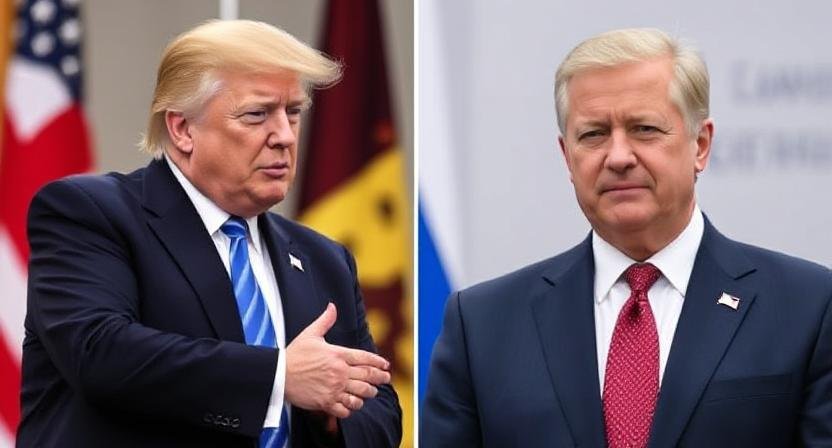
- Ukrainian President Zelensky was visibly shocked after Trump left the G7 summit without addressing Ukraine’s urgent needs or condemning Russia.
- Trump abruptly exited the summit in Canada, skipping a crucial meeting on Ukraine and citing other global priorities.
- G7 leaders expressed concern over Trump’s apparent disengagement, with some calling him non-serious and indifferent toward the alliance’s goals.
- Despite Trump’s absence, Canada and the UK moved forward with fresh sanctions against Russia, pledging continued support to Ukraine.
BANFF, Alberta — The picturesque calm of the Canadian Rockies did little to mask the rising geopolitical tension inside the G7 summit halls, where the absence of U.S. President Donald Trump cast a long shadow over urgent discussions on Ukraine.
In a move that left fellow leaders stunned and Ukrainian President Volodymyr Zelensky visibly unsettled, Trump departed the summit prematurely, skipping a crucial session on the Ukraine crisis and refusing to endorse further sanctions against Russia.
Zelensky, who had flown in by helicopter on Tuesday morning, arrived to find a summit thrown into disarray by Trump’s abrupt exit the previous evening. “We need support from our allies,” Zelensky said before a meeting with Canadian Prime Minister Mark Carney. His plea came just hours after Ukraine suffered one of the deadliest Russian airstrikes in weeks — a chilling reminder of the stakes at hand. Yet, the man once considered Ukraine’s most powerful Western backer had already left the building.
Tehran Secretly Asks Gulf Allies to Push Trump for Ceasefire with Israel Amid Soaring Oil Prices
Sources close to the summit described Zelensky as “visibly shocked” by the cold treatment. Trump, according to one European diplomat, “didn’t give a damn” about Ukraine — a sentiment echoed in his remarks before leaving the summit.
The American president cited the Israel-Iran conflict as a more pressing concern, leaving no doubt about his shifting geopolitical priorities. His decision to leave the summit halfway not only derailed Ukraine’s diplomatic hopes but also rattled allies, many of whom expressed anxiety over what they saw as Trump’s growing disinterest in multilateral diplomacy.
“This isn’t just about optics — this is about substance,” said a senior EU official. “He didn’t just walk away from a meeting; he walked away from a war.” Trump’s exit meant he missed a Tuesday breakfast discussion dedicated to Ukraine, which was to include Zelensky and NATO Secretary-General Mark Rutte. In his absence, the remaining leaders moved forward with plans to bolster sanctions against Russia, though the path forward now appears more fragmented.
READ MORE: Tehran Secretly Asks Gulf Allies to Push Trump for Ceasefire with Israel Amid Soaring Oil Prices
Prime Minister Carney reaffirmed Canada’s commitment to Ukraine, announcing new military assistance and sanctions aimed at Russia’s shadow oil fleet. The United Kingdom followed suit, targeting not only Russian logistics networks but also domestic collaborators allegedly aiding Moscow’s war machine. But Trump’s reluctance to sign on threatened to blunt the effect of Western unity.
“When I sanction a country, that costs the U.S. a lot of money — a tremendous amount of money,” Trump said Monday, signaling a broader reluctance to escalate financial pressure on the Kremlin. His view contrasts sharply with that of Senator Lindsey Graham, who introduced a bill proposing a 500% tariff on any nation purchasing Russian oil. Trump, while acknowledging the bill’s strength, dismissed it as a “harsh” measure that would require his personal blessing.
READ MORE: Iran sought US pressure on Israel for ceasefire via Gulf states, sources say
Perhaps more troubling to European leaders was Trump’s suggestion that Russia should never have been expelled from the G8 — the very move taken in response to its 2014 annexation of Crimea. “I think that was a mistake,” Trump said, doubling down on a position that effectively legitimizes Moscow’s breach of international law. “I think you wouldn’t have a war right now if you had Russia in [the G8].”
Zelensky’s task was already difficult — arriving at the summit as missiles reduced Kyiv buildings to rubble and left 15 dead, 75 wounded. But with Trump’s unexpected departure and open skepticism of sanctions, the diplomatic landscape shifted under his feet. The Ukrainian leader, still committed to peace talks and an unconditional ceasefire, now finds himself navigating not just a war with Russia but a widening strategic distance with Washington.
Adding to the unease is the growing European sentiment that they may need to act independently of the U.S. EU foreign-policy chief Kaja Kallas hinted that the bloc could enforce new sanctions alone if necessary — particularly a proposal to lower the price cap on Russian oil from $60 to $45 per barrel. Yet, enforcement without American cooperation may be toothless, given Washington’s global financial leverage and naval presence.
Inside the summit corridors, leaders were left asking if Trump’s disinterest in Ukraine signals a broader pivot in U.S. foreign policy. His administration, some fear, is increasingly open to rapprochement with Moscow, while quietly curbing support for Kyiv. This concern was reinforced by Trump’s February clash with Zelensky during the latter’s visit to the Oval Office, a meeting reportedly marked by terse exchanges. A subsequent encounter at the Vatican was described by U.S. officials as “very productive,” but it failed to dispel doubts about Trump’s commitment.
Looking ahead to the upcoming NATO summit in The Hague on June 24, diplomats are now recalibrating their expectations. Both Trump and Zelensky are slated to attend, and the world will be watching closely to see whether the U.S. president re-engages or continues his sidestep on Ukraine.
Senator Graham, for his part, remains optimistic about European resolve. “If a country buys cheap Russian oil and doesn’t help Ukraine, they are screwed. That is the price for propping up Putin’s war machine,” he said last week. His message, though, seemed more directed at America’s allies than at Trump, whose strategy may prioritize short-term diplomacy over long-term deterrence.
For now, Zelensky is left to rely on those allies still standing beside him — Canada, the U.K., parts of the EU — as he seeks both battlefield support and a political solution. But the shock and silence from the G7’s most powerful leader have introduced a troubling new uncertainty into Ukraine’s path forward.