



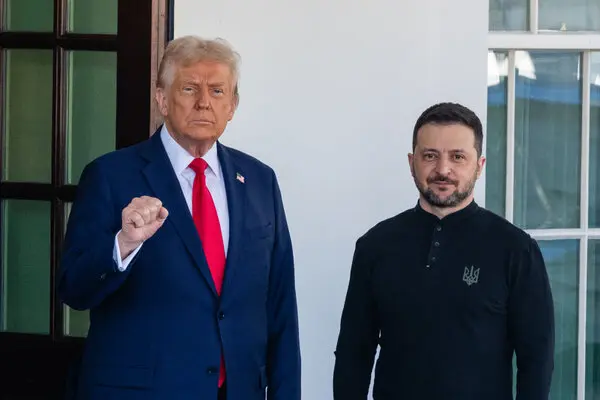
- Trump warns of Russian retaliation following a direct call with Vladimir Putin, who vowed to respond to Ukrainian drone strikes on Russian airfields.
- Zelensky rejects Russian peace terms as “ultimatums,” urging an unconditional ceasefire and accusing Moscow of using talks to delay sanctions.
- Western support wavers, with Defense Secretary Hegseth skipping a key NATO meeting, adding uncertainty to the future of U.S. military aid.
- Frontline pressure intensifies, as Russia gains ground in Sumy and Ukraine strikes deep inside Russia, risking further escalation instead of diplomacy.
As the war in Ukraine enters yet another volatile phase, the U.S. President Donald Trump’s warning that Russian President Vladimir Putin is preparing retaliation for recent Ukrainian drone attacks marks a pivotal turn in the narrative surrounding peace efforts in the region. Despite backchannel diplomacy and formal negotiations, the latest developments underscore the widening gulf between Russian and Ukrainian positions, with little sign of de-escalation.
Trump, who spoke with Putin for over an hour recently, described the conversation as “good” but admitted it wouldn’t immediately lead to peace. He emphasized Putin’s anger over Ukraine’s long-range drone strikes that damaged strategic bomber airfields deep inside Russian territory — an operation seen by many as a psychological blow to the Kremlin.
Trump Treads Carefully After Ukrainian Drone Blitz Hits Deep Inside Russia: Is a Putin Call Coming?
The call comes at a time when Ukraine, emboldened by limited but symbolic battlefield victories and Western backing, has forcefully rejected Moscow’s latest peace terms. Ukrainian President Volodymyr Zelensky labeled Russia’s demands an “ultimatum” rather than a serious negotiation offer, accusing Moscow of using the talks to buy time and avoid further international sanctions.
From the Russian perspective, the talks appear equally futile. In a televised cabinet meeting, Putin dismissed the Ukrainian government as a “terrorist regime,” declaring negotiations impossible under current conditions. He cited Ukraine’s refusal to acknowledge Russian sovereignty over occupied territories and its continued attacks on civilian and military infrastructure inside Russia.
The public positions reveal that both sides remain entrenched in maximalist demands. Russia seeks Ukrainian capitulation — including territorial concessions, neutrality guarantees, and military restrictions. Ukraine, in turn, insists on a full Russian withdrawal, the return of abducted children, and the freedom to join Western alliances.
READ MORE:America’s Nuclear Blind Spot: The Looming Threat of a Decapitation Strike
Amid these irreconcilable positions, Trump’s statement about Putin’s impending retaliation has alarmed observers. It suggests that Moscow may use the drone strikes — including those that disabled Russian bombers and damaged infrastructure in Bryansk, Kursk, and even the strategic Crimean Bridge — as a pretext for escalated warfare. Already, Russia has intensified drone and missile strikes and begun new offensives in northeastern Ukraine.
Reports indicate Russian forces are advancing in the Sumy region, capturing villages and shelling city centers. Despite Zelensky’s public dismissal of these gains as minor, Ukrainian military analysis suggests that enemy troops are closing in on the regional capital. With Russian rocket fire killing five civilians this week, the front line is again becoming increasingly volatile.
At the diplomatic level, the distance between peace rhetoric and battlefield realities is stark. This week’s second round of peace talks, held in Istanbul, yielded almost no tangible results, save for a prisoner swap agreement. Around 500 Ukrainian soldiers are expected to return home this weekend, and talks on exchanging fallen soldiers’ bodies are underway.
But even this limited progress is overshadowed by the broader impasse. Zelensky has proposed an unconditional ceasefire as a prelude to a trilateral summit involving the U.S., Russia, and Ukraine. Yet Putin has categorically ruled out such talks, indicating he sees no value in negotiating with what he deems a hostile, illegitimate leadership in Kyiv.
READ MORE:A drone strike devastated Russia’s air force. The U.S. is vulnerable, too.
This hardening of Russian rhetoric is consistent with long-term strategic signals. Analysts, including Tatiana Stanovaya of the Carnegie Russia Eurasia Center, warn that provocations such as the drone strikes may not pressure Moscow into compromise but could instead embolden Putin to escalate. “He will respond by becoming more hardline and less compliant,” she wrote, emphasizing the Kremlin’s historical aversion to perceived weakness.
Meanwhile, the role of the West — particularly the United States — remains in flux. At NATO headquarters, Ukraine’s supporters gathered this week to rally new pledges of military aid. The U.K. and Germany co-chaired the meeting, promising delivery of 100,000 drones by April 2026. But a key absentee cast a shadow over proceedings: U.S. Defense Secretary Pete Hegseth, a Trump appointee, did not attend.
While NATO Secretary General Mark Rutte downplayed the omission, Hegseth’s absence — even virtually — raises questions about Washington’s future support for Kyiv. With Biden-era aid packages winding down, the Trump administration has not yet committed to continued large-scale assistance, leaving European allies to shoulder a growing share of the burden.
Trump’s pivot toward direct dialogue with Putin also raises eyebrows in diplomatic circles. It’s a reminder that should Trump return to the White House, U.S. policy on Ukraine could drastically shift. For now, president Trump continues to advocate a more transactional, realist approach to the conflict — one that might prioritize American disengagement over Ukrainian sovereignty.
In the immediate term, all signs point toward escalation. Russian retaliation for Ukraine’s deep strikes appears imminent. Kyiv, in turn, is preparing for intensified assaults while continuing to demand more weapons and diplomatic leverage from the West. And with both sides rejecting the other’s terms, peace — even a temporary ceasefire — appears further away than ever.
In this geopolitical landscape, the battlefield remains the primary venue for negotiation. Unless external forces — particularly the United States — play a more assertive role in bridging the divide, the war is poised to continue in cycles of attrition and reprisal, with civilian populations bearing the brunt of each new phase.