



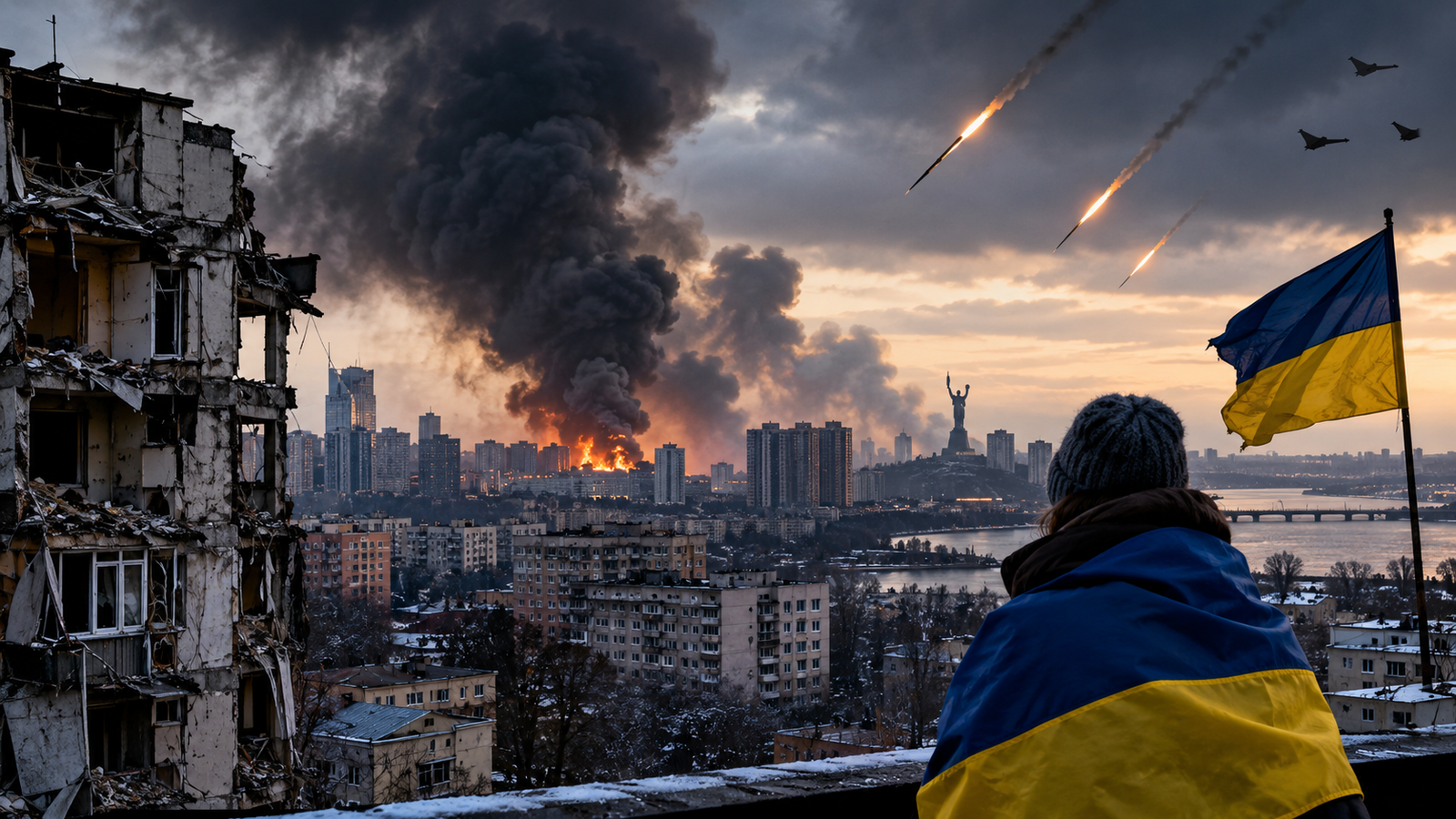
- Ukraine War: Russia attacks Kyiv with missiles and drones targeting civilian, digital and economic infrastructure.
- Ukraine faces another difficult winter as Russian strikes threaten energy and communications networks.
- Western support continues, but Kyiv faces growing pressure as global attention shifts toward the Middle East.
Ukraine War continues as Kyiv is once again being tested by a Russian campaign that is no longer aimed only at military targets. The latest missile and drone attacks suggest a broader strategy: exhaust civilians, disrupt the infrastructure of everyday life and increase pressure on Ukraine’s political leadership as diplomacy struggles to produce a ceasefire.
On September 25, Russian attacks killed at least seven people in Kyiv and injured dozens more, including children. The bombardment continued into Saturday, with another drone striking an office building in the capital’s Solomianskyi district.
Amid intensified Ukraine War, the significance of the latest attacks lies not simply in their intensity but in the widening range of targets. Russia has increasingly focused on the digital and economic infrastructure that keeps modern Ukraine functioning. Data centres and internet providers in Kyiv have been hit, temporarily disrupting connectivity for roughly 100,000 households. A strike on the offices of telecommunications company Datagroup killed four people.
This represents an important evolution in Russia’s air campaign. The objective is not merely to destroy electricity generation or military facilities. It is to make ordinary life increasingly difficult.
READ NEXT: Ukraine Runs Out of Interceptors as Russian Missiles Strike Kyiv, Exposing Western Aid Failure
Banks, payment systems, businesses, government agencies and emergency services depend upon digital connectivity. If these networks repeatedly come under attack, the consequences can spread far beyond the immediate blast zone. Ukraine has spent years developing a relatively decentralised internet infrastructure, but officials now fear that sustained attacks could place critical systems under growing pressure as winter approaches.
The timing is particularly important.
Ukraine is entering another winter after almost five years of full-scale war. Its energy system has repeatedly been attacked, while industrial production has suffered severe disruption. The Guardian reported that Ukraine failed to produce a single tonne of steel this month, underscoring the extent to which Russia’s long-range campaign is now affecting the foundations of the Ukrainian economy.
Yet it would be inaccurate to conclude that Europe has simply abandoned Kyiv.
READ MORE: Ukraine war latest: Cars left burning in another deadly strike on Kyiv – as US puts forward new peace talks location
Europe continues to provide substantial financial and military assistance. On September 18, the European Commission disbursed another €3.3 billion for Ukrainian defence procurement, including drones and missiles. The broader Ukraine Support Loan provides €60 billion for defence and €30 billion for budgetary assistance during 2026-27. Earlier in September, the European Commission also approved €6.1 billion for air and missile defence, ammunition, drones and electronic warfare.
The real problem for Kyiv is therefore not the complete absence of European support. It is the gap between political commitments and the speed, scale and availability of military capabilities needed on the battlefield.
That gap has become particularly visible in air defence.
Ukraine is critically dependent on Patriot systems and interceptors to protect major cities from ballistic missiles. But Patriot supplies have come under additional pressure because of the wider conflict in the Middle East. Washington has also had to balance Ukraine’s requirements against its own military commitments. President Donald Trump has now reportedly approved licences allowing Ukraine eventually to produce Patriot missiles domestically, but building such a capability will take time.
For Kyiv, time is precisely what Russia is trying to take away.
The Middle East has simultaneously absorbed enormous international diplomatic and military attention. The war involving Iran, the disruption of energy markets and the strategic importance of the Strait of Hormuz have pushed Ukraine further down the international news agenda. Trump’s attention has necessarily been divided, while European governments remain unwilling to cross the threshold into direct military confrontation with Russia.
This creates a dangerous strategic paradox. Europe can provide money, weapons and industrial support without entering the war directly. But Russia can continue applying pressure while calculating that NATO governments remain determined to avoid a direct confrontation between Russian and Western forces.
Moscow appears to understand that calculation.
Russia is also facing Ukrainian attacks deep inside its territory. Kyiv has struck Russian oil refineries and facilities associated with missile production, presenting its campaign as an attempt to impose costs on the Russian war machine. The resulting cycle of attack and retaliation is increasingly becoming a long-range war of economic exhaustion.
Energy adds another layer to the problem.
Europe has made considerable progress in reducing its dependence on Russian gas. Russian gas accounted for about 45% of EU gas imports in 2021; by 2025 the share had fallen to about 12%. The European Union has adopted a phased legal ban on Russian gas imports, although Russian gas continues to enter European markets during the transition.
Ukraine, meanwhile, is preparing for another difficult energy season. Poland’s Orlen has agreed to supply Ukraine with three LNG cargoes in early 2027, reflecting Kyiv’s efforts to diversify energy supplies after repeated Russian attacks on its infrastructure.
The political dimension inside Ukraine is equally important, but claims that Ukrainians have broadly “turned against” President Volodymyr Zelenskyy need qualification.
A Kyiv International Institute of Sociology survey conducted from August 21 to September 10 found that 54% of Ukrainians in government-controlled territory said they trusted Zelenskyy, while 41% said they did not. The figure was almost unchanged from the previous month. The survey covered 1,003 adults and excluded Ukrainians living abroad and people in territories not controlled by Kyiv.
There is therefore evidence of significant dissatisfaction, but not evidence of a nationwide collapse in support for Zelenskyy.
The deeper issue is exhaustion.
Millions of Ukrainians have been displaced during the war. Families are living with repeated air-raid alerts, damaged homes, disrupted electricity and uncertain economic prospects. The question increasingly confronting Kyiv is not simply how long Ukraine can continue fighting, but how long its society can sustain the human and economic costs of an open-ended conflict.
That is precisely why the coming winter could become strategically important.
Russia does not necessarily need to defeat Ukraine in a single decisive offensive. It can attempt to erode the country’s infrastructure, economy and civilian resilience while waiting for political calculations in Washington and European capitals to change.
For Ukraine, the danger is that international attention becomes fragmented while Russian pressure remains concentrated.
Kyiv therefore enters the winter neither abandoned by Europe nor securely protected by it. It remains dependent on Western weapons, European financing, American technology and its own increasingly sophisticated military-industrial effort.
The central geopolitical question is whether that support can arrive quickly enough to prevent Russia from converting Ukraine’s infrastructure crisis into a political crisis.
The battlefield may determine the military balance. But this winter, the struggle for Ukraine could increasingly be decided in homes without heat, offices without internet, factories without power and cities waiting for the next air-raid alarm.
That is the pressure Moscow is now applying to Kyiv.