



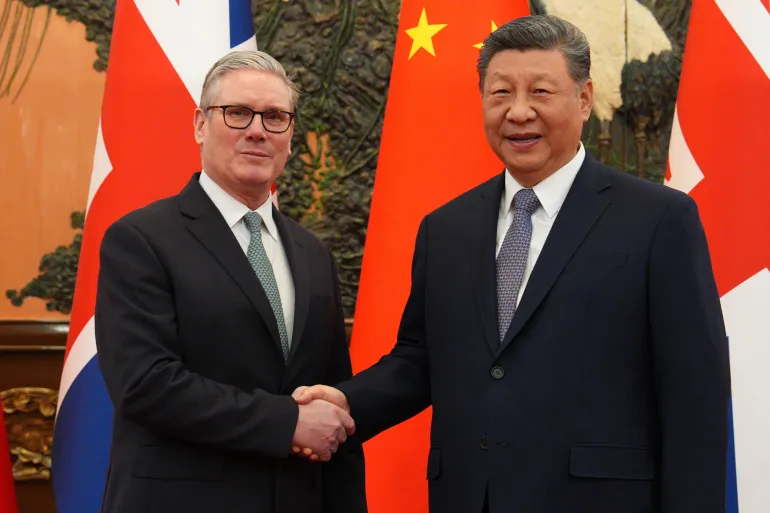
- UK’s Prime Minister Starmer Stuns West as UK-China relations reach new heights as Starmer secures tariff cuts, visa relaxations, and market access for professional services.
- AstraZeneca pledges $15 billion investment in China, demonstrating confidence in bilateral trade.
- Starmer openly defies U.S. warnings, signaling Britain’s independent foreign policy stance.
- China lifts travel restrictions for critical UK lawmakers, emphasizing pragmatic engagement.
In a statement that sent shockwaves through Washington and European capitals alike, UK Prime Minister Keir Starmer declared on Friday that it would be “foolhardy” for Britain to ignore China, signaling a striking shift in London’s approach to Beijing.
Speaking from Shanghai, Starmer’s candid acknowledgment broke with decades of cautious Western rhetoric and positioned Britain as a pragmatic player willing to hedge against U.S. unpredictability.
Starmer’s remarks came as he concluded a high-profile visit to China, accompanied by one of the most powerful British delegations in memory, including industrialists, investors, businessmen, and senior political figures.
China Emerges as Global Trade Anchor as US Allies Pivot from Trump’s America First Policies
Over three hours of talks with President Xi Jinping, Britain secured tariff reductions on its whisky exports, relaxed visa rules, and made progress on market access for professional services—a rare acknowledgment of concessions from the world’s second-largest economy.
“For the UK to be the only country that refuses to engage would not be in our national interest,” Starmer told the BBC, underlining the geopolitical realism driving his visit. The timing was significant: French President Emmanuel Macron recently visited China, and German Chancellor Friedrich Merz is scheduled to follow, leaving Britain at risk of falling behind in Europe’s broader China engagement.
Trump says ‘very dangerous’ for UK to do business with China as Starmer lands in Shanghai
The visit also delivered major commercial gains. British pharmaceutical giant AstraZeneca committed to a $15 billion investment in China, while smaller Chinese investments in Britain were also announced, signaling a mutual, if cautious, economic opening. Earlier, Starmer met with executives from Chery Motors, which plans to establish a research and development centre for commercial vehicles in Liverpool.
While Starmer’s pragmatism was clear, the U.S. reaction underscored the delicate balance he is attempting to strike. President Donald Trump labeled closer UK-China ties as “very dangerous” but did not elaborate. Washington, however, had been briefed in advance, and Starmer emphasized that London need not choose between its traditional ally and Beijing.
UK-China Trade and Investment: Why the Starmer Visit Signals a New Economic Era
This marks a noticeable departure from Starmer’s usual diplomatic restraint. Over the past weeks, he has openly challenged Trump, demanding apologies for disparaging NATO allies and rejecting proposals to annex Greenland from Denmark, signaling a UK leader increasingly willing to assert independence in foreign policy.
China’s response has been measured. Alongside economic concessions, Beijing agreed to lift travel restrictions on a group of British lawmakers previously critical of China’s human rights and security policies. While full commentary from China’s foreign ministry was not immediately available, the willingness to engage on both economic and political fronts illustrates Beijing’s interest in cultivating Britain as a key European partner outside the immediate orbit of U.S. influence.
Starmer’s visit reflects more than opportunistic trade diplomacy; it is a strategic recalibration by Britain’s centre-left Labour government, which has struggled to deliver robust economic growth since taking office in 2024. “We have a business delegation of 60 leaders, and you only need five minutes with them to see what a difference it will make to our economy,” Starmer noted.
The implications are unmistakable: Britain, once a staunch critic of China, is now openly signaling that engagement is not only inevitable but essential. In doing so, Starmer has subtly challenged the Western consensus on China, raising questions about U.S. leverage over its closest allies and underscoring the limits of Washington’s ability to dictate Europe’s economic and strategic choices.
As Starmer departs China, the message is clear to Beijing and to the world: the UK is prepared to pursue its interests independently, balancing economic opportunity against geopolitical caution, and redefining Europe’s approach to China in 2026.