



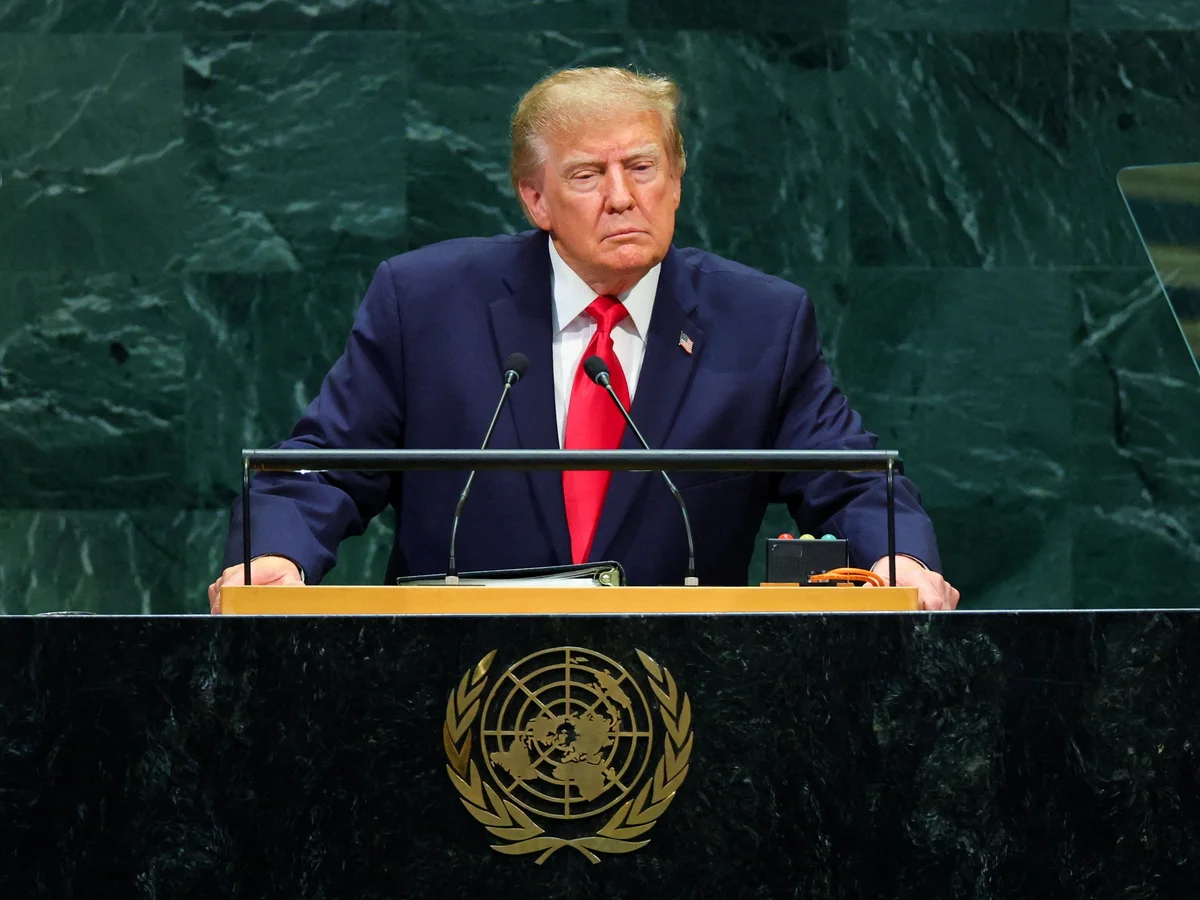
- UNGA 2026 Speeches featured U.S. President Donald Trump presenting an ultimatum to Tehran, demanding total compliance while touting unilateral military deterrence.
- Iranian President Masoud Pezeshkian delivered a defiant address rejecting foreign aggression, keeping mediator channels open despite a U.S. delegation walkout.
- Prime Minister Shehbaz Sharif framed multilateralism as vital for regional peace, demanding water sovereignty over the Indus Basin and highlighting climate vulnerabilities.
- Ukrainian President Volodymyr Zelenskyy urged the international community to starve Moscow’s war economy by targeting Russian energy revenues.
The rubber hit the road this week at the United Nations General Assembly at a time of supreme global urgency. With the Middle East crisis reverberating through global energy markets, artificial intelligence raising existential anxieties, and the high-stakes power rivalry between the United States and China offering sparse room for compromise, world leaders converged on New York to stake their claims, project defiance, and navigate an increasingly fragmented geopolitical landscape.
READ NEXT: Falkland Islands crisis escalates as Javier Milei warns UN of unilateral action over oil drilling
From explosive ultimata at the rostrum to momentous shifts in Latin American leadership and quiet diplomatic overtures in the corridors, the opening days of the high-level debate revealed a international community grappling with coercive diplomacy, shifting alliances, and raw geopolitics.
1. Donald Trump: Coercive Diplomacy and “Super Intelligence”
Taking center stage, US President Donald Trump delivered an address characterized by stark choices and transactional foreign policy. Dominating his speech was an unyielding warning directed toward Tehran. Framing his decision as a post-midterm choice, Trump declared that he faces two options regarding Iran: seal a comprehensive deal after the November elections or “annihilate the Islamic Republic”. Calling on all member nations to enforce total economic isolation on Iran, Trump asserted that American strikes had effectively halted Tehran’s nuclear momentum while reiterating a willingness to strike key sites instantly if activity resumes.
Beyond Iran, Trump pointed to his diplomatic interventions across global flashpoints. He singled out Prime Minister Shehbaz Sharif of Pakistan as a “terrific man,” quoting Sharif’s praise that US mediation had saved millions of lives during the May confrontation between India and Pakistan. Addressing the conflict in Eastern Europe, Trump expressed optimism that a peace agreement between Kyiv and Moscow is imminent. On technological supremacy, Trump announced a rhetorical pivot, stating the US would reframe artificial intelligence under the banner of “super intelligence,” while taking aim at traditional multilateral bodies by describing the International Court of Justice as “evil.”
                       ┌────────────────────────────────────────┐
                       │     KEY GA GAUNTLETS & RHETORIC        │
                       └───────────────────┬────────────────────┘
                                           │
         ┌─────────────────────────────────┼────────────────────────────────┐
         │                                 │                                │
         ▼                                 ▼                                ▼
┌─────────────────┐               ┌─────────────────┐              ┌─────────────────┐
│  UNITED STATES  │               │      IRAN       │              │    PAKISTAN     │
│  • Post-midterm │               │ • "Did not bend │              │ • Multilateral- │
│    ultimatum to │               │   the knee"     │              │   ism as vital  │
│    Tehran       │               │ • Defiant tone  │              │ • Focus on      │
│  • "Super Intel"│               │ • Pictures of   │              │   Indus Basin   │
│    branding     │               │   strike victims│              │   & Kashmir     │
└─────────────────┘               └─────────────────┘              └─────────────────┘
2. Masoud Pezeshkian: Defiance Amid Diplomatic Apertures
Addressing the assembly despite uncertainties surrounding his delegation’s transit, Iranian President Masoud Pezeshkian offered a calculated mix of ideological defiance and diplomatic pragmatism. Rejecting accusations of state-sponsored terror, Pezeshkian maintained that Tehran’s actions constituted self-defense against covert aggression and strikes on its domestic targets.
READ MORE: Iran’s president hits out at ‘bully’ Trump in UN speech but signals willingness to talk
“We have only defended ourselves. We are not terrorists,” Pezeshkian stated, holding up photos of children killed in a civilian strike on Minab. Addressing Washington directly, he noted: “Yes, they did hit us, but we did not bend the knee.” The address prompted a walkout by the US delegation. Yet, behind the public confrontation, preliminary channels remained visible; reports confirmed that Iranian foreign minister Abbas Araghchi and US envoys engaged in mediator-led discussions regarding crucial shipping corridors in the Strait of Hormuz.
3. Delcy Rodríguez: Venezuela’s Political Shift
In her debut UN General Assembly address, acting Venezuelan President Delcy Rodríguez signaled a turning point for Caracas following the dramatic extractions and political shifts of early 2026. Speaking as former president Nicolás Maduro remains detained in a Brooklyn facility awaiting trial, Rodríguez declared that “today, Venezuela is being reborn.”
Rodríguez outlined steps toward internal political dialogue with opposition factions and pledged future electoral processes, following high-stakes negotiations that opened the country’s vast hydrocarbon reserves to international investment. Her presence highlighted the rapid realpolitik unfolding in the region, punctuated by a bilateral meeting with President Trump to discuss energy, mining, and regional security cooperation—even as key opposition figures face ongoing access barriers domestically.
+-------------------+-------------------------------------------------------------------+
| LEADER            | CORE GEOPOLITICAL MESSAGE & KEY HIGHLIGHTS                        |
+-------------------+-------------------------------------------------------------------+
| Donald Trump      | Frame: Coercive diplomacy; complete economic isolation of Iran;   |
| (United States)   | fast-tracked Ukraine deal; re-branding AI to "super intelligence". |
+-------------------+-------------------------------------------------------------------+
| Masoud Pezeshkian | Frame: Resistance to unilateral sanctions; holding images of      |
| (Iran)            | civilian casualties while keeping mediator channels open for trade.|
+-------------------+-------------------------------------------------------------------+
| Shehbaz Sharif    | Frame: Championing multilateralism; Indus Water Treaty rights;    |
| (Pakistan)        | humanitarian focus on Gaza; climate vulnerability & flood losses. |
+-------------------+-------------------------------------------------------------------+
| Volodymyr         | Frame: Targeted economic containment; crippling Kremlin oil       |
| Zelenskyy         | revenues; preparedness for upcoming harsh winter energy warfare.  |
+-------------------+-------------------------------------------------------------------+
| Delcy Rodríguez   | Frame: National rebirth; structural economic reforms; expanding   |
| (Venezuela)       | international energy partnerships on the global stage.            |
+-------------------+-------------------------------------------------------------------+
4. Shehbaz Sharif: Multilateralism, Water Sovereignty, and Climate Crisis
Prime Minister Shehbaz Sharif of Pakistan framed his address around the indispensable need for multilateral cooperation to solve regional and existential threats. Reaffirming Pakistan’s belief in peaceful dispute resolution, Sharif recalled the May border escalation with India, noting that despite operating from a position of strategic strength, Islamabad opted for a ceasefire to preserve peace in South Asia.
Turning to core national interests, Sharif called for a structured, result-oriented dialogue with New Delhi regarding the Indus Water Treaty, asserting the inseparable rights of Pakistan’s 240 million citizens over regional water resources. He reaffirmed Islamabad’s principled support for Kashmir’s right to self-determination and drew a poignant parallel between regional loss and the plight of Palestinians in Gaza, declaring that “the smallest coffins are the heaviest to carry.”
Highlighting domestic vulnerabilities, Sharif brought the ongoing climate catastrophe back into international focus. Pointing out that Pakistan contributes under 1% of global greenhouse emissions yet suffers catastrophic, recurrent mega-floods, he called for structural equity in global climate finance while praising regional infrastructure initiatives under China’s Global Governance framework.
5. Volodymyr Zelenskyy: Target the Aggressor’s Coffers
Ukrainian President Volodymyr Zelenskyy delivered an austere assessment of the war in Eastern Europe as it approaches another brutal winter. Focusing squarely on economic levers, Zelenskyy argued that the most effective path to ending aggression is starving the Kremlin of trade revenues.
“When someone gives Russia more money through trade, they give this war more time,” Zelenskyy stated, defending Ukraine’s targeted strikes on refinery infrastructure while urging Western allies to tighten trade restrictions. Addressing the domestic front, he warned that while Moscow intends to target Ukraine’s civil energy grid during cold months, Kyiv possesses the drone capability to ensure the economic pain is mutual, even as diplomatic channels for potential trilateral summits remain open.
6. Sidelined Giants and Parallel Debates
Notable for his absence at the podium was Chinese President Xi Jinping, represented at UNGA by Vice President Han Zheng. Instead, Beijing chose to engage Washington directly in high-level bilateral summits covering AI safety, trade extensions, and cross-strait stability, underlining how major power negotiations increasingly unfold in parallel alongside formal assembly sessions.
Meanwhile, European leaders used the rostrum to champion international law. French President Emmanuel Macron defended the authority of international courts, calling for a “double moratorium” on energy and Black Sea shipping attacks. In his UN debut, UK Prime Minister Andy Burnham focused on the governance of artificial intelligence, framing AI as a transformative driver of economic growth that demands robust international guardrails to mitigate global security risks.
As the curtain closes on the opening sessions, the 81st General Assembly leaves behind a stark blueprint of contemporary geopolitics: an international order navigating sharp power plays, where multilateral diplomacy operates under the heavy shadow of unilateral leverage.