



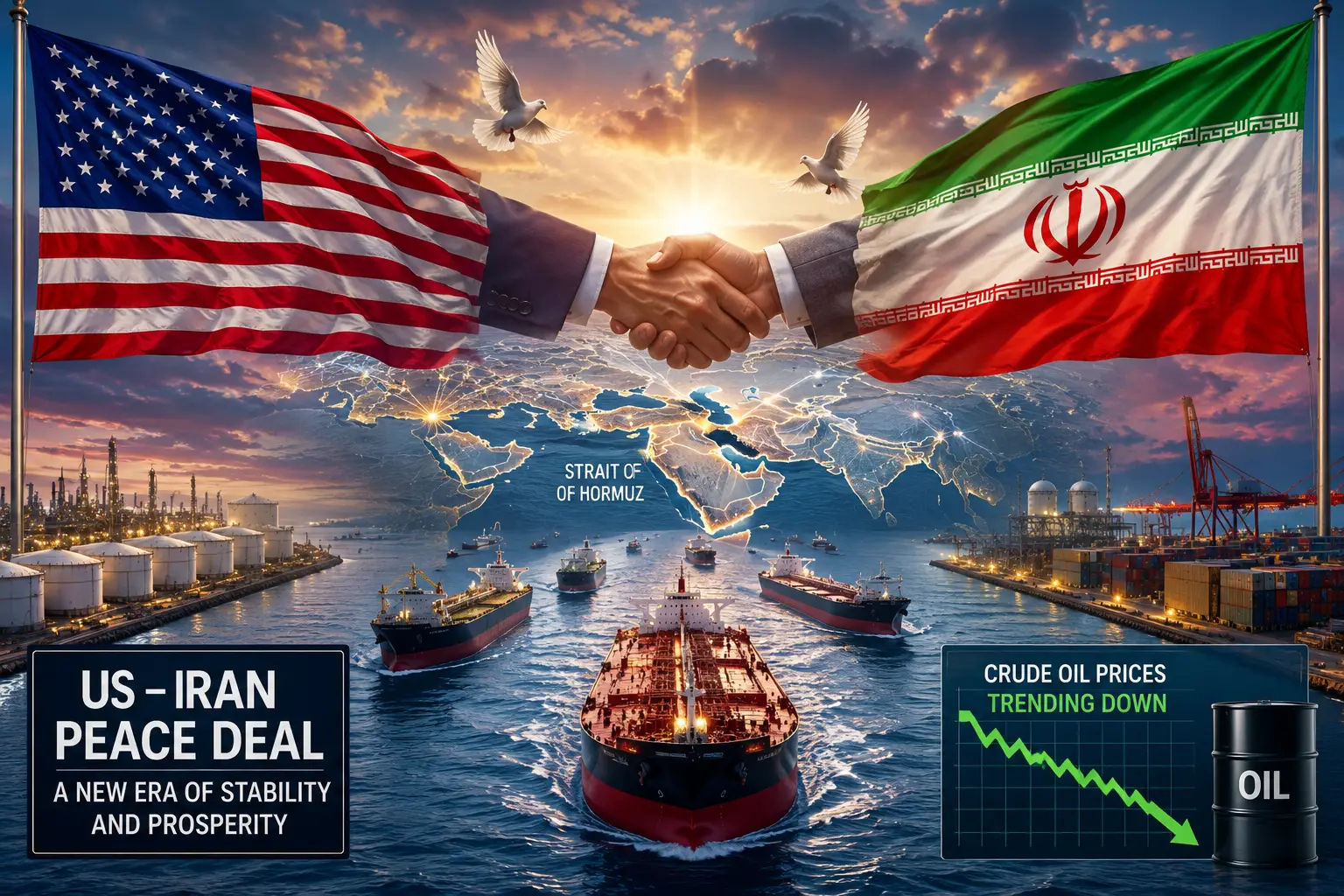
- US Iran peace deal: US and Iran move toward final peace agreement after months of conflict
- President Trump halts strikes while Tehran suspends retaliatory actions
- Pakistan-led mediation backed by global powers drives breakthrough
- Oil prices decline as global trade routes and key ports regain momentum
The Iran war is now expected to end within a week, as both Washington and Tehran move decisively toward signing a final agreement—marking a dramatic de-escalation after months of high-stakes confrontation that had pushed the Middle East and global markets to the brink.
Diplomatic sources confirm that the framework of the deal has already been finalized, largely through Pakistan’s quiet but decisive mediation, backed by the strategic weight of Saudi Arabia, Turkey, China, Russia, and Egypt. The emerging consensus reflects not just a bilateral understanding between the United States and Iran, but a broader geopolitical alignment aimed at preventing a prolonged regional war.
In a striking shift in tone, President Donald Trump declared on Thursday that the United States is “very close” to concluding peace arrangements with Tehran. More importantly, he confirmed that Washington has halted further military strikes, reversing earlier threats to escalate attacks and even seize Iran’s critical oil infrastructure, including Kharg Island. The pause in hostilities signals a calculated pivot from coercion to closure.
“Iran will be spared,” Trump told reporters, adding that the documents are in “pretty final shape” and could be signed within days. While he stopped short of providing specific terms, U.S. officials suggest that Tehran has moved closer to meeting key American demands regarding its nuclear program.
Fragile Pause in Gulf War: Trump Claims Victory While Middle East Braces for Oil Price Surge
On the other side, Iran has mirrored this restraint. Despite earlier retaliatory strikes targeting U.S.-linked installations across the Gulf, Tehran has now paused offensive operations. Though Iranian officials remain publicly cautious—stating that no final decision has been announced—the shift in military posture underscores a tacit acceptance of the diplomatic track.
Even Israel, which had maintained a more aggressive stance throughout the conflict, has aligned itself with the emerging ceasefire dynamics, signaling a broader regional acceptance of de-escalation.
The breakthrough did not emerge in isolation. Behind the scenes, Pakistan played a pivotal role in bridging the trust deficit between Washington and Tehran. The proposed agreement, initially framed as a 60-day transitional Memorandum of Understanding, outlines a phased “relief-for-compliance” mechanism—linking sanctions relief to verifiable Iranian commitments. Saudi Arabia and Turkey lent critical diplomatic support, while China and Russia ensured strategic backing, transforming the initiative into a multilateral effort.
Trump Cancels Iran Strikes, Says Peace Deal Could Be Signed in ‘Coming Days
Qatar also contributed by shuttling revised proposals between Tehran and Washington, with its leadership confirming “progress” in ongoing negotiations, though stopping short of endorsing Trump’s optimism.
One of the central sticking points—Iran’s demand for immediate access to tens of billions of dollars in frozen assets—appears to be narrowing. Negotiators are reportedly exploring staggered financial releases tied to compliance benchmarks, a compromise that could unlock the deal.
The impact of this imminent peace has already begun to ripple across global markets. Maritime activity is rapidly picking up across key ports, including Singapore, the United Arab Emirates, Qatar, and Pakistan’s Gwadar. Shipping lanes that had been paralyzed by tensions in the Strait of Hormuz are gradually reopening, restoring confidence in global supply chains.
Energy markets are responding in kind. Crude oil prices, which had surged amid fears of prolonged disruption, are now trending downward as the risk premium fades. Analysts suggest that a formal reopening of the Strait of Hormuz—expected immediately after the agreement is signed—could stabilize prices further and ease inflationary pressures worldwide.
The geopolitical implications are equally significant. For the Trump administration, the deal offers a high-profile diplomatic victory ahead of mounting domestic scrutiny and pressure from Republican hardliners wary of repeating the 2015 nuclear agreement. Senator Lindsey Graham and other allies have already signaled that any deal will face rigorous congressional review.
For Iran, the agreement provides a pathway out of economic isolation without a full capitulation to U.S. demands—preserving strategic leverage while alleviating domestic economic strain.
Yet, despite the optimism, uncertainties remain. The agreement has not been formally signed, and past negotiations have collapsed at the final stage. Trump himself has previously declared deals “imminent” only for talks to unravel.
Still, the current convergence of military restraint, diplomatic momentum, and global stakeholder alignment suggests that this time may indeed be different.
If the agreement is finalized as expected—potentially at a signing ceremony in Europe within days—it would mark not just the end of a volatile chapter in U.S.-Iran relations, but a rare instance of coordinated global diplomacy successfully averting a wider war.
For now, the guns have fallen silent, the oil is flowing again, and the world watches as a fragile peace edges closer to reality.