



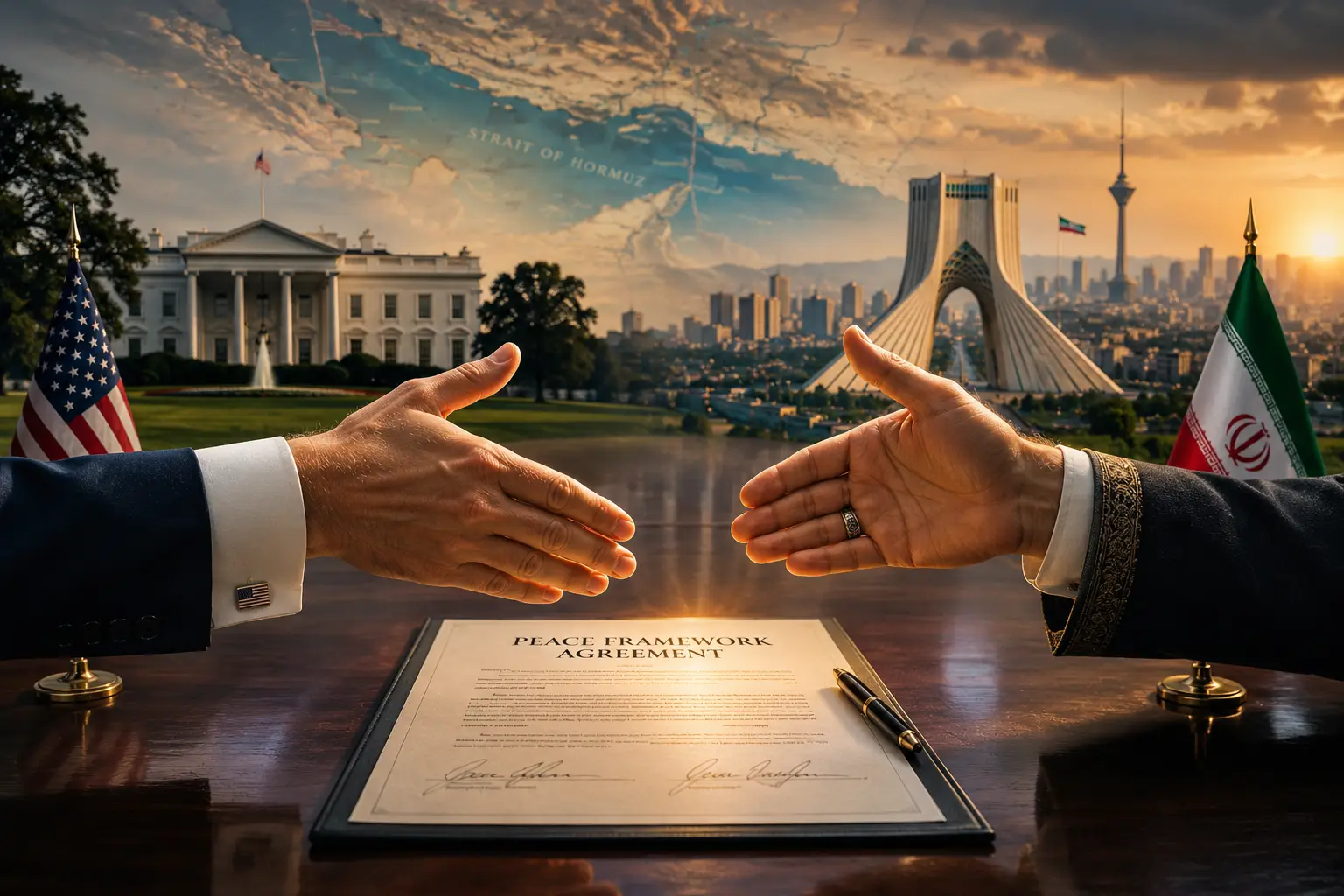
- US Iran Peace Deal reaches advanced stage with 80% agreement confirmed by officials
- Trump announces breakthrough while Pakistan confirms finalized draft text
- Iran awaits supreme leader approval, delaying final signing of historic accord
- Deal includes sanctions relief, nuclear rollback, and phased regional de-escalation
WASHINGTON — The United States and Iran have reached a profound and potentially historic understanding on the core contours of a peace agreement, with both sides now moving into the final phase of securing formal approval and implementation, according to senior officials across three governments directly involved in the negotiations.
President Donald Trump announced the breakthrough late Friday, declaring that “we just made a great settlement of the war with Iran,” signaling what could become the most consequential diplomatic shift in the Middle East in years. His statement was swiftly reinforced by Pakistan’s Prime Minister Shehbaz Sharif, whose government has played a central mediating role.
“Setting aside the noise, we can confirm that a final, agreed-upon text of the peace deal has been reached,” Mr. Sharif said, adding that Islamabad was now working “closely” with both Washington and Tehran to finalize the next steps.
Senior officials on both sides describe the agreement as roughly 80 percent complete, with technical, political, and procedural hurdles still remaining — most notably the need for final endorsement from Iran’s supreme leadership.
Pakistan Leads Historic Breakthrough as US and Iran Move Toward Peace Agreement
A senior Iranian official, speaking to The Islamabad Telegraph on condition of anonymity due to the sensitivity of the process, cautioned that while the framework has been agreed, internal approval could take time.
“Well, as far as I know, to contact the supreme leader it takes a lot of time as it has to be written only and through various middlemen so that these Israeli can’t do him any harm. It may take some more time,” the official said.
At the heart of the emerging agreement is a phased framework designed to halt hostilities while laying the groundwork for a broader nuclear settlement. Under the proposed terms, Iran would commit not to develop or acquire nuclear weapons and would begin dismantling its stockpile of highly enriched uranium. In return, the United States would gradually ease sanctions, offering Tehran a pathway toward economic recovery.
U.S. and Iran close to signing peace deal, officials say
The deal is structured as a “relief-for-performance” mechanism: the more Iran complies with nuclear rollback measures and regional de-escalation commitments, the more economic benefits it would receive. These include the potential lifting of sanctions, the reopening of trade channels, and eventual access to frozen financial assets — though U.S. officials insist that no upfront cash payments will be made.
A critical early component of the agreement would trigger a 60-day transitional period. During this phase, Iran would reopen the Strait of Hormuz — a vital artery for global oil shipments — while the United States would scale back its naval and economic blockade of Iranian ports. The reopening of the strait is expected to stabilize global energy markets, which have been rattled by months of disruption.
Yet, even as optimism builds, significant uncertainties remain. Iranian officials have emphasized that the nuclear component of the negotiations — the most contentious issue — has effectively been deferred to a second stage of talks. “The nuclear issue has been postponed to the final agreement,” Iran’s foreign minister said earlier, underscoring the complexity of bridging longstanding differences.
Within Iran, the draft agreement is still being reviewed by powerful security factions, including elements of the Islamic Revolutionary Guard Corps, whose approval is not guaranteed. These groups have historically taken a harder line, prioritizing strategic deterrence over diplomatic compromise.
On the American side, officials say the Trump administration believes it is negotiating from a position of strength. Iran’s diminished control over the Strait of Hormuz and increased international pressure have shifted the balance, allowing Washington to push for stricter commitments on nuclear dismantlement and regional conduct.
“Their system is very complicated,” one senior U.S. official said. “Most of the people with authority want to sign this deal — but not everybody.”
The road to this moment has been marked by volatility. The conflict began on February 28 with joint U.S.-Israeli strikes on Iranian targets, followed by 39 days of intense fighting before a fragile ceasefire was reached in April. That truce has since been repeatedly tested by sporadic escalations, including recent exchanges in the Persian Gulf and Lebanon.
Behind the scenes, a flurry of diplomatic activity over the past 48 hours appears to have been decisive. Officials described an “all-hands-on-deck” effort, with President Trump personally involved in refining key provisions of the agreement, particularly those concerning the disposal of nuclear material.
Regional actors, including Gulf states and European governments, have quietly pressed both sides to finalize the deal, fearing that another round of escalation could destabilize global markets and trigger a wider war.
If concluded, the agreement would not only end active hostilities but also open a narrow and uncertain path toward a comprehensive nuclear accord — a goal that has eluded successive administrations for decades.
For now, the world watches as the final pieces fall into place, with one critical signature still pending — and the fate of the agreement resting on a decision that may take time to reach.