



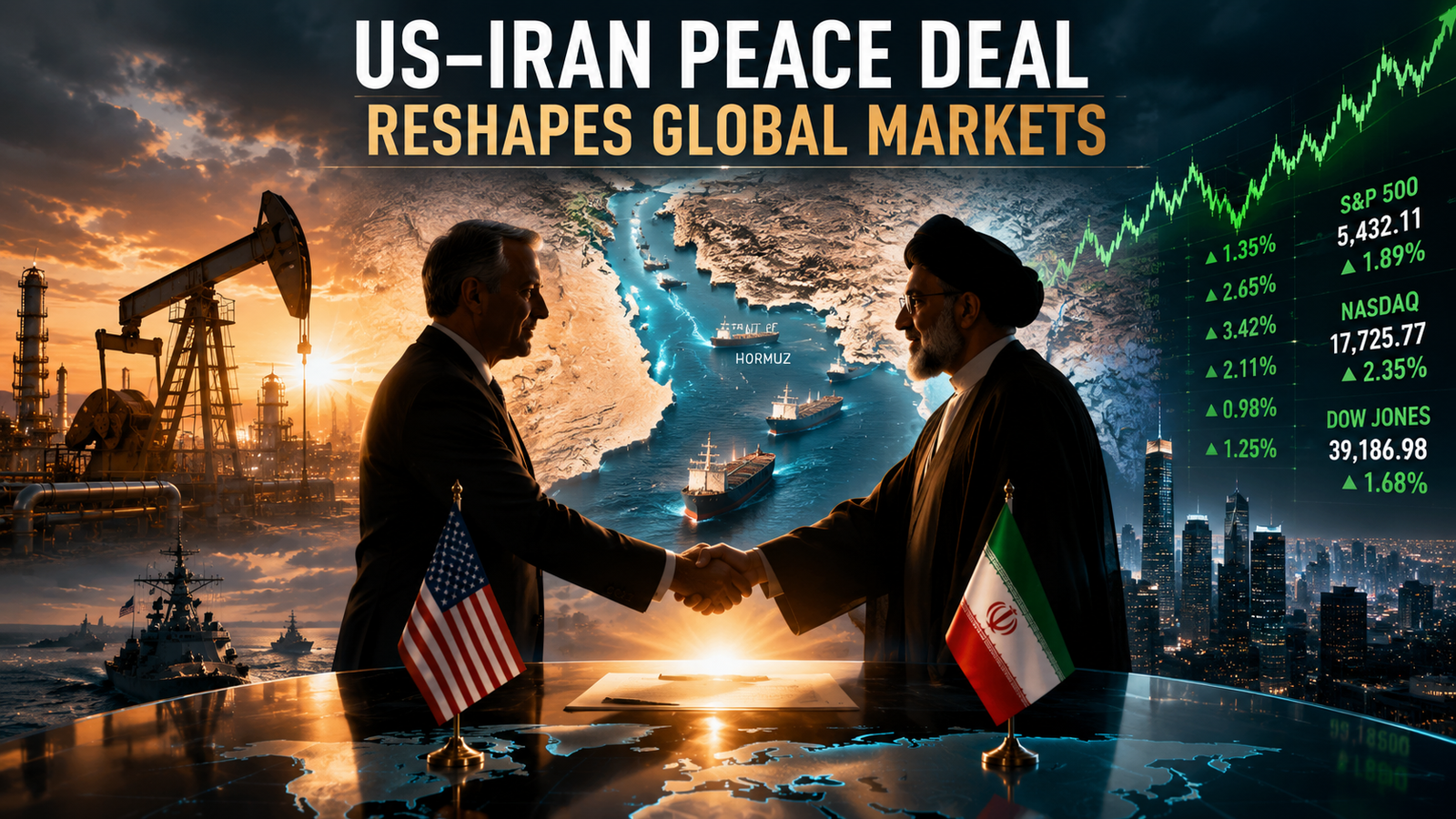
- US Iran Peace Deal: Oil prices decline as markets price in return of Iranian supply
- Inflation outlook improves but remains vulnerable to shocks
- Strait of Hormuz stability remains a critical risk factor
- Central banks expected to stay cautious despite easing pressures
A long-anticipated diplomatic breakthrough between the United States and Iran now appears within reach, triggering a notable shift across global financial markets and strategic policy circles. With an interim agreement expected to be signed within days and a fragile ceasefire already in place, investors have responded with cautious optimism. Oil prices have declined, traditional safe-haven assets such as gold have softened, and energy-sensitive sectors, including airlines and cruise operators, are showing renewed strength. However, despite this early market enthusiasm, the broader implications point to a far more complex and uncertain global outlook.
The most immediate reaction has been visible in energy markets. Expectations that Iranian oil could gradually return to global supply have eased concerns about tight market conditions that dominated during the conflict. This has placed downward pressure on crude benchmarks, offering potential relief to inflation-strained economies, particularly in Europe and emerging markets. However, analysts caution that any sustained decline in oil prices will depend on several factors, including the pace of sanctions relief, Iran’s production capacity, and the strategic decisions of OPEC+ producers.
A key uncertainty remains the security and governance of the Strait of Hormuz, a critical maritime route through which a significant portion of the world’s oil supply passes. While the United States has signaled an end to its naval blockade, the durability of this decision will depend on compliance mechanisms within the agreement. Any disruption in this corridor could quickly reverse recent price declines and reintroduce volatility into global markets.
BREAKING: U.S., Iran Reach Interim Peace Deal After Months of Conflict; Signing Set for June 19 in Switzerland
Geopolitically, the emerging agreement represents a temporary de-escalation rather than a comprehensive resolution. The proposed 60-day negotiation framework highlights the fragility of the process, as core issues—including Iran’s nuclear program, the scope of sanctions relief, and regional security dynamics—remain unresolved. The role of regional actors, particularly Israel, adds another layer of uncertainty. Recent military activity in Lebanon underscores the risk that parallel conflicts could undermine diplomatic progress and destabilize the fragile ceasefire.
Trump’s Iran Deal Raises Questions Set to Dominate G-7
For policymakers, the conflict has exposed structural vulnerabilities that will persist beyond any formal agreement. Energy security is expected to remain a central priority. Governments are likely to expand strategic reserves while accelerating investment in alternative energy sources, including renewables and nuclear power. Europe may intensify efforts to diversify its energy mix, while Asian economies are expected to pursue a balanced strategy that protects both economic growth and supply security.
Defense spending is also likely to increase. At the upcoming G7 summit, the United States is expected to push its allies to raise military expenditures, framing the Iran conflict as evidence of a more volatile and multipolar global environment. This trend could sustain demand for defense-related investments even as energy markets stabilize.
Monetary policy adds another layer of complexity. Although lower oil prices may ease inflationary pressures, central banks are unlikely to shift rapidly toward interest rate cuts. The Federal Reserve, under new leadership, is widely expected to hold rates steady in the near term. However, internal divisions are becoming more apparent, with some policymakers concerned that inflation remains vulnerable to renewed geopolitical shocks, particularly if the peace process falters.
Looking ahead, financial markets are entering a phase of measured optimism rather than sustained stability. While reduced geopolitical risk may support equities in the short term, uncertainty will continue to shape investor behavior. Sectors capable of performing under both scenarios—continued de-escalation or renewed tension—are expected to attract the greatest attention.
The most likely outcome is not a return to pre-conflict conditions, but the emergence of a managed equilibrium characterized by reduced immediate risk alongside persistent underlying tensions. A finalized agreement would mark a significant diplomatic milestone, yet it will not eliminate the structural rivalries that define relations between Washington and Tehran.
In this evolving environment, the global economy is entering a phase where geopolitical risks are less acute but more enduring. The anticipated agreement may provide short-term relief, but it also signals the beginning of a more complex era in which stability is conditional and uncertainty remains a defining feature of the global order.