



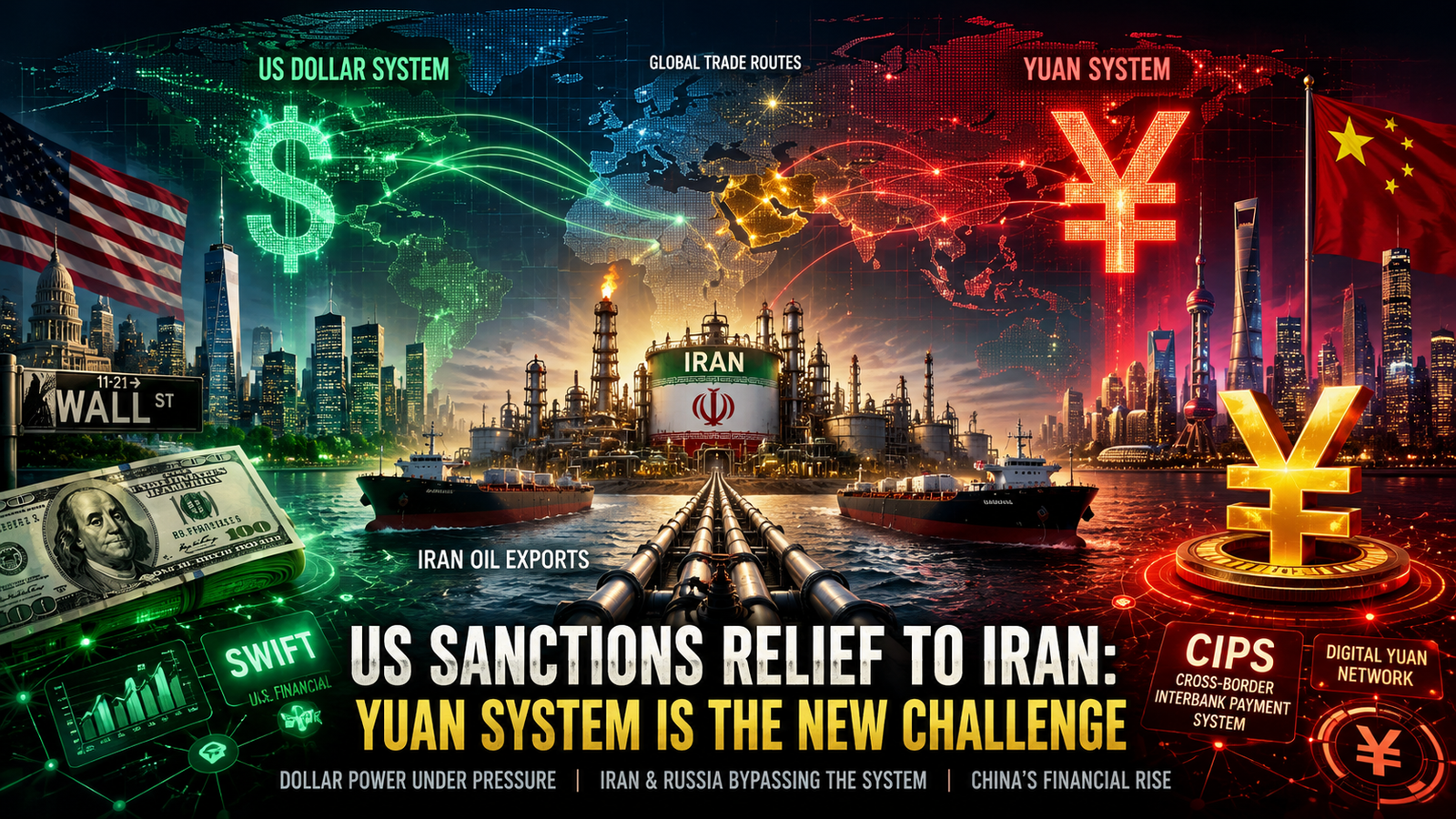
- US Iran sanctions relief yuan system reshapes nuclear deal negotiations as Tehran gains financial independence
- Iran earns billions in oil trade using yuan, bypassing US dollar oversight
- China’s CIPS and digital yuan platforms challenge Western financial dominance
- Russia and other nations increasingly adopt yuan to evade sanctions
The United States has once again turned to a familiar diplomatic lever in its renewed engagement with Iran: sanctions relief. As negotiations unfold over Tehran’s nuclear program, Washington is offering access to nearly $100 billion in frozen assets and easing restrictions on Iranian oil exports in exchange for stricter nuclear oversight and long-term denuclearization commitments. On paper, it reflects a classic American playbook—economic pressure followed by conditional relief.
But beneath the surface, a far more complex reality is taking shape—one that threatens to erode the very foundation of U.S. economic power. The rise of China’s yuan-based financial ecosystem, increasingly adopted by sanctioned states like Iran and Russia, is quietly undermining Washington’s sanctions architecture. And that shift is now casting a long shadow over the effectiveness of any future U.S.-Iran deal.
For decades, the dominance of the U.S. dollar has given Washington unparalleled leverage in global affairs. Nearly 80% of international trade finance is conducted in dollars, and most dollar transactions pass through American-controlled financial institutions. This has allowed U.S. authorities to monitor, restrict, and, when necessary, choke off financial flows to adversaries.
However, that dominance is no longer absolute.
Iran, under intense sanctions pressure since 2018, has spent years building alternative financial pathways—most notably through China. Today, a significant portion of Iran’s oil trade is conducted in Chinese yuan, bypassing the dollar entirely. According to U.S. estimates, Tehran generated up to $43 billion in oil revenues in 2024 alone, much of it settled in yuan rather than dollars.
Pakistan Brokered US Iran Deal Delivers Historic Win-Win for Washington and Tehran
This shift is not merely tactical—it is strategic.
By operating outside the dollar system, Iran effectively shields its transactions from U.S. scrutiny. Payments made in yuan do not pass through American banks, limiting Washington’s ability to track or block them. Instead, these transactions are processed through China’s Cross-Border Interbank Payment System (CIPS), a growing alternative to the Western-dominated SWIFT network.
While still smaller than SWIFT, CIPS is expanding rapidly. Daily transaction volumes have surged, reflecting increased adoption not just by Iran, but also by Russia and other nations seeking insulation from U.S. sanctions. The trend accelerated following Western sanctions on Moscow after the Ukraine war, with more than 90% of Russia-China trade now conducted in yuan or rubles.
For Washington, this represents a structural challenge.
The very premise of sanctions relief hinges on economic leverage—the ability to reward compliance by granting access to global financial markets. But if Iran already has a functioning parallel system, the incentive to comply weakens. In essence, Tehran can negotiate from a position of greater resilience, knowing that its economic survival no longer depends solely on reentry into the dollar-based system.
China’s role in this transformation cannot be overstated.
China Is Luring the World to the Yuan—and Hobbling Western Sanctions
Beijing has spent over a decade laying the groundwork for the yuan’s internationalization. From launching yuan-denominated oil contracts in Shanghai to establishing bilateral currency swap lines with developing countries, China has steadily expanded the currency’s global footprint. More recently, initiatives like the mBridge platform—leveraging blockchain technology for cross-border payments—are pushing the boundaries even further.
These systems are not designed to replace the dollar overnight. Instead, they aim to create parallel channels—financial “lanes” that operate beyond U.S. jurisdiction. For countries facing sanctions or geopolitical pressure, these lanes offer a lifeline.
Iran has been among the earliest and most active adopters.
Investigations reveal a sophisticated network of intermediaries, shell companies, and barter arrangements facilitating Iran-China trade. In many cases, yuan payments for Iranian oil are not even transferred to Tehran directly. Instead, funds are routed through Chinese entities and used to pay for goods and infrastructure projects within Iran. This system minimizes financial exposure while ensuring a steady flow of essential imports.
In some instances, transactions have bypassed traditional currency systems altogether. Barter deals—such as exchanging oil for industrial goods—have re-emerged as a practical workaround. Meanwhile, cryptocurrencies are increasingly being used for smaller, harder-to-trace payments.
Even strategic maritime routes are being influenced. Reports suggest that vessels transiting sensitive waterways like the Strait of Hormuz have been asked to settle fees in yuan or digital currencies—further entrenching non-dollar practices in global trade.
For the United States, the implications are profound.
Sanctions remain a powerful tool, but their effectiveness is diminishing at the margins. Each transaction conducted in yuan instead of dollars represents a small but meaningful erosion of U.S. financial oversight. Over time, these shifts could accumulate into a significant structural change in the global economy.
Yet, it would be premature to declare the end of dollar dominance.
Despite its rise, the yuan still accounts for a relatively small share of global trade finance—around 6% compared to the dollar’s overwhelming lead. Moreover, China’s strict capital controls and managed exchange rate limit the currency’s appeal as a global reserve. For the yuan to truly rival the dollar, Beijing would need to undertake significant economic reforms—moves that carry their own risks.
For now, China’s strategy appears more measured: not replacing the dollar, but weakening its exclusivity.
This nuanced approach is already yielding results. Countries in Asia, the Middle East, and parts of Africa are increasingly exploring yuan-based trade arrangements, particularly in energy markets. Even traditional U.S. partners have signaled openness to diversification, driven by both economic pragmatism and geopolitical considerations.
Against this backdrop, the ongoing U.S.-Iran negotiations take on added significance.
Sanctions relief may still offer Iran tangible benefits—greater access to global markets, improved oil prices, and the unfreezing of critical assets. But it is no longer the all-or-nothing proposition it once was. Tehran now has alternatives, however imperfect, and that changes the negotiating dynamic.
For Washington, the challenge is twofold: securing a robust nuclear agreement while adapting to a rapidly evolving financial landscape. This may require a rethinking of sanctions policy itself—moving beyond reliance on dollar dominance toward more multilateral and technologically adaptive approaches.
US Iran sanctions relief yuan systemThe stakes extend far beyond Iran
At its core, this is a story about the future of global finance. As geopolitical tensions intensify, the world is gradually shifting from a unipolar monetary system to a more fragmented, multipolar one. The dollar will likely remain dominant for the foreseeable future, but its uncontested reign is increasingly being challenged.
And in that shifting landscape, the outcome of the U.S.-Iran talks may serve as a critical test case—not just of diplomacy, but of the enduring power of economic statecraft in a changing world.