



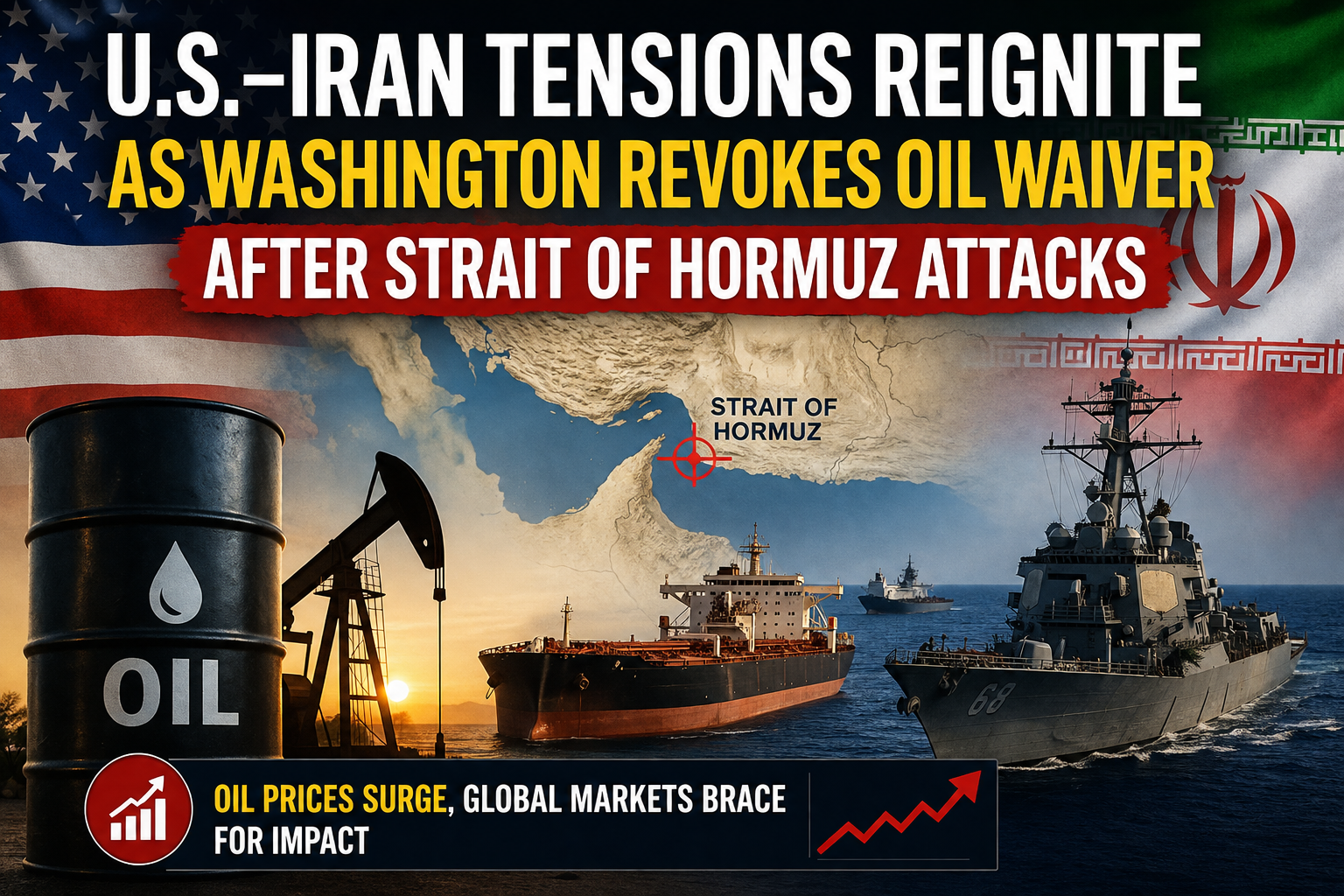
- US Iran Strait of Hormuz oil crisis: The United States revoked Iran’s oil waiver after IRGC attacks on ships in the Strait of Hormuz.
- At least three commercial vessels were targeted, escalating maritime tensions in a critical global oil chokepoint.
- Brent crude surged nearly 5%, signaling renewed volatility in global energy markets.
- The fragile US-Iran interim agreement now risks collapse, threatening global fuel prices and supply chains.
WASHINGTON — The fragile détente between the United States and Iran has sharply deteriorated, with Washington revoking a కీల economic waiver that allowed Tehran to sell oil on global markets, following a series of Iranian attacks on commercial vessels in the Strait of Hormuz. The move signals a renewed escalation between the two adversaries and raises fears of fresh instability in global energy markets.
The U.S. Treasury Department on Tuesday announced the immediate revocation of a license granted on June 21 that had permitted Iran to export oil and repatriate revenues as part of a 60-day interim diplomatic arrangement. The waiver, widely viewed as the central economic incentive underpinning the U.S.–Iran memorandum of understanding (MoU), will now expire fully by July 17, allowing only a short grace period for previously authorized transactions.
The decision came just hours after Iran’s Islamic Revolutionary Guard Corps (IRGC) launched anti-ship cruise missiles and one-way attack drones targeting vessels transiting the strategically vital Strait of Hormuz. According to U.S. officials, at least three commercial ships were struck, while American naval forces intercepted several incoming drones.
READ MORE: Strait of Hormuz Ship Attack: Guard’s Missile Strikes Threaten US-Iran Peace Talks in Islamabad
The latest confrontation marks a significant breakdown in the already fragile agreement reached last month, which had temporarily halted hostilities, reopened the Strait of Hormuz, and led to the lifting of a U.S. naval blockade on Iranian ports. That arrangement was intended as a stepping stone toward a broader nuclear agreement, but progress had remained limited even before this week’s escalation.
Oil Markets React Sharply
Global energy markets responded immediately to the renewed tensions. Brent crude prices surged nearly 5% following the announcement, climbing to approximately $76 per barrel after having stabilized in recent weeks. Analysts warn that the revocation of Iran’s oil waiver—combined with escalating maritime insecurity—could trigger sustained volatility in oil prices and disrupt global supply chains.
The Strait of Hormuz, through which roughly one-fifth of the world’s oil supply passes daily, remains a critical chokepoint. Any disruption to shipping lanes in the region carries immediate and far-reaching implications for global energy security.
REALED NEWS: U.S. Revokes Waiver Allowing Sale of Iranian Oil
Market observers caution that the situation could worsen if military activity intensifies or if the United States reimposes its naval blockade of Iranian ports. American warships are reportedly on standby for such a scenario, underscoring the precarious nature of the current standoff.
Strategic Calculations and Diplomatic Fallout
U.S. officials described Iran’s actions as “unacceptable” and said the revocation of the oil waiver was a direct response intended to impose immediate economic pressure. Despite the escalation, Washington has indicated that it remains open to negotiations aimed at reaching a comprehensive agreement.
However, the latest developments have cast serious doubt on the viability of ongoing diplomatic efforts. The interim MoU had been built on two foundational pillars: limited sanctions relief for Iran—primarily through oil exports—and guaranteed safe passage for commercial vessels in the Strait of Hormuz. Both elements now appear to be under significant strain.
Iran had relied on the waiver to access much-needed foreign currency through oil sales, while the United States viewed uninterrupted maritime traffic as essential to maintaining stability in global energy markets. With both sides now failing to secure these core objectives, the agreement risks unraveling entirely.
Compounding tensions, U.S. officials expressed surprise at the timing of Iran’s attacks, which occurred amid ongoing negotiations and during a sensitive political period following the funeral of Iran’s former Supreme Leader, Ayatollah Ali Khamenei. Efforts to establish a military deconfliction channel between U.S. forces and the IRGC have reportedly stalled, further increasing the risk of miscalculation.
Shipping Lanes Under Threat
In recent days, the United States had been coordinating closely with commercial shipping operators to establish a secure maritime corridor along the southern edge of the Strait, near Oman’s coastline. However, Iranian forces warned that vessels using this route could be targeted, signaling a willingness to challenge U.S.-backed navigation efforts.
Tuesday’s attacks appear to have followed through on that threat, raising concerns among shipping companies and insurers. Maritime security experts warn that sustained targeting of vessels could lead to a sharp increase in shipping costs, insurance premiums, and transit delays—factors that would ultimately translate into higher global energy prices.
Uncertain Path Forward
Diplomatic sources indicate that talks between U.S. and Iranian negotiators have made little substantive progress toward a final nuclear agreement. Technical discussions remain in early stages, and key issues—including uranium enrichment limits, sanctions relief, and the release of frozen Iranian assets—have yet to be resolved.
Policy analysts suggest that the current crisis highlights the inherent fragility of the interim arrangement. “Iran seeks economic relief, while the United States prioritizes energy security and non-proliferation,” one former U.S. official noted. “Without a more comprehensive follow-on agreement, the current framework is unlikely to hold.”
The reimposition of economic pressure through the oil waiver revocation underscores Washington’s strategy of leveraging financial tools to influence Iranian behavior. However, Tehran’s willingness to escalate militarily in response suggests that both sides remain locked in a cycle of pressure and retaliation.
Global Implications
The renewed confrontation between the United States and Iran is expected to have immediate and adverse effects worldwide. Energy-importing nations, particularly in Asia and Europe, could face rising fuel costs, while emerging markets may experience inflationary pressures linked to higher oil prices.
For now, the Strait of Hormuz remains open but increasingly volatile. With military assets on high alert and diplomatic channels under strain, the risk of a broader conflict cannot be ruled out.
As the situation unfolds, the world is once again witnessing a high-stakes geopolitical confrontation at the heart of the global energy system—one that threatens to undo recent progress and plunge markets back into uncertainty.