



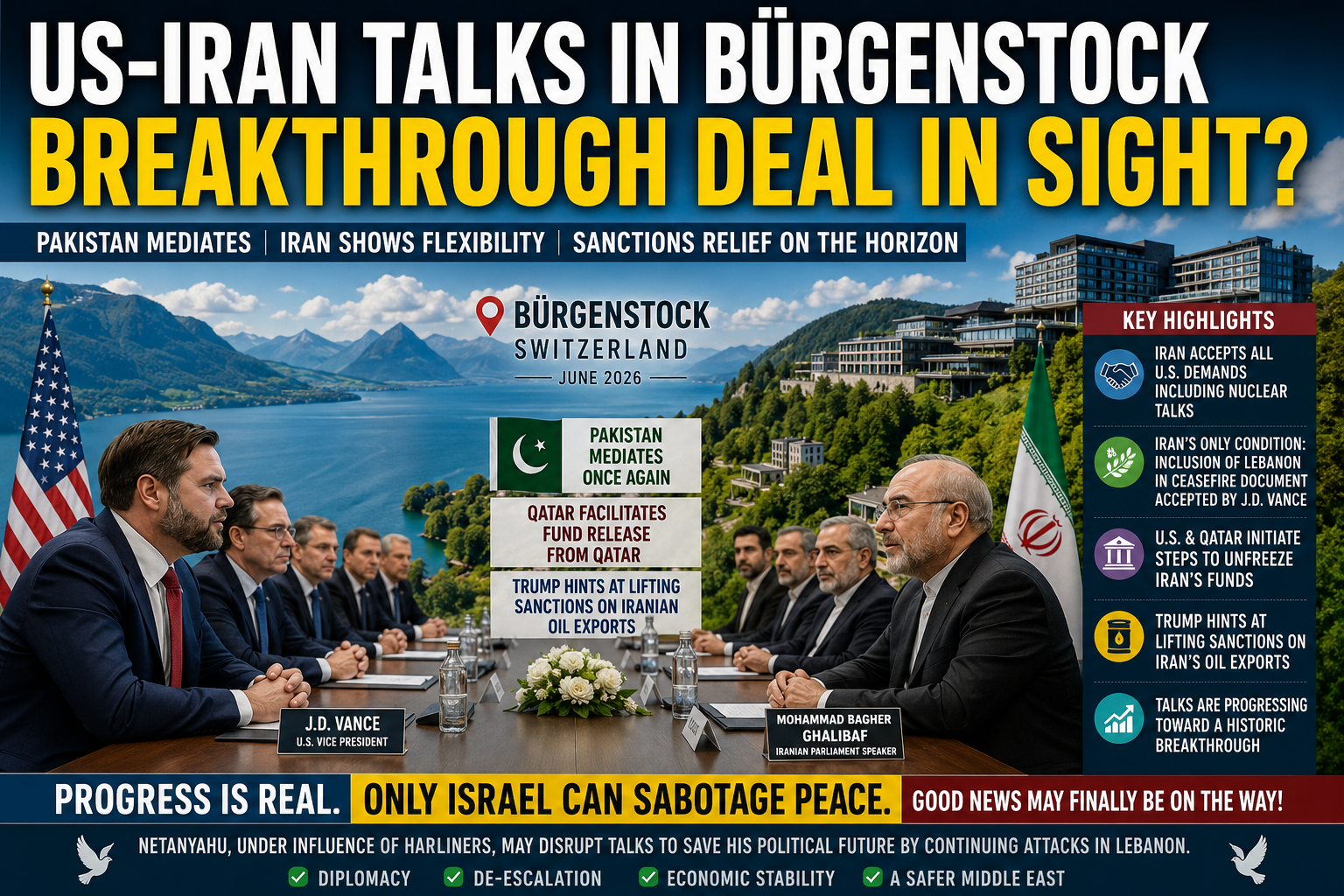
- US Iran Talks Bürgenstock enter decisive phase with strong confidence from all sides
- Pakistan emerges as key mediator bridging Washington and Tehran
- Iran agrees to nuclear discussions, demands Lebanon ceasefire inclusion
- Sanctions relief and oil export flexibility signal major economic shift
BÜRGENSTOCK, Switzerland — High-stakes diplomacy has returned to the Alpine heights of Bürgenstock, where Pakistan is once again mediating between the United States and Iran in what officials on all sides describe as the most promising round of negotiations since the conflict began earlier this year.
Unlike previous encounters marked by deep mistrust and brinkmanship, this latest round has opened with an unusual sense of confidence. Delegations from Washington and Tehran, led by U.S. Vice President J.D. Vance and Iranian parliamentary speaker Mohammad Bagher Ghalibaf, have entered direct talks following preliminary consultations with Pakistani and Qatari mediators.
Diplomats familiar with the process say the mood is markedly different: less adversarial, more transactional—and, crucially, forward-looking.
At the heart of the renewed optimism lies a significant shift in Iran’s posture. According to multiple sources close to the negotiations, Tehran has signaled its willingness to accept a broad framework of U.S. demands, including substantive engagement on its nuclear program. This includes limits on uranium enrichment, enhanced verification mechanisms, and long-term restrictions that Washington has long sought but struggled to secure.
Iran’s primary condition, however, underscores the regional complexity of the deal. Tehran has insisted that Lebanon be explicitly included in the ceasefire architecture tied to the broader agreement. That demand appears to have been met. Vice President Vance, speaking before the talks began, confirmed that the United States is prepared to incorporate Lebanon into the final document, effectively aligning one of Iran’s key geopolitical concerns with Washington’s diplomatic roadmap.
JD Vance, PM Shehbaz Sharif, and Field Marshal Asim Munir Converge in Switzerland for High-Stakes US-Iran Talks Amid Hormuz Crisis
This concession has helped unlock momentum that had previously stalled. In parallel, the United States and Qatar have already taken tangible steps to build trust, including initiating the release of billions of dollars in Iranian funds held in Doha.
President Donald Trump has gone further, publicly hinting at a phased lifting of sanctions on Iranian oil exports—an economic lifeline for Tehran and a signal of Washington’s seriousness about reaching a durable agreement.
Taken together, these developments suggest that the negotiations are no longer exploratory but are instead moving into an implementation phase.
US-Iran talks in Switzerland get under way as strait of Hormuz remains closed
Diplomats describe a structured agenda: first stabilizing the regional security environment, particularly in Lebanon; then advancing a verifiable nuclear arrangement; and finally institutionalizing economic normalization measures.
Yet, even as progress appears within reach, a single destabilizing variable looms large: Israel.
Israeli Prime Minister Benjamin Netanyahu, under mounting domestic pressure and increasingly influenced by hardline factions within his government, remains deeply skeptical of the emerging framework. Israeli officials have repeatedly signaled that they will continue military operations against Hezbollah in Lebanon, regardless of the diplomatic track unfolding in Switzerland. Recent escalations on the Lebanon front—despite prior ceasefire understandings—have reinforced concerns among U.S. and Iranian negotiators alike that Israel could act as a spoiler.
Western intelligence assessments have warned that Netanyahu, facing political uncertainty at home, may have incentives to prolong or expand the conflict to reshape the strategic landscape—or his own political future. Any significant Israeli military action in Lebanon during these talks could rapidly derail the fragile progress achieved so far.
For now, however, both Washington and Tehran appear determined to press ahead. Iranian officials have arrived in Bürgenstock projecting confidence, buoyed by what they view as favorable terms and a shifting balance of power following months of conflict. The U.S. delegation, for its part, is equally resolute, driven by economic pressures, energy market volatility, and the political imperative to secure a foreign policy breakthrough.
The presence of Pakistan as a mediator continues to be a critical stabilizing factor. Having successfully hosted earlier rounds of dialogue in Islamabad, Pakistani officials are seen as trusted intermediaries capable of navigating the senstivity of both sides while maintaining momentum. Their role in shaping the negotiation framework and bridging last-minute gaps has been widely acknowledged by diplomats involved in the process.
Security around the venue reflects the gravity of the moment. The secluded resort overlooking Lake Lucerne has been transformed into a fortified diplomatic zone, with Swiss authorities deploying extensive measures to ensure the safety and secrecy of the proceedings. Behind the guarded perimeters, however, the focus remains firmly on crafting a deal that could reshape the Middle East’s strategic landscape.
If successful, the Bürgenstock talks could mark the beginning of a broader regional de-escalation—reopening critical routes through the Strait of Hormuz, stabilizing global energy markets, and reducing the risk of a wider war. More importantly, they could lay the groundwork for a long-elusive understanding between the United States and Iran.
For the first time in months, there is a tangible sense that diplomacy is not merely buying time, but actually delivering results.
A breakthrough is not guaranteed. But as negotiations intensify in the Swiss Alps, one message is becoming increasingly clear: a deal is closer than ever—and, barring disruption, good news may finally be on the way.