



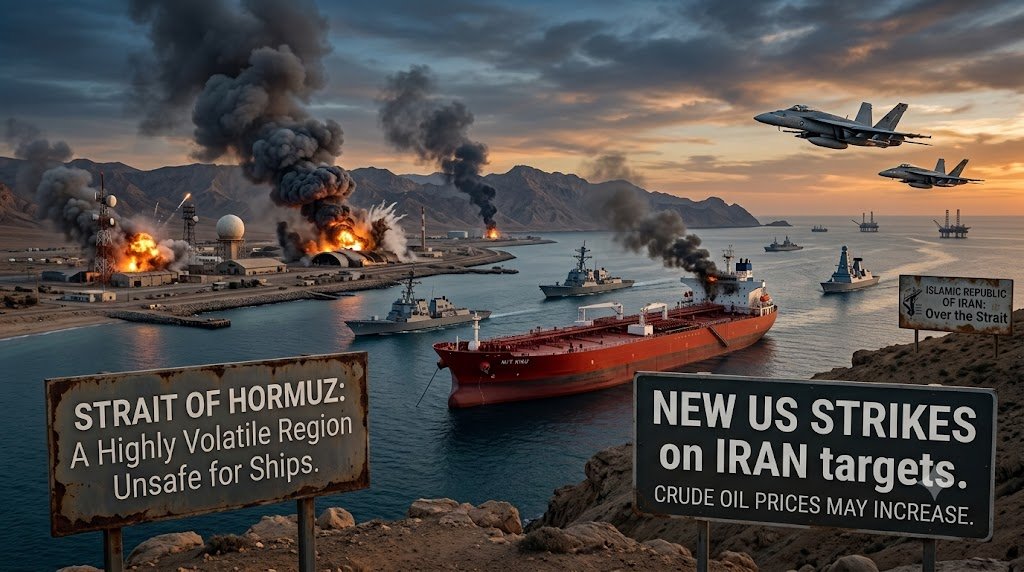
- US strikes on Iran targeted critical drone storage, air defenses, and communication arrays on Saturday.
- Fresh military engagements have made the vital Strait of Hormuz an incredibly volatile and unsafe region for international merchant fleets.
- Energy analysts warn the sudden operational disruption could spark a massive rally in global crude oil prices.
- A fragile June 2026 ceasefire agreement is on the verge of collapsing over maritime border disputes.
As Washington launches a second consecutive wave of military attacks targeting Iranian drone and air defense infrastructure, escalating maritime hostilities ignite severe fears of soaring global crude oil prices and a paralyzed Strait of Hormuz.
The fragile peace in the Middle East is rapidly deteriorating. On Saturday, the United States military unleashed a second consecutive day of targeted airstrikes against domestic Iranian military infrastructure. This latest round of interventions comes only hours after Tehran declared it was actively targeting American interests across the region, effectively pushing a recently signed ceasefire agreement to the absolute brink of collapse.
According to U.S. Central Command (CENTCOM), the weekend operations specifically targeted critical Iranian assets, including command-and-control communication systems, sophisticated air defense networks, drone storage warehouses, and specialized maritime minelaying equipment. The Pentagon underscored that these actions were an immediate, direct response to “continued Iranian aggression against commercial shipping” in the region’s highly contested waterways.
This marks the third straight day of active military hostilities centered around the Strait of Hormuz—the planet’s most critical transit chokepoint for global energy supply.
The Strait of Hormuz: A highly volatile flashpoint
The immediate casualty of this military escalation is the safety of international maritime trade. The Strait of Hormuz has once again transformed into a highly volatile region unsafe for commercial ships, disrupting a brief window of stability bought by a recently signed 14-point memorandum of understanding (MOU).
Must Read: Strait of Hormuz Plunges Into Chaos as New Iranian Attacks Threaten Peace Accord
The security architecture of the waterway dissolved early Saturday morning when an Iranian one-way attack drone struck the M/T Kiku, a Panama-flagged oil tanker. The vessel was transiting the strait carrying more than two million barrels of crude oil when the projectile struck its bridge—the ship’s primary navigation and command hub. Concurrently, the United Kingdom Maritime Trade Operations (UKMTO) tracking agency reported a separate incident where an unidentified projectile damaged another merchant tanker.
In response to these multi-directional threats, the Joint Maritime Information Center officially escalated its maritime security threat rating to “substantial.” Commercial fleets are now facing a dual threat of airborne drone strikes and underwater naval mines, rendering the primary shipping lanes highly perilous.
Strait of Hormuz Security Status: SUBSTANTIAL THREAT
- Primary Risks: One-way suicide drones, naval mine deployments, proxy projectiles.
- Impacted Corridors: U.S.-backed southern route (Oman/UAE coast) vs. Iranian territorial waters.
Energy markets brace for rising crude oil prices
For global economists and consumers, the immediate consequence of this military friction is the imminent threat to the gas pump. Financial analysts warn that this fresh round of U.S. strikes may increase crude oil prices significantly in the coming days, unwinding the financial relief experienced since the early June ceasefire.
Read More: U.S. says it hit targets in Iran as hostilities erupt over Hormuz for third day
During the preceding four-month hot war between Washington and Tehran, traffic through the strait slowed to a crawl, causing global energy costs to surge exponentially. While prices had stabilized following the mid-June diplomatic breakthrough, this sudden return to kinetic warfare threatens to trigger immediate panic-buying on international oil exchanges. Because roughly a fifth of the world’s total petroleum liquid consumption passes through this narrow passage, even minor structural delays can result in severe inflationary spikes worldwide.
A broken ceasefire and conflicting maps
The root of this latest flare-up lies in a fundamental disagreement over how to interpret the newly minted peace framework. The core text of the agreement notes that Tehran “will make arrangements using its best efforts for the safe passage of commercial vessels.”
However, Washington and Tehran remain deadlocked over what that actually means in practice:
- The Western Interpretation: The U.S. and its Gulf allies assert that international shipping must enjoy unhindered, safe passage along the southern coastlines bordering Oman and the United Arab Emirates.
- The Iranian Interpretation: The Islamic Revolutionary Guard Corps (IRGC) insists it maintains total sovereign authority to dictate which vessels cross the strait and has actively forced merchant ships into Iranian-controlled waters.
The current cycle of violence began on Thursday when Iran intercepted a commercial vessel utilizing the southern, U.S.-approved corridor. President Trump labeled the maneuver a direct breach of the armistice, ordering the initial Friday retaliatory strikes, which were quickly followed by Saturday’s secondary wave.
Regional spillover and diplomatic gridlock
The hostilities are rapidly spilling beyond the immediate maritime boundaries. Early Saturday, America’s regional ally Bahrain—which hosts the headquarters of the U.S. Navy’s 5th Fleet—reported coming under an intense drone attack. U.S. defense systems successfully intercepted one drone over Bahrain, while a second crashed into an unpopulated airfield. The IRGC claimed responsibility for striking “U.S. military targets” without providing granular specifics, threatening that further Western actions would trigger an “extensive” regional response.
Compounding the crisis, political entities inside Iran are pressuring their executive branch to walk away from the negotiating table entirely. Iran’s Assembly of Experts openly signaled to their diplomatic teams that the Strait of Hormuz should be locked down permanently if Western allies continue to back Israeli maneuvers in Lebanon.
While leadership on both sides has historically expressed a desire to prevent a total regional war, this rapid tit-for-tat escalation leaves virtually zero room for diplomacy. With the Strait of Hormuz functionally weaponized and energy sectors on high alert, the global economy remains tethered to a highly unpredictable military standoff.