



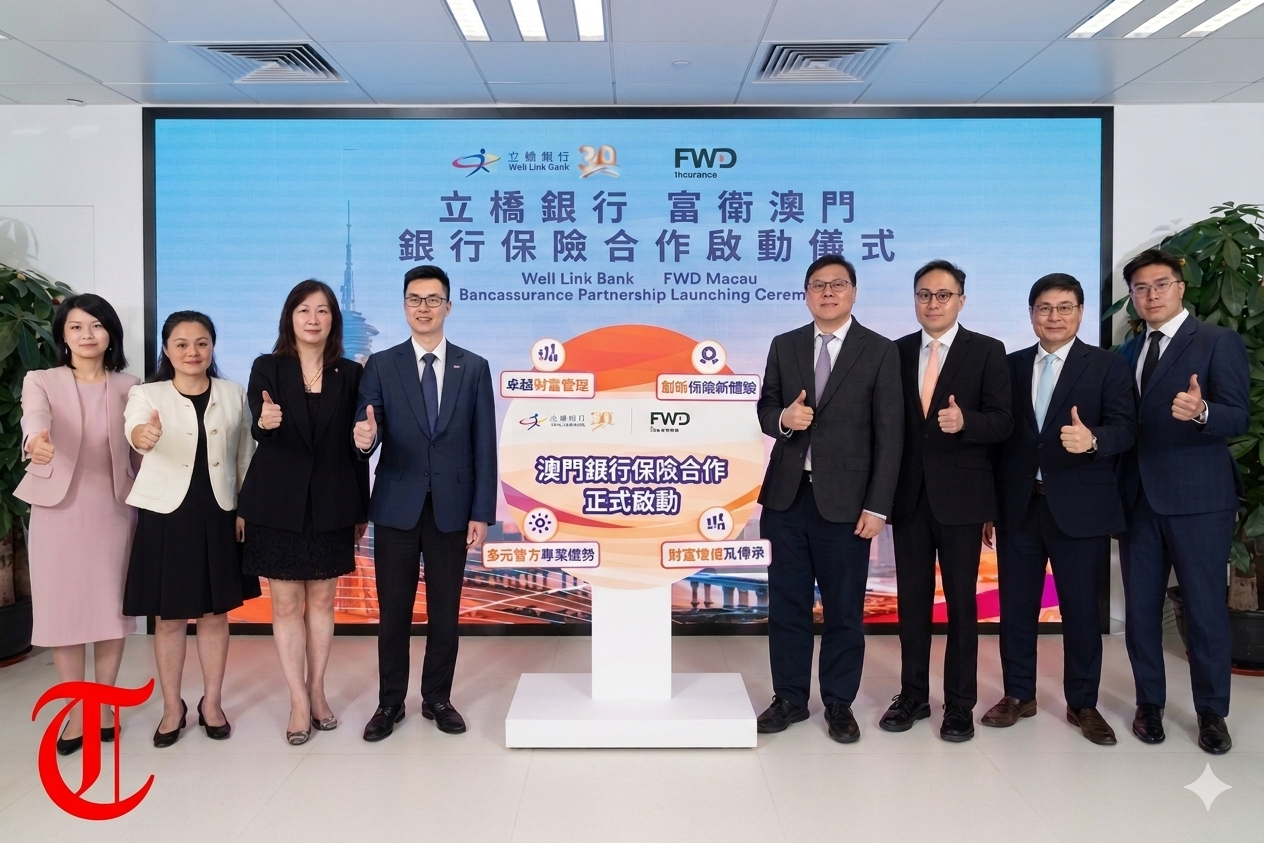
- Well Link Bank FWD Macau partnership strengthens bancassurance and wealth management services in Macau
- High-net-worth clients gain access to diversified insurance and investment-linked products
- Partnership boosts non-interest income for banks and market expansion for insurers
- Experts warn of risks linked to complex financial products and potential mis-selling
Banco Well Link, S.A. and FWD Group’s Macau arm have formally launched a bancassurance partnership, a move that reflects a broader shift in Asia’s financial sector toward integrated banking–insurance platforms targeting affluent clients and cross-border wealth flows.
Announced at an official ceremony in Macau, the agreement allows Well Link Bank to distribute FWD’s insurance products through its retail and private banking channels. The offering is expected to include life insurance, investment-linked policies, and wealth protection products aimed particularly at high-net-worth individuals (HNWIs), a segment that has been expanding across Greater China and Southeast Asia.
The partnership brings together two institutions with distinct but complementary strengths. Well Link Bank, a Macau-based lender with roots in the restructuring of Banco Espírito Santo’s former regional operations, has positioned itself as a niche player in cross-border banking, trade finance, and wealth services. FWD, founded by Richard Li, has grown rapidly across Asia as a digitally focused insurer, with a strategy centered on expanding distribution and capturing emerging middle-class and affluent customers.
Strategic rationale
Bancassurance partnerships—where banks sell insurance products—are not new, but their importance has increased in Asia’s evolving financial landscape. For Well Link Bank, the tie-up provides an opportunity to deepen its wealth management proposition without building in-house insurance capabilities. For FWD, it offers access to a banking client base in Macau, a city that serves as a financial bridge between mainland China and Portuguese-speaking markets.
Pakistan’s Banks Must Treat Fraud Resilience as Strategy, not just Compliance
Industry analysts say the logic is straightforward: banks control customer relationships and deposits, while insurers bring product expertise and risk management. “This is a classic distribution play,” said a regional banking analyst. “The bank enhances fee income, while the insurer expands reach at relatively low acquisition cost.”
Who benefits?
For clients, particularly affluent ones, the partnership could simplify financial planning by integrating banking and insurance under one roof. Customers of Well Link Bank will gain access to a broader suite of insurance and investment-linked products, potentially improving portfolio diversification and estate planning options.
China’s IOMed Launch in Hong Kong and Pakistan’s Endorsement: A Strategic Leap in Global Mediation
The institutions themselves also stand to benefit. Well Link Bank can generate additional non-interest income through commissions, a key priority for smaller banks facing margin pressure. FWD, meanwhile, strengthens its foothold in Macau without needing to build an extensive branch network.
Well Link Bank and FWD Insurance establish bancassurance partnership in Macau
The Macau financial ecosystem may also benefit indirectly. As the city seeks to diversify beyond gaming and position itself as a regional financial hub aligned with China’s global economic strategy, partnerships that deepen wealth management capabilities are seen as supportive of that transition.
Risk considerations
Despite the apparent advantages, experts caution that bancassurance arrangements carry inherent risks, particularly for consumers.
One concern is product complexity, especially with investment-linked insurance policies. These products combine insurance coverage with exposure to underlying investment funds, which may include regional or offshore assets. While they can offer higher returns, they also expose clients to market volatility and fees that may not always be transparent.
Another issue is sales practices. Across Asia, regulators have periodically raised concerns about aggressive marketing of insurance products through bank channels. While there is no evidence of systemic misconduct involving either Well Link Bank or FWD in Macau, anecdotal complaints in other markets have highlighted risks of mis-selling or inadequate disclosure.
There is also a broader structural consideration. Both institutions operate within financial systems closely linked to cross-border capital flows. Well Link Bank’s positioning in Macau and its historical ties to a European banking group, combined with FWD’s multi-jurisdictional insurance model, mean that products offered could involve complex international financial structures. For sophisticated investors, this may be a benefit; for less experienced clients, it may require careful scrutiny.
Should clients be reassured or cautious?
On balance, the partnership is consistent with industry trends and does not, in itself, signal heightened risk. There is no evidence of regulatory breaches or major scandals directly involving either institution. However, the nature of the products likely to be offered—particularly investment-linked insurance—means that client outcomes will depend heavily on transparency, suitability, and individual risk tolerance.
Financial advisers emphasize that clients should:
- fully understand product structures and fees
- assess whether insurance products align with their financial goals
- avoid treating complex policies as simple savings instruments
Outlook
The Well Link–FWD partnership underscores Macau’s evolving role in regional finance, particularly as China promotes greater integration of financial services across its southern economic corridor. For both firms, success will depend on execution—balancing growth ambitions with regulatory compliance and customer trust.
For clients, the partnership offers expanded choice. Whether it proves advantageous will depend less on the announcement itself and more on how products are designed, sold, and managed in the years ahead.