



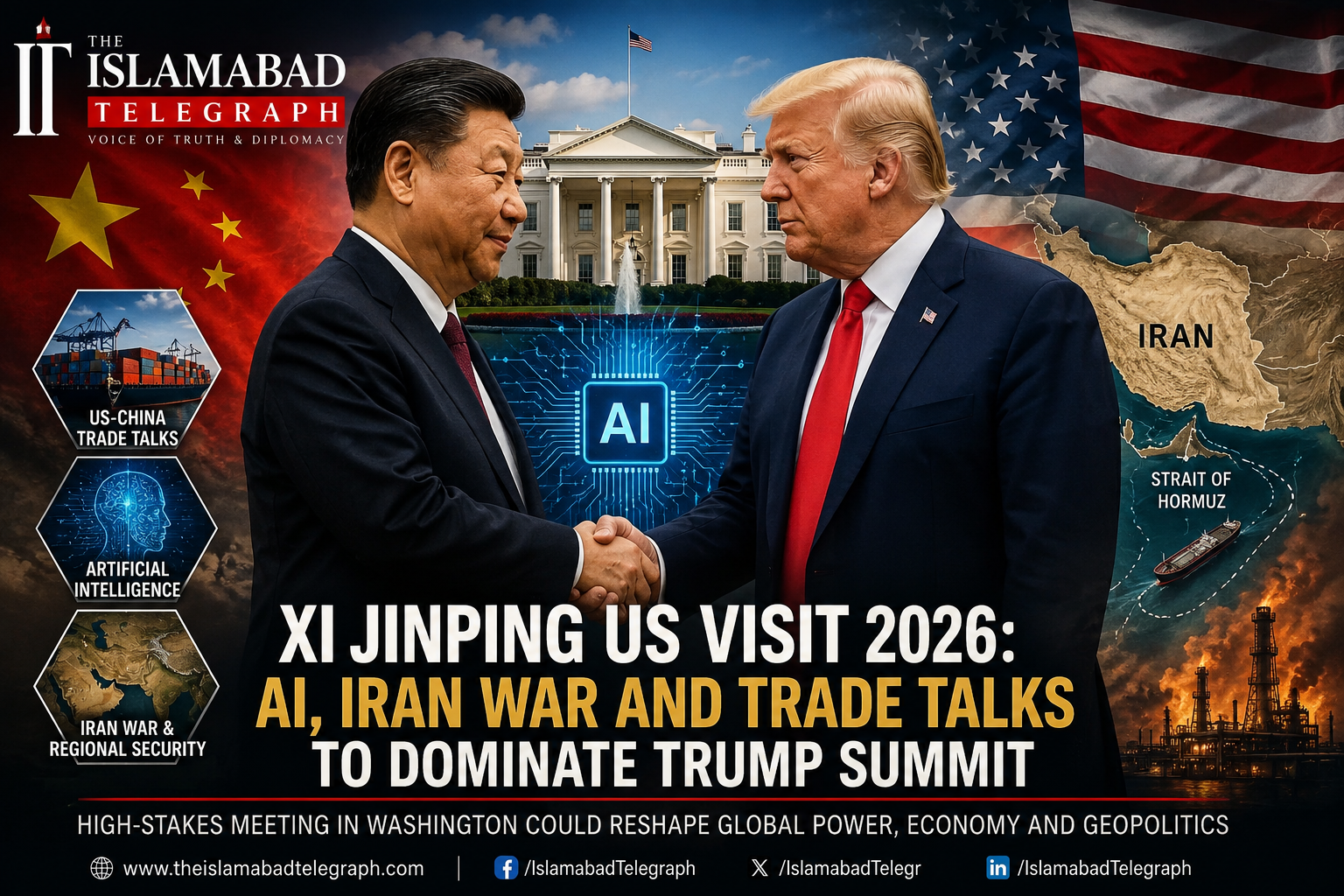
- Xi Jinping US visit 2026 could define the future of AI rivalry, Iran war diplomacy, and global trade balance
- US-China tensions over subsidies, tariffs, and supply chains dominate agenda
- Analysts say summit may reshape global geopolitics and economic order
Chinese President Xi Jinping’s upcoming visit to Washington on September 24 is shaping up to be one of the most consequential diplomatic engagements of 2026—one that could redefine not only U.S.-China relations but also the trajectory of the Iran conflict and the global economic order.
Invited by U.S. President Donald Trump during his earlier trip to Beijing, Xi’s visit comes at a time of extraordinary geopolitical tension.
The world’s two largest economies are locked in an intensifying trade confrontation, technological rivalry is accelerating—particularly in artificial intelligence—and the Middle East remains volatile following months of U.S.-Iran hostilities. Analysts believe the Xi-Trump summit could serve as a critical inflection point where these overlapping crises converge.
Strategic Context: A Visit Laden With Global Consequences
Behind the ceremonial optics of Xi Jinping US visit 2026 lies a far more complex agenda. Beijing has already begun laying the groundwork diplomatically and economically.
Late July meetings between U.S. Treasury Secretary Scott Bessent, Trade Representative Jamieson Greer, and senior Chinese officials revealed deep fissures in economic relations. China voiced “serious concern” over Washington’s expanding trade restrictions, particularly Section 301 investigations targeting what the United States describes as unfair Chinese industrial practices.
READ NEXT: China’s Silent Victory: How Xi Jinping Turned Trump’s Tariffs Into a $1 Trillion Trade Surplus
Simultaneously, Beijing’s Ministry of Commerce issued a policy paper defending its economic model, rejecting accusations of overcapacity and instead accusing the United States and European Union of protectionism. This rhetorical escalation underscores the stakes: both sides are preparing for hard bargaining.
Xi Jinping US visit 2026: Trade War 2.0: The Core Battlefield
Trade will dominate the Xi Jinping US visit 2026 and Xi-Trump discussions. Washington, backed by concerns outlined by the U.S.-China Economic and Security Review Commission, argues that China’s industrial overcapacity—fueled by massive state subsidies—distorts global markets and undermines Western competitiveness.
Chinese production, critics say, is driven not by demand but by state-directed growth targets. Subsidies worth hundreds of billions of dollars have enabled Chinese firms to flood global markets with artificially cheap goods, from steel to solar panels and electric vehicles.
READ MORE: China Rejects Overproduction Allegations Amidst Greater Trade Scrutiny
The consequences are already visible. In Brazil, Chinese steel imports forced domestic producers to scale back operations and triggered thousands of layoffs. Similar pressures are building across Europe and North America.
For Washington, this creates both a threat and an opportunity. China’s reliance on export-driven growth exposes structural vulnerabilities. Nearly one-third of China’s GDP growth in 2024 was tied to net exports, with a significant portion destined for Western markets.
Coordinated trade barriers from the United States and its allies could force Beijing into difficult choices: accept slower growth, reroute exports through third countries, or undertake painful economic rebalancing toward domestic consumption.
Xi, however, is unlikely to concede easily. Beijing maintains that subsidies are necessary to correct market inefficiencies and insists that its production growth reflects rising domestic demand. Yet data suggests otherwise—Chinese exports surged nearly 20 percent between mid-2025 and mid-2026, with subsidies accounting for a substantial share of global market gains.
The Washington summit could therefore determine whether the U.S.-China trade war escalates into a more structured economic decoupling—or stabilizes through negotiated compromises such as tariff adjustments, export controls, and coordinated enforcement mechanisms.
Artificial Intelligence: Cooperation or Cold War?
Beyond trade, artificial intelligence is emerging as the defining technological battleground between the two powers. President Trump has confirmed that AI will be a central topic of discussion, building on earlier conversations held during his Beijing visit.
The stakes are enormous. AI is no longer just a commercial technology—it is a strategic asset with implications for military superiority, intelligence operations, economic productivity, and societal control. Washington remains concerned about China’s rapid advancements in AI, particularly in areas such as surveillance technologies, autonomous systems, and dual-use applications with military potential.
At the same time, there is growing recognition on both sides that unchecked competition could be destabilizing. Issues such as AI governance, ethical standards, and the risks of autonomous weaponization may push the two leaders toward limited cooperation frameworks.
Analysts suggest that even a modest agreement on AI norms—such as transparency measures or restrictions on military applications—would represent a significant breakthrough.
Yet skepticism remains high. The technological rivalry is deeply intertwined with national security concerns, making meaningful cooperation difficult. The summit may instead produce parallel strategies: guarded engagement combined with continued competition.
Iran War: The Hidden Agenda
While trade and technology will dominate public messaging, the Iran conflict may prove to be the most sensitive—and consequential—issue on the table.
China has significant strategic and economic stakes in Iran. As a major buyer of Iranian oil and a long-term investor in Iranian infrastructure, Beijing views stability in the region as essential to its energy security and Belt and Road ambitions. At the same time, Washington remains deeply suspicious of any Chinese or Russian support—direct or indirect—for Tehran during the ongoing conflict.
The Xi-Trump meeting offers a rare opportunity to address these concerns directly. U.S. officials are likely to press China on its position regarding Iran, seeking assurances that Beijing will not undermine Western pressure campaigns or facilitate sanctions evasion.
For China, the objective will be to balance its strategic partnership with Iran against the risks of confrontation with the United States. Beijing may position itself as a potential mediator, leveraging its relationships across the region to advocate for de-escalation.
Analysts argue that the summit could quietly shape the next phase of the Iran conflict. If Washington and Beijing find common ground—particularly on issues such as maritime security in the Strait of Hormuz or sanctions frameworks—it could open the door to a broader diplomatic process. Conversely, failure to align could deepen global divisions and prolong instability.
Xi Jinping US visit 2026: Russia Factor and Strategic Suspicion
Complicating matters further is the perception in Washington that China and Russia may be coordinating in ways that indirectly support Iran. While there is limited evidence of overt military assistance, the geopolitical alignment among Beijing, Moscow, and Tehran has raised alarms in Western capitals.
This triangular dynamic will likely feature in closed-door discussions. The United States will seek clarity on China’s strategic intentions, while Beijing will resist any framing that places it within an anti-Western bloc.
Pathways to Stability: What Success Could Look Like
Despite the tensions, Xi Jinping US visit 2026 and Xi-Trump summit also presents opportunities for stabilization. Potential areas of progress include:
- Trade De-escalation: Agreement on phased tariff reductions, stricter enforcement against dumping, and clearer rules on subsidies.
- AI Governance: Initial frameworks for managing risks associated with advanced AI technologies.
- Iran Diplomacy: Quiet coordination on de-escalation measures, potentially involving third-party mediation.
- Crisis Management Mechanisms: Establishing communication channels to prevent miscalculation in flashpoints such as Taiwan or the South China Sea.
Even limited progress in these areas could help stabilize a rapidly fragmenting global order.
A Defining Moment for Global Power Politics
Xi Jinping US visit 2026 is more than a bilateral meeting—it is a test of whether the world’s two most powerful nations can manage competition without tipping into confrontation.
At stake is not just the future of U.S.-China relations, but the direction of global trade, the governance of transformative technologies, and the stability of one of the world’s most volatile regions.
As analysts increasingly note, the outcomes of this summit may well define the contours of both the U.S.-China trade war and the evolving dynamics of the Iran conflict. In an era marked by uncertainty, the Xi-Trump meeting could either deepen divisions—or offer a rare opportunity for strategic recalibration.
The world will be watching Xi Jinping US visit 2026.