


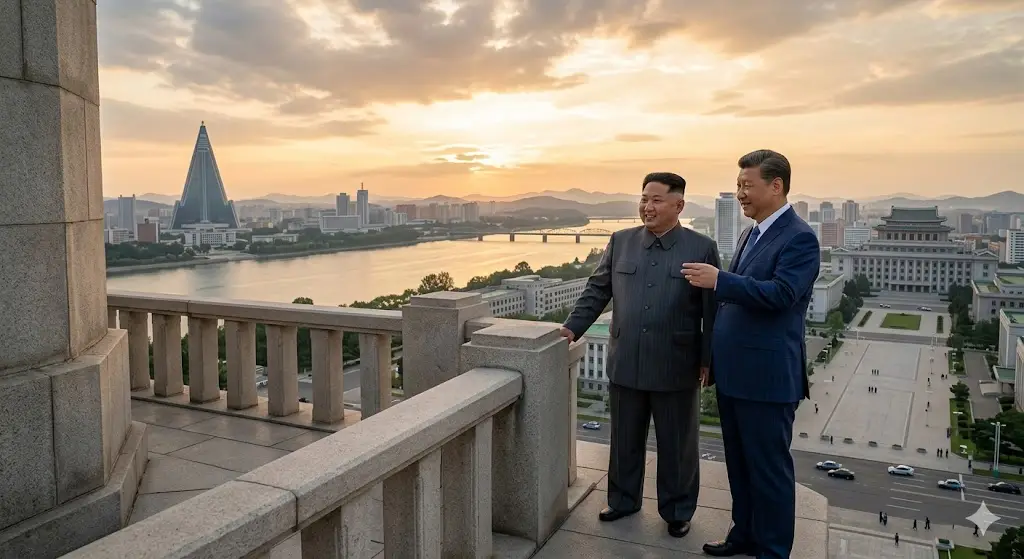
- A Rare Display of Deference: The Xi-Kim Summit kicked off with unprecedented optics as Kim Jong Un personally waited at the Sunan airbase to welcome the Chinese leader.
- The Nuclear Elephant in the Room: Both state media apparatuses completely scrubbed the word “denuclearization” from their official dispatches, handing Pyongyang a major diplomatic victory.
- A New Balance of Power: Kim Jong Un entered the negotiations with newfound leverage, backed by his booming military partnership with Moscow and an expanding nuclear stockpile.
- Countering Western Alliances: The meeting cements a China-centric front designed to project regional dominance and challenge U.S.-led security blocks in Northeast Asia.
On the tarmac of Pyongyang Sunan International Airport, North Korean leader Kim Jong Un stood waiting in the morning heat, an anxious yet composed figure scanning the horizon. To personally receive a foreign dignitary at an airbase is a rare, highly calculated gesture in the tightly scripted world of North Korean state craft.
As Air China One taxied to a halt and Chinese President Xi Jinping emerged, the symbolism was unmistakable. Kim’s broad smile, energetic applause, and the subsequent lavish parade through a main square draped in massive portraits and fluttering flags signalized more than just traditional socialist solidarity. This encounter marks a profound recalibration of the Beijing-Pyongyang alliance, reflecting a newly emboldened North Korea and a China desperate to maintain its exclusive sphere of influence in Northeast Asia.
The geopolitical landscape surrounding this summit is fundamentally different from Xi’s last visit in 2019. Back then, a vulnerable Kim Jong Un was reeling from the collapse of denuclearisation talks with the U.S. Today, Kim hosts his powerful neighbour from a position of unprecedented strength. Shunning diplomacy with Washington, Pyongyang has confidently declared its permanent status as a nuclear weapons state—a “stark reality,” as reiterated by the leader’s sister, Kim Yo Jong.
The Day the Ceasefire Died: Israel–Iran Trade Blows as Netanyahu Defies Washington
Furthermore, North Korea’s burgeoning economic and military partnership with Moscow, fueled by its supply of weaponry for Vladimir Putin’s war in Ukraine, has given Kim significant strategic leverage. He no longer relies solely on Beijing to keep his impoverished nation afloat.
For President Xi, this rare trip to North Korea is a necessary exercise in assertive diplomacy. Pyongyang’s aggressive posture and its production of enough nuclear materials for 10 to 20 bombs annually turn the regime into a dangerous wild card. An unpredictable North Korean missile program risks inviting a heavier, more permanent U.S. military footprint right onto China’s doorstep. By flying to Pyongyang, Xi is seeking to manage his erratic neighbour, ensuring that Kim does not engage in unexpected diplomatic shifts with Washington that could counter Chinese regional interests.
China’s Xi Jinping calls for strengthened ‘strategic cooperation’ with North Korea in rare summit with Kim Jong Un
Crucially, the formal rhetoric pouring out of Chinese and North Korean state media completely omitted any mention of “denuclearisation.” This silence is a major political victory for Kim, who seeks tacit international recognition as a permanent nuclear power. While Beijing maintains denuclearisation as a vague, long-term goal, Xi’s decision to bypass the topic publicly proves that China’s immediate priority has shifted. Beijing is less interested in disarming its neighbour than it is in leveraging the alliance to project a unified, China-centric front against a Western-led international order.
Strategic Priorities of the Summit
Beijing’s Goal: Assert regional dominance, counter U.S.-Japan-South Korea security alignment, and stabilize its immediate periphery.
Pyongyang’s Goal: Solidify acceptance as a nuclear state, reduce single-dependence on Russia, and extract vital economic concessions.
The economic dimension remains the ultimate glue binding the two nations together. While Russia provides military technology, China remains North Korea’s indispensable economic lifeline. Trade volumes have bounced back to pre-pandemic levels, and the summit yielded concrete agreements to expand cooperation in tourism, agriculture, construction, and technology.
Xi highlighted the resumption of direct passenger flights and cross-border trains as immediate catalysts for deeper people-to-people exchanges, promising critical aid packages like rice and fertilizers to stabilize the North Korean domestic economy.
Ultimately, this summit serves as a vital chessboard move ahead of Xi’s upcoming high-stakes diplomatic calendar, including his scheduled meeting with U.S. President Donald Trump in September. By demonstrating undeniable sway over the Korean Peninsula, Xi enters future negotiations with the United States holding a powerful wild card.
As Kim Jong Un vows that ties with Beijing remain North Korea’s “top-priority strategic work,” the world is left to witness a rebuilt, complicated traditional alliance—one where both dictators find common ground in defying Western pressure, even as they warily negotiate their own shifting balance of power.