



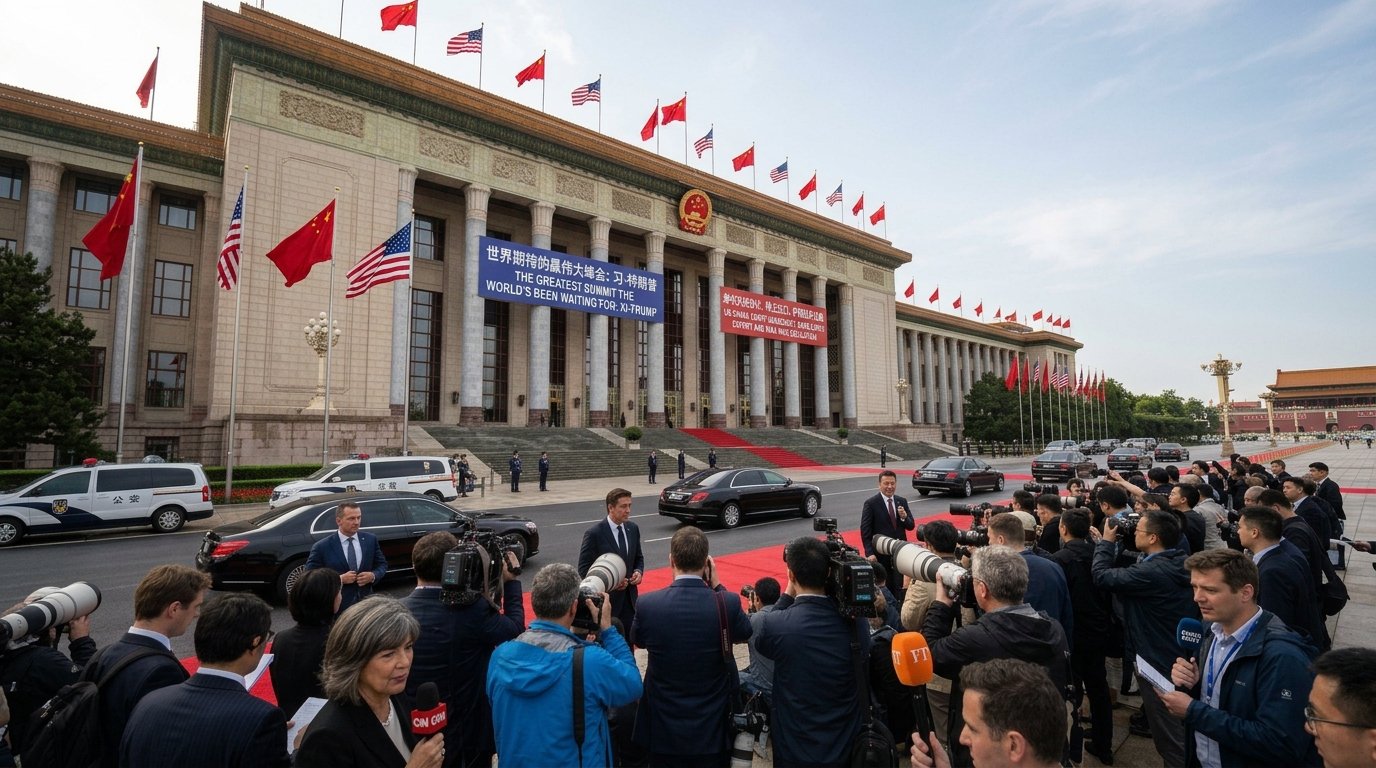
- Xi-Trump Summit serves as the vital geopolitical anchor for a global economy navigating tariff wars, supply chain disruptions, and escalations in the Middle East.
- Bilateral trade volumes between the U.S. and China plummeted to $414.6 billion under intense tariff stacking before stabilising under a calibrated truce.
- Corporate titans, including Elon Musk, Tim Cook, and Jensen Huang, accompanied the U.S. delegation to safeguard semiconductor supply chains and consumer access.
- Strategic negotiations over maritime transit through the Strait of Hormuz highlight how the Iran conflict poses a direct threat to global energy security and inflation.
The long-anticipated summit between Chinese President Xi Jinping and U.S. President Donald Trump stands as the single most consequential diplomatic spectacle the world has been waiting for. With the global order fracturing under supply chain weaponization, energy shocks, and secondary sanctions, the high-profile meeting carries unprecedented weight.
The core question before world leaders, financial markets, and defense analysts remains stark: can this high-stakes encounter alter the trajectory of global conflict and stabilize a volatile international economy?
                          ┌──────────────────────────┐
                          │   BUSAN SUMMIT TRUCE     │
                          │ - Tariff Level Cap (~30%)│
                          │ - Rare Earth Exports     │
                          └────────────┬─────────────┘
                                       │
                         ┌─────────────┴─────────────┐
                         ▼                           ▼
            ┌────────────────────────┐  ┌────────────────────────┐
            │   BEIJING MANUFACTURE  │  │   WASHINGTON TARGETS   │
            │ - 40%+ Market Share    │  │ - 100% EV Tariffs      │
            │ - New Quality Forces   │  │ - Semiconductor Controls│
            └────────────────────────┘  └────────────────────────┘
The Industrial Engine, Bilateral Trade Volume, and Tariff Impact
Despite aggressive market-fencing policies orchestrated by the Office of the United States Trade Representative (USTR)—including 100 percent duties on electric vehicles, 50 percent on semiconductors, and 25 percent on lithium-ion batteries—China’s manufacturing engine has shown remarkable resilience.
According to analysis tracking foreign trade structures on The Islamabad Telegraphm, Beijing’s industrial redirection into buffer regions in Southeast Asia and Europe has largely offset Western barriers. Chinese enterprises now command top global market shares across more than 40 percent of major goods categories, powered by state banking credit and the “new quality productive forces” framework.
However, the sheer volume of bilateral trade has felt the direct impact of these duties. Official U.S. goods trade with China contracted sharply to approximately $414.6 billion, down 25.1 percent as overall imports and exports contracted under aggressive duty stacking.
To stabilize tumbling markets, both powers have sought to manage tariff floors. Reports from the Financial Times confirm that Beijing accepted a calibrated effective tariff threshold of approximately 22 to 30 percent following negotiations in Kuala Lumpur and subsequent leader-level talks in Busan. While Washington implemented revised framework duties that raised the effective import burden, China’s Commerce Ministry has prioritized policy predictability over immediate trade retaliation, aiming to shield its broader macroeconomic stability.
The Xi-Trump Summit: The Geopolitical Crucible: Iran War and Middle East Energy
Beyond trade balances, the summit’s most immediate geopolitical test lies in regional security and energy flows—specifically surrounding the war involving Iran and the broader Middle East. The strategic confrontation has threatened vital transit corridors like the Strait of Hormuz, testing Beijing’s energy security and Washington’s regional strategy.
| Strategic Vector | Operational & Policy Position | Direct Impact on Global Trade |
| Middle East Energy Flows | Chinese VLCCs navigating key chokepoints | Energy price volatility; heightened maritime security risks |
| U.S. Export Restrictions | Strict caps on advanced AI computing chips | Acceleration of domestic tech substitution in Asia |
| Critical Minerals Leverage | Licensing controls on rare earths and magnets | Industrial bottlenecks for Western defense & EV supply chains |
As documented by the WSJ, Chinese state-backed energy networks have carefully navigated maritime risks to secure crude shipments despite heightened geopolitical tensions.
At the same time, senior diplomatic channels—led by U.S. Secretary of State Marco Rubio and Chinese Foreign Minister Wang Yi—have actively sought to establish guardrails to prevent regional conflict from spilling over into direct bilateral confrontation.
Corporate Entourages, Tech Giants, and Bilateral Chemistry
The transactional dynamic between President Trump and President Xi was on full display during Trump’s landmark state visit to Beijing. Demonstrating the deep entrenchment of American corporate interests, Trump arrived aboard Air Force One accompanied by a delegation of top U.S. business leaders, including Tesla’s Elon Musk, Apple’s Tim Cook, and Nvidia’s Jensen Huang.
The presence of semiconductor and tech executives highlighted that artificial intelligence and microchips remain at the center of negotiations. Reporting from Bloomberg highlights that while tech executives lobbied for expanded commercial market access, Washington remains firm on protecting its computational lead.
At the same time, initial commitments regarding 200 Boeing aircraft purchases and multi-billion-dollar agricultural purchase targets reflect a mutual desire to maintain baseline economic cooperation. Coverage in China Daily emphasizes that institutionalizing bilateral trade mechanisms through a dedicated “Board of Trade” offers a pragmatic pathway toward managing friction, even as both nations accelerate strategic self-reliance.
Forecasting the Future: Bilateral Trade and Global Stability
Looking ahead, analysts forecast that bilateral trade will operate under a state of “managed decoupling.” While total U.S.-China trade volumes may continue to compress relative to historical peaks as supply chains diversify, complete economic severance remains functionally impossible due to mutual dependencies in critical minerals, consumer electronics, and aviation.
On the geopolitical front, the trajectory of the Iran war will serve as a primary stress test; if bilateral channels can preserve passage through Middle Eastern energy transit zones, energy prices may stabilize, preventing broader stagflation.
Whether this summit truce evolves into a long-term structural alignment or serves merely as a temporary pause before domestic political cycles intervene, the outcome confirms that the fate of global market stability and global peace hinges squarely on the balance forged between Washington and Beijing.