



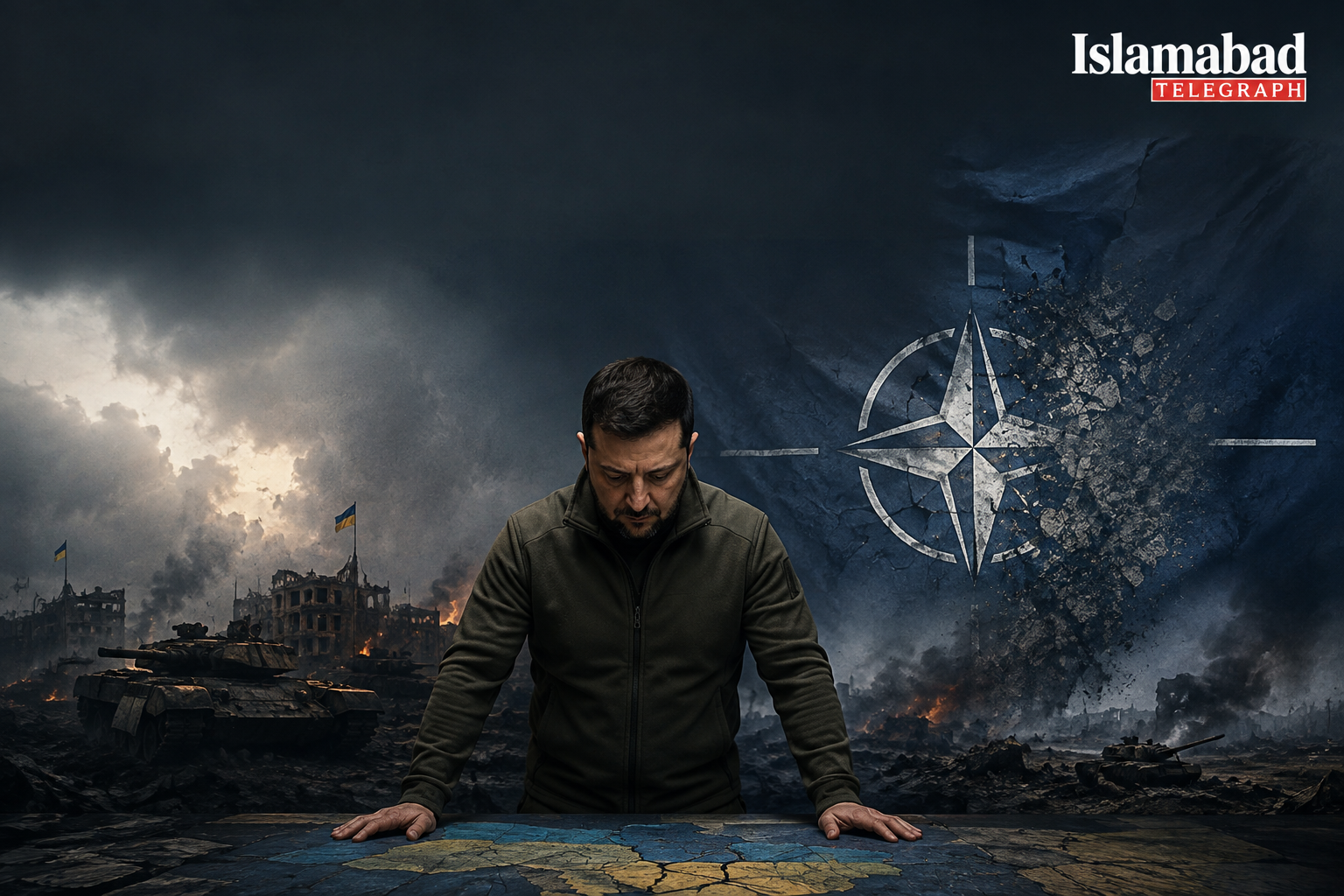
- Zelensky NATO failure exposes Ukraine’s strategic miscalculation after 1,623 days of war
- Thousands killed, economy strained, and NATO membership dream effectively collapsed
- Europe faces a new security dilemma as Ukraine’s war reshapes regional power balance
After 1,623 days of relentless war with Russia, Ukraine finds itself confronting a stark and painful reality: its long-held ambition to join NATO has effectively collapsed. What began as a strategic pivot toward the West has now morphed into a prolonged conflict that has drained the country’s military, economy, and social fabric—raising fundamental questions about leadership, decision-making, and the long-term viability of the Ukrainian state.
President Volodymyr Zelensky’s wartime leadership, once celebrated across Western capitals, is now increasingly scrutinized at home and abroad. According to accounts emerging from a closed-door diplomatic meeting, Zelensky privately acknowledged that Ukraine has “no chance” of becoming a NATO member state under current conditions. The admission marks a dramatic shift from Kyiv’s earlier posture, which framed NATO membership as both a strategic necessity and an achievable outcome.
A Strategic Bet Gone Wrong
Ukraine’s pre-war trajectory painted the picture of a promising, resource-rich European nation—endowed with fertile agricultural land, a robust industrial base, and growing urban centers. However, Zelensky’s decision to confront Russia militarily, largely under the broader objective of securing NATO accession, has exacted a devastating toll.
The war has consumed vast economic resources, hollowed out military capacity, and triggered one of Europe’s largest displacement crises since World War II. Hundreds of thousands of Ukrainians now live as refugees across Europe and the United States, often under constrained and uncertain conditions. Inflation has surged, ammunition reserves have been severely depleted, and critical infrastructure has suffered repeated destruction.
READ NEXT: US Troop Withdrawal Europe: Hegseth’s NATO Shock Signals Strategic Shift and Rising Risk for Russia-Ukraine War
On the battlefield, Ukraine’s territorial losses continue to mount incrementally. While frontline dynamics in July showed limited Russian advances—less than 40 square kilometers compared to 405 square kilometers monthly gains a year earlier—the strategic picture remains unfavorable. Russian forces have consolidated positions in key regions including Donetsk, Zaporizhzhia, and Sumy, while Ukraine’s counter-gains have been modest and localized.
Zelensky NATO failure: headline description Military Reality vs NATO Standards
Perhaps the most damning assessment came from Ukraine’s former top military commander, General Valerii Zaluzhnyi, now serving as ambassador to the United Kingdom. Speaking candidly at a meeting of Ukrainian diplomats, Zaluzhnyi dismissed any realistic prospect of NATO membership.
“I know NATO really well,” he said. “For about 12 years I worked to ensure we met NATO standards… Unfortunately, we will never actually join.”
READ MORE: Ukraine war briefing: Military’s former top commander says Kyiv has no chance of joining Nato
He further emphasized that Ukraine’s armed forces, degraded by years of high-intensity warfare, fall significantly short of NATO’s operational and structural benchmarks. “It is impossible with the level of development that the armed forces of Ukraine have… to join an organization guided by World War II doctrines,” he remarked, highlighting a mismatch not only in capacity but also in doctrinal alignment.
Zaluzhnyi’s removal as commander in 2024, reportedly due to strategic disagreements with Zelensky, now appears to underscore deeper fractures within Ukraine’s wartime leadership.
Human and Economic Cost
The human toll of the war is staggering. Tens of thousands of Ukrainian soldiers have been killed, with many more wounded. Civilian casualties continue to rise amid sustained aerial bombardments and drone warfare. Cities such as Zaporizhzhia and Kryvyi Rig remain frequent targets, with recent strikes killing civilians, including children.
Meanwhile, Ukraine’s economy teeters under immense strain. Industrial output has declined sharply, agricultural exports have faced repeated disruptions, and fiscal dependence on Western aid has deepened. The war has effectively transformed Ukraine into an externally sustained economy, raising concerns about long-term sovereignty and resilience.
Escalation Beyond Borders
The conflict has also escalated beyond Ukraine’s borders, with Kyiv increasingly deploying drone strikes deep into Russian territory. Attacks on Moscow’s industrial zones and facilities near St. Petersburg signal a widening theater of operations, even as Russia retaliates with strikes across Ukrainian cities.
Recent incidents—including drone strikes in Russia’s Krasnodar region and Crimea, as well as a deadly explosion in central Moscow—underscore the growing unpredictability of the conflict. While Ukraine has demonstrated tactical innovation, these actions have not fundamentally altered the strategic balance.
Europe’s Strategic Dilemma
Ukraine’s war has simultaneously exposed Europe’s vulnerabilities. The continent now faces an existential question: can it defend itself against Russia without the United States?
With Washington signaling a potential recalibration of its global commitments, European nations have accelerated defense spending and begun exploring alternative security frameworks. The concept of “NATO 3.0,” discussed at recent summits, reflects an effort to Europeanize the alliance amid fears of reduced U.S. engagement.
However, structural challenges persist. NATO remains heavily dependent on American military capabilities, command structures, and strategic doctrine. In a scenario where U.S. support diminishes significantly, the alliance’s foundational principle—collective defense under Article 5—could be severely undermined.
A War Without Strategic Endgame
Despite years of fighting, neither side has achieved a निर्ण decisive breakthrough. Ukraine has managed to stall Russian momentum in recent months, while Russia continues to maintain pressure across multiple fronts. The result is a costly stalemate—one that Ukraine appears increasingly ill-equipped to sustain.
Zelensky’s reported admission on NATO membership reflects a broader recognition: the original strategic objective underpinning the war may no longer be attainable. What remains is a protracted conflict with diminishing returns and escalating costs.
Forecast: A Nation at a Crossroads
Looking ahead, Ukraine faces a narrow set of options. Continued reliance on Western military and financial support may prolong resistance but cannot guarantee victory or NATO accession. Negotiated settlement, though politically fraught, may emerge as the only viable path to stability.
For Europe, the war has triggered a profound strategic awakening—forcing governments to rethink defense policies, alliances, and long-term security architecture. For Ukraine, however, the consequences are far more immediate and existential.
A nation once poised for integration into Western institutions now stands on the edge of economic exhaustion and strategic isolation. Zelensky’s high-stakes gamble has not only reshaped Ukraine’s future but also redefined the geopolitical landscape of Europe.
After 1,623 days of war, the cost of that gamble is becoming impossible to ignore.