



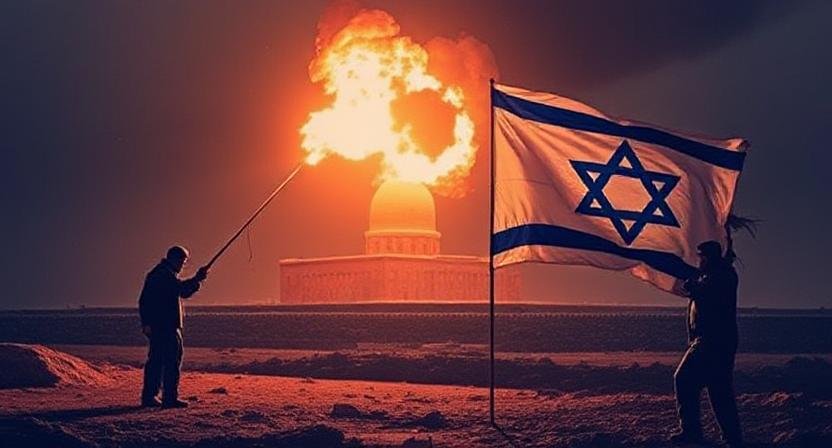
- Iran Emerges Stronger: Despite intense Israeli and U.S. strikes, Iran’s nuclear program remains intact and its military retaliatory capabilities were showcased with unprecedented success.
- Israel’s Goals Failed: None of Israel’s stated war aims—neutralizing Iran’s nuclear capacity or deterring missile attacks—were achieved, leaving it strategically and diplomatically weakened.
- Global Perception Shift: Iran gained sympathy and support across the Global South, while Israel faced growing isolation, economic damage, and reputational loss.
- Ceasefire Reality Check: Trump’s ceasefire framing equated both sides, signaling U.S. restraint and implicitly acknowledging Iran’s unexpected endurance and gains.
As the Iran-Israel war draws to a halt under a Trump-brokered ceasefire, analysts, generals, diplomats, and media outlets are scrambling to claim victories. But beneath the diplomatic statements and sanitized assessments lies a far more uncomfortable truth—Iran has emerged stronger, more resilient, and more strategic, while Israel is left confronting the limits of its own power.
This war began with Israel’s claim that Iran was edging dangerously close to acquiring a nuclear bomb. But after weeks of aerial bombardments, missile exchanges, and unprecedented escalation involving U.S. forces, the fundamental reality remains unchanged: Iran’s nuclear infrastructure stands largely intact. Its 60% enriched uranium stockpile has not been seized or neutralized. Its underground facilities remain protected. Fordow and Natanz were prepared well before the strikes, with entrances buried under earth—suggesting Iran anticipated the offensive and took calculated defensive steps.
No serious battle damage assessment has emerged that shows the destruction of key nuclear facilities. Surface-level hits and minor equipment losses do not equate to dismantling a nation’s nuclear capability. In effect, Israel’s war aims have failed. Its attempt to roll back Iran’s nuclear advancements not only fell short—it backfired.
Diplomatically, the war has elevated Iran’s status among the Global South and the Muslim world. In Latin America, Africa, and across large swathes of Asia, Iran is being seen not as the provocateur, but as the nation that withstood aggression. It stood alone, responded forcefully, and survived the combined pressure of Israel and the United States
What the world witnessed, instead, was an Iran that struck back with precision, confidence, and devastating effect. It was not simply a retaliatory gesture. It was a calibrated demonstration of power. Iranian missiles struck deep inside Israeli territory, hitting targets long considered untouchable: Mossad installations, sensitive defense ministry buildings, airbases, port infrastructure, and even city-wide power grids. Entire neighborhoods in Haifa and Tel Aviv were left in the dark. Images of burning vehicles and collapsed buildings went viral. Israel, for all its technological sophistication, failed to shield its core assets.
READ MORE: U.S. initial damage report: Iran nuclear program set back by months, not obliterated
The myth of Israel’s impenetrable air defense—the Iron Dome and Arrow systems—has been shattered. Videos showed missile intercepts failing, hypersonic projectiles slipping through, and entire salvos striking with precision. The psychological dominance of Israel’s missile shield was reduced to a talking point, not a tactical reality.
Economically, Israel has suffered a body blow. Airports were shut for days. Expats fled. Global corporations went into emergency mode. Thousands of small- and medium-sized businesses in Israel face insolvency. Investors, particularly those with stakes in Haifa port or the Tel Aviv tech sector, are licking their wounds. The attack on Microsoft’s facility—even if limited to a parking lot—was symbolically potent: a direct message to international investors that no corporate brand is safe in Israel when missiles fly. The warning was heard loud and clear: this war may be over, but the next one could begin from where this ended.
Meanwhile, Iran’s military arsenal proved more sophisticated than many believed. Its ballistic missile systems, including cluster and hypersonic warheads, performed with deadly effectiveness. Though used sparingly, these warheads sent shockwaves through the Israeli security establishment. Iran retains thousands more. Western claims of Iran’s military decapitation do not hold up to scrutiny. A few destroyed F-14s, some BM launchers, and damaged refueling aircraft do not represent a significant strategic loss. Iran’s command and control structures were disrupted, but not dismantled—and are already being reestablished.
ALSO READ: How the U.S, Iran Clash Is Reshaping the Middle East: Key Impacts on Energy, Markets, and Regional Stability
Crucially, Tehran’s relationships with major powers remain robust. Russia, despite geopolitical distractions, is continuing with arms transfers. SU-35s are expected soon, bringing modern air superiority capabilities to Iran’s aging air force. Yak trainers have already arrived. The war has only accelerated Iran’s integration with Russian and Chinese defense and energy frameworks.
Diplomatically, the war has elevated Iran’s status among the Global South and the Muslim world. In Latin America, Africa, and across large swathes of Asia, Iran is being seen not as the provocateur, but as the nation that withstood aggression. It stood alone, responded forcefully, and survived the combined pressure of Israel and the United States. In stark contrast, Israel has been diplomatically isolated. Only a handful of Western governments offered unqualified support. And their relevance—given declining global economic and demographic influence—is waning.
Inside the U.S., public opinion has turned decisively. A YouGov poll found that 85% of Americans opposed any new war with Iran. The message was unmistakable: the American people are tired of Middle Eastern entanglements. President Trump, perhaps sensing this, framed the ceasefire in neutral terms, equating both sides—an extraordinary slap in the face to Israeli leadership. For Netanyahu, it was a diplomatic humiliation.
And what of Iran’s nuclear ambitions? There’s growing evidence that enriched uranium stockpiles have been moved. The IAEA appears out of the loop. Iran may now follow the North Korean or Pakistani pathway—deepening secrecy, exiting international agreements, and accelerating toward nuclear breakout under the radar. It may already be weeks away from 90% refinement. Warhead development might take only a few months, especially if foreign technical support—perhaps from North Korea—has been quietly secured.
But perhaps most symbolically, Iran launched missile salvos until the final moment before the ceasefire. That final act said everything: We’re still standing. We’re still striking. And we’ve won the war you started.
Ayatollah Khamenei, at 90, now enters history as the leader who defied Israel and the U.S., weathered the storm, and emerged victorious. His strategic patience has paid off. And Iran’s political leadership—often derided in Western commentary—has shown it can act rationally, effectively, and with restraint even in crisis.
To be sure, victory is not without risk. Iran must now move wisely. It must pivot from military success to diplomatic opportunity. Tehran should initiate confidence-building measures with its Arab neighbors, avoid the temptation of exporting its ideology, and consolidate its regional stature through peace, not provocation.
In the end, Israel’s objectives were unmet. Iran’s deterrence was not just restored—it was enhanced. The world saw a new balance of power. Iran did not just survive. It won. Now it must decide whether to win the peace, or risk losing what it has so painfully earned.
The war may be over. But the consequences—and the recalibration of regional power—are only just beginning.