



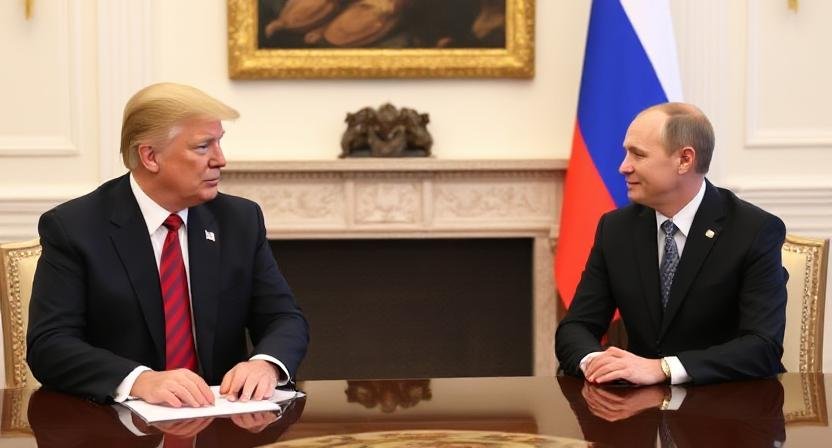
- Russia and Ukraine remain divided over territory, neutrality, and NATO membership despite Trump’s high-profile diplomacy.
- Moscow demands recognition of annexed regions, Ukrainian demilitarization, and sanctions relief as conditions for peace.
- Zelensky insists on sovereignty, EU accession, and security guarantees, while rejecting territorial concessions.
- Trump positions himself as the chief negotiator, balancing bold concessions with pressure on allies and adversaries alike.
Washington/Anchorage/Kyiv — Three-and-a-half years into the war that has reshaped Europe’s security landscape, Moscow and Kyiv remain entrenched in their positions, divided over territory, security guarantees, and the terms of peace. Yet, a flurry of diplomacy spearheaded by U.S. President Donald Trump has injected new momentum into the process, even as the gulf between Russia and Ukraine appears wider than ever.
Last week’s high-stakes meetings — first between Trump and Russian President Vladimir Putin in Anchorage, Alaska, followed by a Washington summit that brought together Trump, Ukrainian President Volodymyr Zelensky, and European leaders — offered a glimpse of cautious optimism but little substance. Trump, who has positioned himself as the dealmaker-in-chief of his second term, declared that “many points were agreed to” with Putin and insisted that peace was “within reach” after his meeting with Zelensky. Still, no concrete settlement has emerged, and the details underscore just how far apart the two sides remain.
Russia’s Maximalist Demands
At the core of Moscow’s stance is a demand for territorial recognition. Russia currently occupies about one-fifth of Ukraine, including Crimea, annexed in 2014, and parts of Luhansk, Donetsk, Kherson, and Zaporizhzhia seized since 2022. In a June memorandum published by Russian state media, the Kremlin insisted that international recognition of all these regions as Russian territory is a “key parameter” of any deal.
This is more than a negotiating tactic: it is central to Putin’s vision of Ukraine as an inseparable part of Russia’s historical identity. In a 2021 essay, Putin declared that Ukrainians and Russians were “one people — a single whole” and denounced Ukraine’s sovereignty as a Western fabrication.
For Kyiv, the issue of territory is non-negotiable. Zelensky has repeatedly stressed that Ukraine will not surrender sovereign land, describing territorial concessions as unconstitutional and politically untenable. “The question of territory must be discussed only at the trilateral level — Ukraine, the U.S., and Russia,” he said before flying to Washington.
Trump, however, hinted at the possibility of “territorial exchanges,” an idea deeply unpopular among Ukrainians and fraught with legal challenges. If pressed, such a proposal could ignite political backlash in Kyiv and fracture Western unity.
Security Guarantees and Neutrality
The second impasse lies in Ukraine’s security posture. Russia’s June memorandum demanded the demilitarization of Ukraine, with strict caps on armed forces and weapons, effectively leaving Kyiv defenseless against future aggression. Moscow also insisted that Ukraine remain “neutral,” barred from NATO or other alliances.
Putin has long portrayed NATO expansion as an existential threat, framing the war as a fight against the “collective West.” For him, a neutral Ukraine would legitimize Russia’s sphere of influence.
Zelensky, meanwhile, views NATO membership as essential for Ukraine’s survival. At the Washington summit, he stressed that European Union accession must be part of Ukraine’s security guarantees, signaling a broader Western orientation.
Caught in between, Trump has floated a compromise: no NATO membership for Ukraine but direct U.S. and European security guarantees outside of NATO. His envoy, Steve Witkoff, even suggested a mechanism resembling Article 5 of the NATO charter but tailored as a U.S.-led coalition guarantee. Putin reportedly accepted “robust security guarantees,” though details remain secret.
Sanctions and Economic Leverage
Economic pressure remains the West’s strongest card. Sanctions imposed under President Biden have damaged Russia’s economy, restricted its military-industrial complex, and frozen $300 billion of Russian central bank assets.
The Kremlin demands complete sanctions relief, calling Western restrictions “illegal.” Trump has hinted at a phased rollback of sanctions as part of a deal, a move likely to test European resolve. Moscow is particularly eager to restore access to international payments and expand oil and gas exports.
Analysts warn that premature sanctions relief would undermine Western credibility and embolden Russia. Yet Trump’s leverage over Europe — especially with Paris proposing to use frozen Russian assets as collateral for peace — may force reluctant allies to the table.
Humanitarian Issues and Civilian Costs
Beyond geopolitics, humanitarian concerns remain unresolved. Ukraine insists that any agreement must include the return of abducted children, prisoners of war, and detained civilians. Zelensky called this “one of the main priorities,” echoed by European Commission President Ursula von der Leyen, who pledged EU support.
For Moscow, humanitarian concessions are less a priority than symbolic bargaining chips. The Kremlin’s June memorandum mentioned a “waiver of mutual claims” for war damages — a clause designed to shield Russia from reparations.
Trump the Negotiator — or Trump the Gambler?
Trump’s high-profile diplomacy has revived speculation about his unique approach to international crises. He prides himself on breaking through diplomatic deadlocks with unconventional tactics, often dismissing traditional allies and institutions in favor of personal rapport with adversaries.
His meetings with Putin showcased both risk and potential. Unlike previous U.S. presidents who avoided legitimizing Russian annexations, Trump has been blunt: “There is no getting back Crimea, and no NATO membership for Ukraine. Some things never change.”
Supporters hail this realism as a pragmatic path toward peace, acknowledging battlefield realities. Critics warn it risks legitimizing aggression, setting a dangerous precedent for future conflicts.
The Road Ahead
For now, the prospects of a settlement remain uncertain. Russia shows no sign of retreating from its maximalist demands. Ukraine, backed by Europe, refuses to cede sovereignty. And Trump, while touting his progress, has offered little detail on how he plans to bridge the chasm.
Yet the sheer fact that all parties — Russia, Ukraine, the U.S., and Europe — are engaged in simultaneous negotiations marks a shift. After years of stalemate, the war has entered a phase where diplomacy is once again possible, even if precarious.
The central question is whether Trump’s dealmaking instincts can produce a settlement that preserves Ukraine’s sovereignty, satisfies Russian demands, and reassures Europe. More likely, the eventual outcome will be a compromise that leaves all sides dissatisfied but exhausted enough to accept.
Until then, the war grinds on — a reminder that even the most powerful negotiator cannot bend history to his will without hard choices from the combatants themselves.