



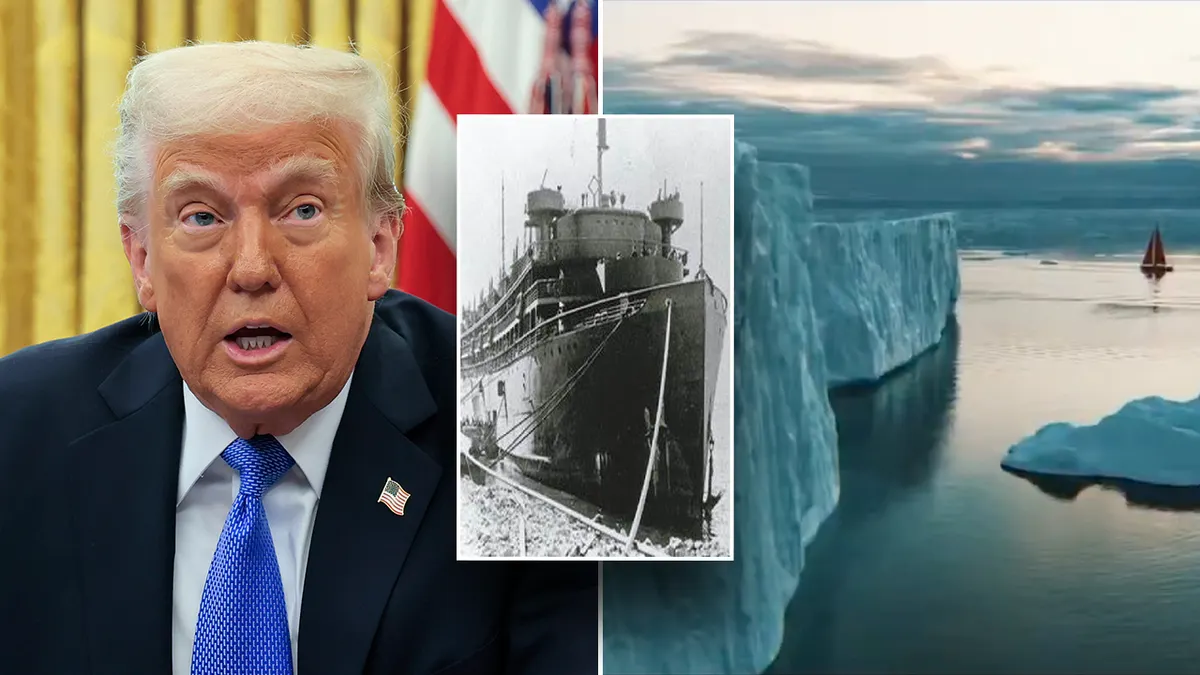
- Greenland remains at the center of a diplomatic firestorm between the U.S. and the EU.
- The strategic importance of the island for missile defense cannot be overstated.
- Denmark has increased its military spending to 3% of GDP to protect its Arctic interests.
- U.S. Special Envoy Jeff Landry is leading the charge for potential annexation.
The geopolitical landscape of 2026 has been irrevocably altered by a series of high-stakes maneuvers from the White House. Following the dramatic seizure of Venezuelan President Nicolás Maduro in Operation Absolute Resolve on January 3, 2026, President Donald Trump has turned his sights toward the Arctic.
Reports from The Islamabad Telegraph and global analysts suggest that the placement of a permanent U.S. flag on Greenland is no longer a matter of “if,” but “when.”
Trump’s Greenland Ambition: 7 Shocking Reasons Why the Arctic is the New Venezuela
As the world watches the fate of Cuba, Iran, and Venezuela, the “Greenland Question” has become the ultimate litmus test for European sovereignty and the future of the NATO alliance.
Greenland Envoy Jeff Landry Denies “Conquer” Ambitions Amid Danish Tension
The Arctic Power Play: Security vs. Sovereignty
For the Trump administration, Greenland is not merely a territory but a “strategic plug” for the North Atlantic. White House Deputy Chief of Staff Stephen Miller recently crystallized this worldview on CNN, dismissing “international niceties” in favor of a reality governed by “strength, force, and power.”
Here’s why Trump says the U.S. ‘needs’ Greenland for Arctic security
The administration’s logic is rooted in two critical factors:
-
Missile Defense: Greenland’s proximity to the North Pole makes it the shortest path for ballistic missiles between the U.S. and Russia.
-
Resource Independence: The island’s vast, untapped reserves of rare-earth minerals are seen as the key to breaking China’s global monopoly on the materials required for high-tech defense and green energy.
A Divided and Defenseless Europe?
The reaction from Brussels and Copenhagen has been one of alarm, yet analysts note a profound “asymmetry of power.” While a joint statement from leaders in France, Britain, Germany, and Poland declared that “Greenland belongs to its people,” the military reality tells a different story.
| Entity | Current Military Status (2026) | Stance on Greenland |
| United States | High readiness; active operations in Venezuela. | Annexation for “hemispheric security.” |
| Denmark | Spending 3% of GDP; increased Arctic presence. | Firm rejection; “NATO would end.” |
| European Union | Structurally weak; lacking a unified army. | Diplomatic support for Denmark. |
| Russia | Significant land army advantage in Europe. | Opposed to U.S. Arctic expansion. |
Despite Denmark pledging 42 billion Danish crowns ($6.58 billion) to boost Arctic defense, the European continent remains heavily dependent on U.S. intelligence and air superiority. Experts suggest that if the U.S. were to withdraw its “security umbrella,” Europe would struggle to defend itself against Russian land-based aggression, making a move to resist a determined U.S. administration nearly impossible.
The “Landry Doctrine” and the Venezuelan Precedent
The appointment of Louisiana Governor Jeff Landry as Special Envoy to Greenland signals a transition from “interest” to “action.” Landry has openly stated his goal is to “make Greenland a part of the U.S.,” offering economic incentives while hinting at the “Venezuelan model” of decisive intervention.
The recent events in Caracas—where U.S. Delta Force units captured Maduro and flew him to New York—have sent a clear message: the Trump administration views the Western Hemisphere as its exclusive domain. With Katie Miller, wife of Stephen Miller, posting a map of Greenland draped in the Stars and Stripes with the caption “SOON,” the psychological warfare is in full swing.
Greenland: A Strategic Bastion in a Warming World
Strategically positioned off Canada’s northeastern coast, Greenland sees more than two-thirds of its landmass pierce the Arctic Circle. This geography has cemented its status as the bedrock of North American defense since World War II, when U.S. forces occupied the island to prevent Nazi encroachment and secure vital Atlantic shipping corridors.
While the post-Cold War era saw the Arctic defined by peaceful international cooperation, the modern landscape is shifting rapidly. As climate change thins the polar ice, it is unlocking a lucrative Northwest Passage for global trade. This environmental shift has reignited a fierce “New Cold War,” as the U.S. enters a high-stakes race against Russia and China for dominance over the region’s vast, untapped mineral wealth.