



- Trump China Visit 2026: China’s supply chain resilience weakens the long-term impact of US tariffs
- Trump’s Beijing visit signals tactical diplomacy, not structural change
- Iran war disruptions are reshaping global manufacturing costs
- Emerging markets are driving China’s export growth beyond the US
As Donald Trump prepares for a closely watched visit to Beijing, the mood among Chinese manufacturers is strikingly pragmatic. Far from the anxiety that defined earlier phases of the U.S.–China trade war, exporters today exhibit a hardened confidence—one shaped by years of tariffs, supply chain disruptions, and geopolitical shocks. The visit, framed by intensifying global tensions and the ongoing Iran war, is unlikely to produce sweeping breakthroughs. Instead, it underscores a deeper structural shift in global trade: the emergence of a more resilient, diversified, and strategically entrenched Chinese manufacturing ecosystem.
At the factory floor level, this resilience is tangible. Yu Yangxian, a salesperson whose firm exports vending machines and smart lockers to the United States, reflects a broader sentiment across China’s industrial base. Despite tariffs that once exceeded 100% during peak tensions in 2025, her company retained most of its American clients. The strategy has been straightforward: absorb part of the cost, pass the rest to U.S. consumers, and expand aggressively into alternative markets. This micro-level adaptation mirrors Beijing’s macroeconomic playbook—one that prioritizes self-sufficiency, scale, and global market diversification.
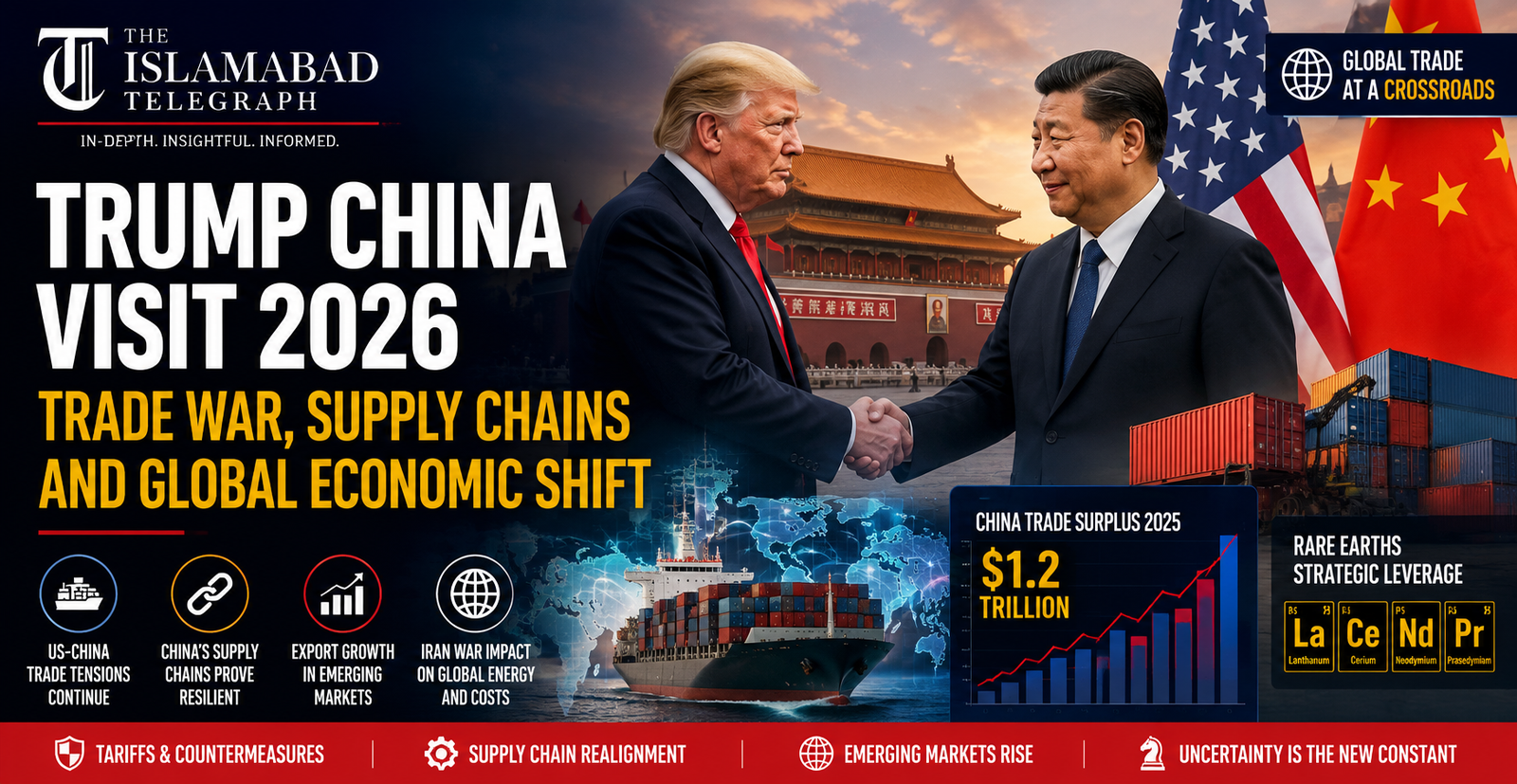
The numbers reinforce this narrative. China closed 2025 with a record trade surplus of approximately $1.2 trillion, even as exports to the United States declined by 20%. Growth in other regions more than compensated: exports surged by over 25% to Africa, and saw steady increases across Southeast Asia, Latin America, and the European Union. This geographic rebalancing reflects a deliberate strategic pivot, reducing reliance on any single market while leveraging cost competitiveness to penetrate emerging economies.
The Iran War’s Aftershocks: Hormuz Chokepoint, Fragile Ceasefire, and the Road to America’s Midterms
For policymakers in Washington, this evolution complicates the calculus of economic pressure. Tariffs, once the centerpiece of U.S. strategy, have lost some of their coercive power. Chinese firms, having weathered the initial shocks, are no longer reacting with urgency to new policy announcements. Instead, they are adapting incrementally, often choosing to wait out political cycles rather than undertake costly relocations. Supply chain diversification—once seen as inevitable—has slowed, with many multinational firms maintaining deep ties to Chinese suppliers.
Chinese exporters ‘numb’ to US threats as Trump set to visit
This inertia is not accidental. China’s industrial ecosystem remains unparalleled in its breadth and integration. From rare earth minerals to advanced manufacturing components, the country occupies critical nodes in global supply chains. Beijing has demonstrated a growing willingness to weaponize this position, notably through export controls on rare earth elements—materials essential for semiconductors, renewable energy systems, and defense technologies. Such measures serve as a potent counterweight to U.S. tariffs, highlighting the asymmetrical dependencies that define the bilateral relationship.
U.S China Trade War 2026: Paris Talks Amid Middle East Conflict May Ease Global Economic Pressure
The geopolitical context further tilts the balance. The Iran conflict has injected volatility into global energy markets, raising input costs for manufacturers worldwide. In the short term, the United States retains leverage as a major energy producer. However, over the longer horizon, China’s dominance in industrial capacity and its ability to secure diversified energy supplies could offset this advantage. This interplay between energy security and industrial policy will likely shape the trajectory of U.S.–China relations well beyond Trump’s visit.
Israel, Lebanon Talks Set for Washington as Iran–U.S. Dialogue in Islamabad Faces Uncertainty Amid Escalating Maritime Tensions
Diplomatically, expectations for the Beijing summit remain modest. Business leaders on both sides view the prospect of a tariff truce as welcome but inherently temporary. The experience of repeated cycles—escalation, negotiation, partial rollback—has fostered a sense of strategic patience. Companies are no longer planning for the next 90 days; they are bracing for a prolonged period of managed competition.
Within this framework, specific concessions may emerge. China could increase purchases of U.S. goods such as agricultural products, energy, or aircraft, providing short-term relief to key American industries. In return, Washington might ease certain export controls or delay additional tariffs. Yet these transactional outcomes are unlikely to address the structural drivers of tension: technology rivalry, national security concerns, and competing visions of global economic governance.
The Taiwan issue looms as a persistent undercurrent. While both sides have signaled a desire to avoid destabilizing actions, the island remains the most sensitive flashpoint in U.S.–China relations. Analysts anticipate that Beijing may use the summit to probe Washington’s موقف, testing the boundaries of its longstanding policy commitments. However, any substantive shift appears unlikely, given the strategic stakes involved.
Looking ahead, the most plausible scenario is one of “fragile stability”—a term increasingly used by analysts to describe the current equilibrium. This implies continued dialogue, periodic agreements, and selective cooperation, punctuated by episodes of tension. For global markets, such a landscape presents both risks and opportunities. Volatility will persist, but so too will the incentives for interdependence.
The broader implication is that globalization is not retreating but reconfiguring. Supply chains are becoming more regionalized, yet they remain deeply interconnected. China’s role within this system is evolving from that of a low-cost manufacturing hub to a central pillar of industrial and technological capacity. Efforts to decouple, while politically appealing in some quarters, face significant economic and logistical constraints.
Trump’s visit to Beijing, therefore, should be understood less as a निर्णायक turning point and more as a moment within a longer continuum. It reflects the ongoing negotiation of power in a multipolar economic order—one where resilience, adaptability, and strategic leverage matter as much as formal agreements.
For businesses and policymakers alike, the key takeaway is clear: uncertainty is the new constant. Navigating this environment will require not only tactical flexibility but also a deeper understanding of the structural forces reshaping global trade. In that sense, the real story is not whether Trump secures a deal in Beijing, but how both nations—and the world—adapt to an era defined by enduring competition and cautious coexistence.