



- US Iran conflict Strait of Hormuz disrupts nearly 20% of global oil supply, shaking energy markets
- U.S. naval blockade cuts Iranian oil exports by over 50%, intensifying economic pressure
- Iran retaliates with missile and drone strikes targeting U.S. bases across Gulf states
- Rising tensions push global shipping costs up by 300%, increasing recession fears worldwide
The confrontation between the United States and Iran has entered a volatile new phase, defined less by declared war and more by sustained, high-intensity shadow conflict stretching across sea lanes, airspace, and strategic installations throughout the Middle East. What began as a pressure campaign has now evolved into a multi-domain confrontation where both sides are testing thresholds without crossing into full-scale war—yet edging dangerously close.
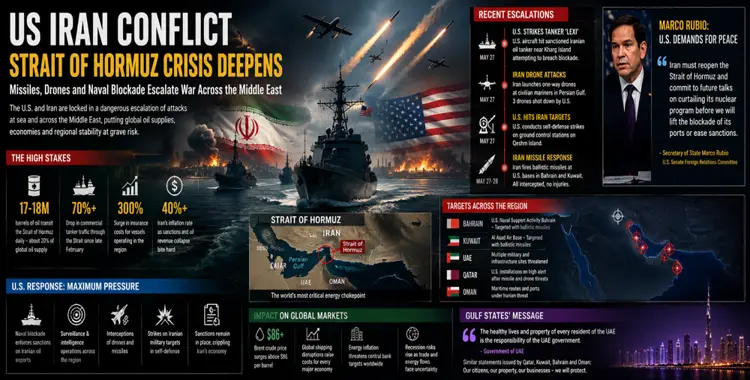
At the center of this escalation lies the Strait of Hormuz, the world’s most critical energy chokepoint, through which nearly 20 percent of global oil supply—roughly 17 to 18 million barrels per day—normally transits. Since late February, when Washington imposed a de facto naval blockade targeting Iranian oil exports, commercial traffic through the strait has fallen dramatically, with industry estimates suggesting a decline of over 70 percent in tanker movement. Insurance premiums for vessels have surged by as much as 300 percent, effectively freezing global shipping confidence in the region.
The U.S. strategy has been clear: economically suffocate Iran while maintaining military superiority at sea. American naval assets, including elements of the Fifth Fleet, have intensified patrols, enforced interdictions, and targeted vessels suspected of breaching sanctions. The most recent flashpoint came when a U.S. aircraft struck the oil tanker Lexi with a Hellfire missile, disabling it near Iran’s Kharg Island export terminal. The tanker, previously sanctioned for transporting millions of barrels of Iranian crude, was allegedly attempting to bypass the blockade.
Trump Brokers Breakthrough: Israel–Hezbollah Ceasefire Signals Strategic Shift in Iran–U.S. Deal
Tehran’s response was swift and asymmetric. Iranian forces launched one-way attack drones targeting civilian maritime traffic in the Persian Gulf, signaling a willingness to disrupt not just U.S. operations but global commerce itself. U.S. Central Command confirmed that at least three drones were intercepted, followed by retaliatory “self-defense strikes” on Iranian ground control stations located on Qeshm Island—a strategic position that overlooks the Strait of Hormuz and provides Iran with a commanding surveillance advantage.
The escalation did not stop at sea. Iran expanded its response geographically, launching ballistic missiles toward U.S. military installations in Bahrain and Kuwait. While none of the missiles reached their intended targets—three were intercepted over Bahrain and two malfunctioned en route to Kuwait—the message was unmistakable: Iran retains significant strike capability despite months of sustained bombardment.
U.S., Iran Trade Heavy Fire in Persian Gulf, Testing Fragile Ceasefire
Recent U.S. intelligence assessments indicate that Tehran still possesses over 70 percent of its pre-war missile stockpile and maintains a robust inventory of mobile launch platforms. Moreover, Iran’s drone production—relatively low-cost and decentralized—continues largely unaffected. Secretary of State Marco Rubio acknowledged this reality during testimony, noting that “these are easy to make,” underscoring the limits of conventional military degradation strategies.
Beyond direct confrontation, Iran has widened the battlefield by targeting U.S.-aligned infrastructure across the region. Reports of missile and drone activity near installations in the United Arab Emirates, Oman, and Qatar have heightened regional anxieties. Gulf states, while not directly engaged in combat, are increasingly exposed. The UAE government, in a firm statement following recent missile threats, declared that “the safety and well-being of every resident remains the absolute responsibility of the state,” echoing similar assurances issued by other Gulf monarchies determined to shield their economic hubs from spillover effects.
Meanwhile, Washington has doubled down on its negotiating posture. Speaking before the Senate Foreign Relations Committee, Rubio laid out the administration’s conditions for de-escalation: Iran must immediately reopen the Strait of Hormuz and commit to long-term restrictions on its nuclear program, including the disposal of highly enriched uranium. Only then, he said, would the United States consider lifting its blockade or easing sanctions that have crippled Iran’s economy, which has contracted sharply amid inflation rates exceeding 40 percent and oil revenues slashed by more than half.
However, diplomacy remains fragile. The ceasefire framework established in April has held only nominally, with repeated violations by both sides. Each engagement—whether at sea or through missile exchanges—pushes the region closer to a tipping point. Political pressure is also mounting within the United States, where lawmakers from both parties are increasingly wary of the war’s economic fallout. Rising fuel prices and disrupted global supply chains have made the conflict not just a foreign policy issue, but a domestic political liability ahead of critical elections.
Complicating matters further is Iran’s internal command structure. Following the death of Supreme Leader Ayatollah Ali Khamenei early in the conflict, power now rests with Mojtaba Khamenei and a shadowy council dominated by the Islamic Revolutionary Guard Corps. Decision-making delays—often taking three to five days due to security protocols and reliance on couriers—have slowed diplomatic responsiveness, adding another layer of unpredictability to an already volatile situation.
Despite intermittent signals of resumed talks, including claims that a draft memorandum is under final review, the reality on the ground suggests otherwise. The battlefield remains active, the rhetoric uncompromising, and the strategic objectives fundamentally at odds.
What emerges is a precarious equilibrium: a war neither side is willing to fully escalate, yet neither prepared to de-escalate without major concessions. The Strait of Hormuz remains both the physical and symbolic epicenter of this संघर्ष—its closure a weapon, its reopening a bargaining chip. Until that knot is untied, the world economy—and regional stability—will remain hostage to a conflict defined by pressure, retaliation, and an ever-narrowing margin for error.