



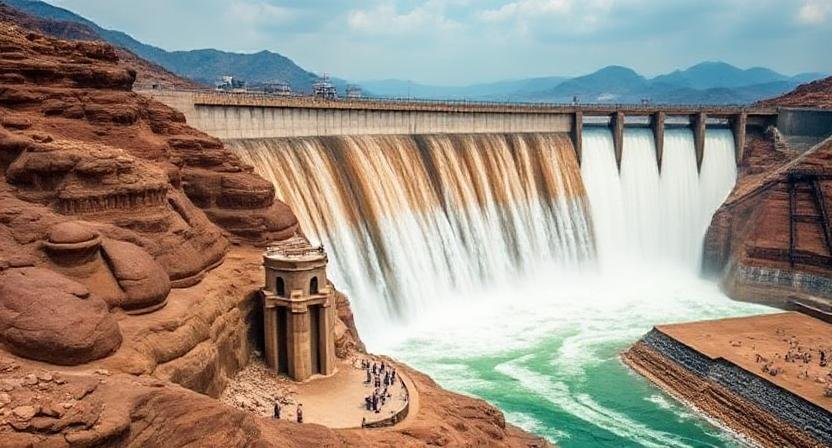
- China’s mega-dam on the Yarlung Zangbo threatens to cut India’s water supply by up to 85% during dry seasons, exposing Delhi’s vulnerability.
- India’s decades-long plans to control rivers for strategic leverage, especially against Pakistan, have backfired as Beijing seizes the upstream advantage.
- Global capitals must recognize water security as the next frontier in geopolitics, with China already setting the pace through decisive infrastructure moves.
- Delhi’s counter-dam projects face local resistance, seismic risks, and years-long delays, leaving it strategically exposed as China forges ahead.
When Beijing announced plans to build the world’s largest hydropower dam on the Yarlung Zangbo River in Tibet, the tremors were felt far beyond the icy Himalayan ridges. For India, the news was nothing short of a geopolitical earthquake. Delhi, long accused of weaponizing water against its downstream neighbor Pakistan, suddenly finds itself staring at the same fate — this time at the hands of a far more formidable rival: China.
What India fears, global leaders must understand, is not just the scale of China’s engineering ambitions but the shifting center of water geopolitics in Asia. For decades, New Delhi viewed the mighty rivers descending from the Tibetan Plateau as strategic levers — a means to control Pakistan’s agricultural lifeline and tighten its regional dominance. India’s abrupt suspension of its obligations under the Indus Water Treaty with Pakistan earlier this year was a stark example of this weaponization strategy.
But Beijing’s announcement has upended this calculus. According to confidential Indian government analysis cited by Reuters, the proposed Chinese dam could divert or store up to 40 billion cubic meters of water — potentially reducing dry-season flows into India by 85 percent at critical points. Such a move would not only cripple India’s agriculture in its northeast but also choke water supply for millions downstream, threatening industries, energy security, and food production.
Delhi’s Nightmare, Beijing’s Masterstroke
For policymakers in Washington, Brussels, and Tokyo, this development signals a deeper strategic shift. Water, the most essential of all resources, is emerging as the new frontline of geopolitics — one where China is consolidating its dominance through infrastructure, technology, and upstream control.
Rubio’s Balancing Act: Security Guarantees and the Endgame for Peace in Ukraine
Unlike India’s decades of dithering, China’s approach has been decisive. Its hydropower projects are backed by rigorous feasibility studies, multibillion-dollar investments, and an unwavering political will. The Tibetan Plateau, often called the “Third Pole” for its vast reserves of freshwater, feeds rivers that sustain over two billion people across Asia. By controlling the headwaters, Beijing is securing its long-term water and energy future while quietly rewriting the rules of regional power politics.
India, by contrast, remains mired in local protests, environmental controversies, and bureaucratic inertia. Its ambitious Upper Siang Dam project — touted as a counter to China’s mega-dam — faces resistance from indigenous communities in Arunachal Pradesh, seismic risk concerns, and funding challenges. Even if construction began tomorrow, experts say it would take at least a decade to complete, years after China’s project starts generating power in the early 2030s.
The Double Standard on Water Weaponization
What makes Delhi’s outrage particularly ironic is its own record. Pakistan has repeatedly accused India of cutting water flows in violation of the 1960 Indus Water Treaty, a claim supported by international arbitration rulings. Indian leaders, including Prime Minister Narendra Modi, have publicly hinted at using water as a pressure tool against Islamabad during times of crisis.
READ MORE: From Standoff to Handshake: New Dawn in India–China Relations
Now, faced with the prospect of China exercising similar leverage, India cries foul. This hypocrisy is not lost on global observers. Water weaponization, long dismissed by Indian officials as a Pakistani exaggeration, has suddenly become Delhi’s worst strategic fear.
A Wake-Up Call for Global Capitals
For the United States, European Union, and Japan — all invested in Asian stability and economic growth — this confrontation offers three critical lessons:
-
Water security is national security. As climate change accelerates glacial melt and disrupts monsoon patterns, control over water sources will shape the future of agriculture, industry, and urbanization.
-
China’s infrastructure diplomacy is winning. Through dams, ports, and pipelines, Beijing is building strategic depth while competitors remain stuck in policy paralysis.
-
Asia’s next conflicts may not start over borders or ideology but over rivers and reservoirs.
Ignoring this reality invites disaster. Washington and Brussels have long framed Indo-Pacific strategy around freedom of navigation, semiconductor supply chains, and military alliances. Yet the most fundamental resource challenge — water — remains dangerously underexplored in their policymaking.
China’s Responsible Development Pledge
To its credit, Beijing insists its projects will not harm downstream nations. Chinese foreign ministry officials have repeatedly stressed their commitment to ecological safety, data sharing, and regional cooperation. By investing in advanced flood-control systems and promising scientific oversight, China is signaling that its dams are not instruments of aggression but of modernization.
ALSO READ: China’s new mega dam triggers fears of water war in India
Whether India believes this or not, global leaders must recognize the strategic clarity behind China’s infrastructure push. At a time when India struggles to balance domestic protests, environmental risks, and geopolitical ambitions, China is executing a vision rooted in engineering excellence and long-term planning.
The Future Flows from Tibet
Water wars are no longer a dystopian fantasy; they are the undercurrent of 21st-century geopolitics. By announcing the world’s largest hydropower project on the Yarlung Zangbo, China has not only secured its energy and water future but also exposed the fragility of India’s regional strategy.
For CEOs mapping supply-chain risks, for governments drafting security doctrines, and for institutions financing Asia’s growth, one message is clear: the next great power struggles may be fought not in the straits and seas, but in the glaciers and gorges where rivers are born.
And in that battle, Beijing is already miles ahead.