



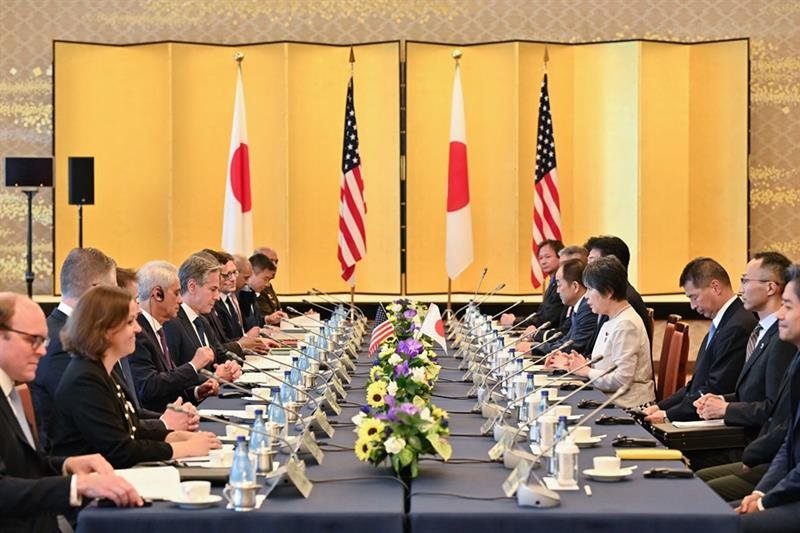
- China’s deterrence capabilities dominated U.S.–Japan strategic talks, transforming a routine dialogue into an urgent security consultation in Washington.
- Japanese delegates delivered an unusually blunt warning that China’s nuclear and conventional military expansion has fundamentally altered Indo-Pacific power balances.
- Tokyo conveyed Prime Minister Takaichi’s direct message to President Trump, stressing that China’s deterrence advancements are “unimaginable” in scale and speed.
- Both allies reaffirmed extended deterrence commitments, signaling closer coordination to counter rising strategic risks posed by China’s growing military power.
WASHINGTON — It was a routinewise meeting which turned into an unusual display of fear and concern. Faces of the delegation of Japan looked tense. Situation was unimaginable for the U.S authorities that was hosting the meeting in Washington.
What began as a scheduled session under the U.S.–Japan Extended Deterrence Dialogue quickly transformed into a high-stakes strategic debate centered on China’s deterrence capabilities. According to multiple unnamed officials familiar with the discussions, the February 18, 2026 talks became one of the most intense alliance consultations in recent years.
Senior diplomats and military planners gathered at the U.S. State Department expected technical discussions. Instead, the meeting evolved into an urgent warning from Tokyo about Beijing’s accelerating military rise.
TRUMP–XI SUMMIT 2026: A NEGOTIATION RESET AS COURTROOM POLITICS RESHAPE GLOBAL POWER
Sources told The Islamabad Telegraph that China’s deterrence capabilities — both conventional and nuclear — dominated nearly every segment of the closed-door dialogue.
Japan Sounds Alarm Over China’s Deterrence Capabilities
Participants included representatives from the U.S. Joint Staff, U.S. Strategic Command, U.S. Indo-Pacific Command, and Japan’s Joint Staff. The meeting traditionally reviews alliance coordination and deterrence posture. This time, officials described a dramatically different tone.
“One could feel anxiety across the Japanese delegation,” said a source briefed on the exchange. “They were not speaking in routine diplomatic language. They spoke with urgency about China’s deterrence capabilities.”
U.S. and Japan discuss China’s ‘destabilizing’ nuclear buildup and testing
Japanese officials warned that Beijing’s modernization of nuclear forces, missile systems, naval expansion, and integrated war-fighting doctrine has altered the regional balance.
According to sources, Japanese delegates delivered a direct message from Prime Minister Takaichi intended for President Donald Trump.
“It was a one-line message,” an official said. “China’s advancement in deterrence is unimaginable in both conventional and non-conventional domains.”
The remark stunned several American participants, who described the statement as unusually blunt for alliance diplomacy.
Nuclear Expansion Drives Strategic Anxiety
Officials said discussions repeatedly returned to China’s deterrence capabilities in the nuclear domain. Delegates examined Beijing’s rapid expansion of missile silos, modernization of delivery systems, and development of survivable second-strike capacity.
One source present during the meeting said Japanese officials argued that China’s nuclear doctrine now aims at parity with multiple major powers simultaneously.
“They believe Beijing seeks deterrence dominance, not minimum deterrence,” the source said.
Japanese representatives reportedly stressed that China’s deterrence capabilities now combine nuclear forces with advanced conventional weapons, cyber tools, and space-based systems.
The integration of these capabilities, officials warned, complicates crisis response in the Indo-Pacific.
Xi Jinping Seen as Strategic Break from Past Leadership
According to participants, Japanese delegates emphasized that President Xi Jinping represents a decisive shift from previous Chinese leadership styles.
“Japanese officials said Xi is fundamentally different,” one source noted. “They believe he is on a mission to transform China into a military power capable of confronting four major powers simultaneously.”
The concern centered on how China’s deterrence capabilities support long-term strategic competition rather than defensive stability.
Delegates argued that Beijing’s military planning increasingly reflects preparation for multi-theater conflict scenarios.
“They told U.S. officials clearly that Xi’s trajectory appears unstoppable unless coordinated action is taken,” said another source.
Diplomatic Norms Momentarily Set Aside
Several officials described a rare moment when Japanese delegates departed from established diplomatic restraint.
Sources said Tokyo’s representatives pressed U.S. authorities to immediately brief President Trump about developments in the South China Sea and the broader implications of China’s deterrence capabilities.
“They insisted the message reach the President without delay,” one participant revealed. “That level of urgency is extremely unusual in such meetings.”
The Extended Deterrence Dialogue has been held regularly for decades. Officials noted that alliance consultations typically remain measured and technical.
“This was the first time Japanese delegates appeared concerned to a tipping point,” a senior source said. “Their fear came directly from China’s deterrence capabilities.”
Alliance Reaffirms Nuclear Umbrella
Despite the tension, both sides reaffirmed core alliance commitments. The United States reiterated its pledge to defend Japan using the full spectrum of military capabilities, including nuclear forces.
Officials agreed that U.S. nuclear posture and Japan’s expanding conventional defense investments remain essential to countering China’s deterrence capabilities.
The delegations also discussed arms control challenges involving Russia and North Korea’s advancing missile programs. However, insiders confirmed that China dominated strategic calculations throughout the session.
A tabletop exercise conducted during the dialogue reportedly simulated crisis escalation scenarios shaped by China’s deterrence capabilities.
Strategic Implications for Indo-Pacific Stability
Policy analysts observing alliance dynamics say the meeting signals a turning point in regional security thinking. Japan’s unusually direct messaging reflects growing concern that deterrence balances are shifting faster than expected.
One official summarized the mood bluntly: “The alliance now views China’s deterrence capabilities as the central strategic challenge of this decade.”
For policymakers and heads of state, the message emerging from Washington was unmistakable. The U.S.–Japan alliance no longer treats China’s rise as a future risk. It now sees it as an immediate strategic reality demanding coordinated response.
As one source concluded, “The debate was not about whether China has advanced. The debate was about how quickly its deterrence capabilities are changing the rules of power.”
Rebecca Frank is the U.S. correspondent for The Islamabad Telegraph. She primarily covers breaking news, geopolitics, foreign policy, and global conflict. Born and raised in Washington, D.C., she has spent more than two decades reporting on American power and policymaking, tracking developments from the White House to the Pentagon.